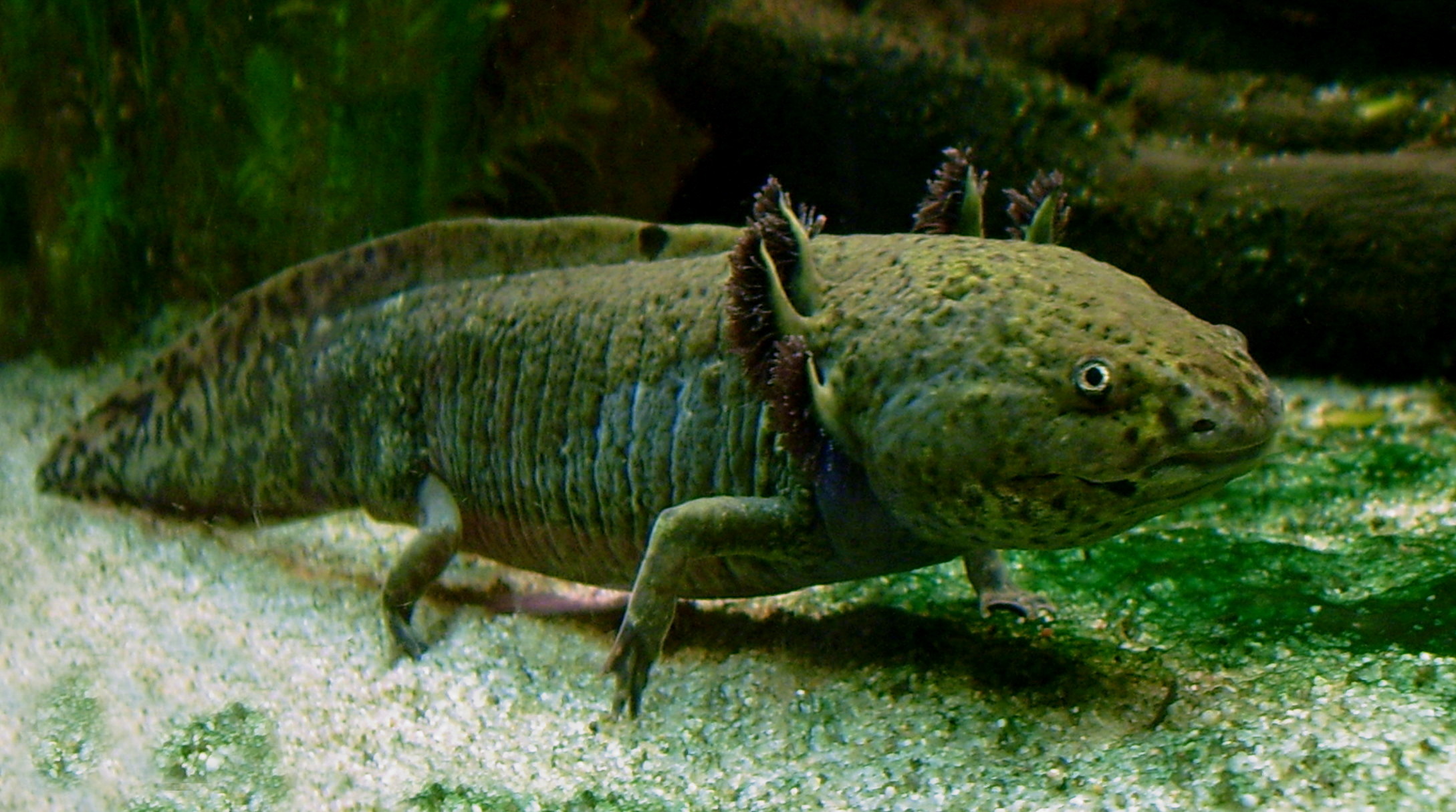
The famous Mexican salamander that retains larval features into adulthood (neoteny). Once abundant in the lakes around Mexico City; now critically endangered due to lake destruction and pollution.
§ Quick facts
§ Encyclopedia
The axolotl is a species of mole salamander. It is neotenic, reaching sexual maturity without undergoing metamorphosis, and the adults remain fully aquatic with obvious external gills. Axolotls may be difficult to distinguish from the larval stage of other neotenic adult mole salamanders, in particular the tiger salamander, or other species such as mudpuppies.
Source: Wikipedia — Axolotl Licensed under CC BY-SA 4.0
§ Identification
Field marks. Robust salamander with external feathery gills, broad flat head, and pale skin (in adults; juveniles darker).
Similar species. Other ambystomatid salamanders (don't retain gills as adults). Aquatic salamanders like waterdogs (different family).
Voice. Silent.
§ Diet & behavior
Diet. Carnivorous: worms, insects, small invertebrates.
Behavior. Famous for retaining gills into adulthood (neoteny). Reproduces in larval form. Critically endangered in wild; widely kept in research labs.
§ Range
Endemic to Lake Xochimilco, Mexico
§ Habitat
Freshwater lake remnants in Mexico City area
§ Threats
Lake destruction, water pollution, introduction of fish predators (tilapia).
§ Conservation status
According to the IUCN Red List, the axolotl is currently classified as Critically Endangered.
§ What helps
Support Lake Xochimilco restoration. Buy captive-bred only (popular in pet trade).
§ Further reading
- Wikipedia — Axolotl
- www.iucnredlist.org — authoritative profile of Ambystoma mexicanum
- IUCN Red List · taxon 1095
- iNaturalist · taxon 27551
- GBIF occurrence records
- Encyclopedia of Life — Ambystoma mexicanum
§ Sources cited
- AmphibiaWeb
- IUCN Mesoamerican Endemics
- The Axolotl Sanctuary
- IUCN Red List 2019


