
Field guide · Species directory
Native North American species.
1175 species and growing. Every entry is verified against the IUCN Red List and authoritative agency sources.
Birds
Birds

Acorn Woodpecker
Melanerpes formicivorus
A boldly black-white-and-red woodpecker famous for "granary trees" — drilling thousands of holes in dead oaks to store acorns. Lives in coop…

American White Pelican
Pelecanus erythrorhynchos
A massive white seabird that hunts in cooperative groups, herding fish to shallow water. Among the largest US birds — wingspan exceeds 2.5 m…

Aplomado Falcon
Falco femoralis
A medium falcon historically much more common in southern Texas; populations crashed.

Arctic Tern
Sterna paradisaea
Migrates from Arctic to Antarctic — among the longest migrations of any animal.

Bald Eagle
Haliaeetus leucocephalus
A bird of prey with a wingspan up to 7.5 feet, the bald eagle is the national bird of the United States and a conservation success story aft…

Baltimore Oriole
Icterus galbula
Vivid orange-and-black icons of eastern summers. Their woven hanging nests are architectural marvels — some last for years after abandonment…
Mammals
Mammals

American Bison
Bison bison
Once 30 million strong and the keystone species of the Great Plains, American bison were reduced to fewer than 1,000 by 1889. Today around 3…

American Black Bear
Ursus americanus
The most common bear species in North America, with populations rebounding in many states. Color varies from black to cinnamon to white.

American Pika
Ochotona princeps
A small ground-dwelling rabbit relative — basically a hamster-shaped mountaineer. Pikas don't hibernate; they spend summer collecting "haypi…

Arctic Fox
Vulpes lagopus
A small fox built for extreme cold — they tolerate temperatures down to -94°F (-70°C) and are the only canid whose paw pads grow fur in wint…

Bighorn Sheep (Desert subspecies)
Ovis canadensis nelsoni
Subspecies of bighorn sheep adapted to desert habitats. Smaller and lighter colored than Rocky Mountain bighorn.

Black-footed Ferret
Mustela nigripes
North America's only native ferret and once thought extinct. Rediscovered in 1981 in Wyoming, they've been bred and reintroduced — about 350…
Fish
Fish

Alligator Gar
Atractosteus spatula
A massive armored predator that can exceed 8 feet and 300 pounds — North America's largest gar. Body covered in interlocking ganoid scales l…

American Eel
Anguilla rostrata
A long snake-like fish with an astonishing life cycle — born in the open Atlantic Sargasso Sea, drifting as larvae for a year before coloniz…

American Paddlefish
Polyodon spathula
A primitive plankton-eating fish with a paddle-like rostrum and a body unchanged for 300+ million years. They swim with mouth agape, filteri…

Apache Trout
Oncorhynchus apache
Arizona's state fish — a small golden-yellow trout native only to the White Mountains. Rescued from near-extinction (just 30 stream miles in…

Atlantic Halibut
Hippoglossus hippoglossus
A massive flatfish of North Atlantic waters. Critically reduced from past commercial fishing.

Atlantic Salmon
Salmo salar
The "king of fish" — a powerful silvery salmon that once supported massive fisheries from New England to Greenland. Wild populations in the …
Marine life
Marine life

Atlantic Bluefin Tuna
Thunnus thynnus
A high-speed warm-blooded predator that can reach 1,500 pounds and 1,000-mile sprints across oceans. Atlantic bluefin populations have decli…

Atlantic Horseshoe Crab
Limulus polyphemus
A "living fossil" virtually unchanged for 450 million years. Their copper-based blue blood (LAL) detects bacterial contamination at 1 part p…

Blue Whale
Balaenoptera musculus
The largest animal that has ever lived — bigger than any dinosaur. Adults reach 100 feet and 200 tons; their hearts alone are the size of a …

Chinook Salmon
Oncorhynchus tshawytscha
The largest of the Pacific salmon and the cornerstone of Pacific Northwest ecosystems — feeding orcas, bears, eagles, and even forests via m…

Elkhorn Coral
Acropora palmata
Once one of the most abundant Caribbean reef-builders, elkhorn coral has declined 95% since the 1980s. Its branching structure provides crit…

Giant Pacific Octopus
Enteroctopus dofleini
The world's largest octopus species — record arm-spans over 30 feet. Highly intelligent and famously curious; they recognize individual huma…
Reptiles
Reptiles

Alabama Red-bellied Turtle
Pseudemys alabamensis
A medium turtle endemic to the Mobile Bay drainage of Alabama. Federally endangered. Distinguished from other red-bellied turtles by Alabama…
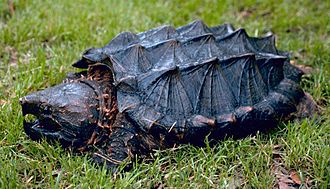
Alligator Snapping Turtle
Macrochelys temminckii
The largest freshwater turtle in North America — record specimens over 200 pounds and 100+ years old. A prehistoric-looking ambush predator …

American Alligator
Alligator mississippiensis
A keystone species and conservation success — recovered from endangered status in 1987 and now numbers over a million in Louisiana alone.

American Crocodile
Crocodylus acutus
The shyer, narrower-snouted cousin of the alligator — and one of only two places on Earth (south Florida) where alligators and crocodiles co…

Blanding's Turtle
Emydoidea blandingii
A medium turtle with a distinctive bright yellow chin and throat and a high-domed black shell with yellow spotting. Among the slowest-maturi…

Bog Turtle
Glyptemys muhlenbergii
North America's smallest turtle — adults barely reach 4 inches. Their bright yellow neck patches are unmistakable. Critically endangered due…
Amphibians
Amphibians

Axolotl
Ambystoma mexicanum
The famous Mexican salamander that retains larval features into adulthood (neoteny). Once abundant in the lakes around Mexico City; now crit…

Barking Treefrog
Hyla gratiosa
The largest US treefrog at 2.5 inches, with a distinctive doglike "bark" call that can be heard up to a mile away. They climb high in trees …

Barred Tiger Salamander
Ambystoma mavortium
One of the world's largest land-dwelling salamanders at up to 14 inches. Bright yellow-and-black striped, they're an icon of western prairie…

Boreal Toad
Anaxyrus boreas boreas
A high-elevation toad with warty olive-brown skin and a pale dorsal stripe. Populations have crashed 75–90% across the Rockies since the 197…

Coastal Tailed Frog
Ascaphus truei
One of the most ancient frog lineages on Earth — split off 100+ million years ago. The "tail" on males is actually a copulatory organ for in…

Foothill Yellow-legged Frog
Rana boylii
A medium-sized frog of California foothill streams. Populations have declined dramatically due to dam-altered streamflow and disease.
Insects
Insects

American Bumble Bee
Bombus pensylvanicus
Once one of the most common bumble bees across the eastern US, the American bumble bee has declined nearly 89% over the past 20 years and is…

Cecropia Moth
Hyalophora cecropia
North America's largest native moth — wingspan up to 6 inches. Stunning crimson-red bodies with white eyespots on broad brown wings. Adults …

Eastern Tiger Swallowtail
Papilio glaucus
A large yellow-and-black butterfly that's often considered the eastern US's most familiar swallowtail. Females come in two color forms — yel…

Hine's Emerald Dragonfly
Somatochlora hineana
A federally endangered dragonfly restricted to spring-fed dolomite prairie wetlands. Down to a few sites in the Midwest. Among the most habi…

Miami Blue Butterfly
Cyclargus thomasi bethunebakeri
A tiny butterfly federally listed as endangered. Down to a few hundred individuals. Devastated by habitat loss, hurricanes, and possibly inv…

Monarch Butterfly
Danaus plexippus
Famous for one of the longest insect migrations on Earth, traveling up to 3,000 miles from Canada to central Mexico each fall.
Arachnids
Arachnids

Arizona Bark Scorpion
Centruroides sculpturatus
A small pale scorpion — the most venomous in North America. Stings are painful and can require antivenom in young children, but adult fatali…

Bold Jumping Spider
Phidippus audax
A small bold jumping spider — black with white markings and metallic green chelicerae. Famous for hunting by sight and stalking prey with ca…

Brown Recluse Spider
Loxosceles reclusa
A medium-sized brown spider with violin-shaped marking on body. Medically significant — bites can cause severe necrotic lesions.

Carolina Wolf Spider
Hogna carolinensis
The largest wolf spider in North America — body up to 1.5 inches. A ground-hunter that chases prey rather than spinning a web. Mothers carry…

Cellar Spider (Daddy Long Legs)
Pholcus phalangioides
Common indoor spider often called "daddy long legs" but is a true spider. Eats other spiders.
Eastern Wolf Spider
Hogna sp.
Generic reference to eastern wolf spider species.
Crustaceans
Crustaceans

Atlantic Blue Crab
Callinectes sapidus
A swimming crab with bright blue claws and a sturdy diamond-shaped shell. The Chesapeake Bay blue crab fishery is one of the most economical…

Acorn Barnacle
Semibalanus balanoides
A sessile crustacean (yes — barnacles are crustaceans, not mollusks) that builds a calcified plate-armor home cemented to rocks. Tiny feathe…

Asian Shore Crab (invasive)
Hemigrapsus sanguineus
A small invasive crab introduced via ballast water. Now extremely abundant along eastern US coastline. Displacing native crabs.

Atlantic Hermit Crab
Pagurus longicarpus
A small marine crustacean that protects its soft abdomen by occupying empty snail shells, switching shells as it grows. Common on East Coast…

Atlantic Stone Crab
Menippe mercenaria
Stout-bodied crab with massive claws. Major commercial fishery; claws regenerate after harvest, allowing sustainable fishing.

Common Crayfish (Northern)
Faxonius virilis
A medium-sized lobster-like freshwater crustacean — a keystone food source for many fish, birds, and mammals. Native populations support ent…
Plants
Plants

American Ginseng
Panax quinquefolius
A spring ephemeral herb famous for its medicinal root, valued in Chinese medicine. Heavily over-harvested across the Appalachians; commercia…

Bald Cypress
Taxodium distichum
A deciduous conifer (it sheds needles each fall, hence "bald") that thrives where most trees would drown. Their iconic "knees" rising from s…

Black Cherry
Prunus serotina
A medium-sized native tree that hosts more caterpillar species than any other tree in eastern North America (~450 species). Its fruit is an …

Butterfly Weed
Asclepias tuberosa
A native milkweed with brilliant orange flat-topped flower clusters — a magnet for monarchs and a critical host plant for monarch caterpilla…

California Poppy
Eschscholzia californica
California's state flower and the reason whole hillsides turn fluorescent orange after wet winters — a "superbloom" event that draws crowds …

Coast Redwood
Sequoia sempervirens
The tallest tree species on Earth — record holders top 380 feet. Old-growth coast redwoods can live over 2,200 years and host their own cano…
Fungi & Lichens
Fungi & Lichens

Yellow Morel
Morchella esculenta
The most prized wild mushroom in North America — a honeycomb-textured fruiting body that appears for a few weeks each spring. Morel hunting …

Artist's Conk
Ganoderma applanatum
A massive woody perennial shelf fungus that can persist on a single host tree for decades. The pure white spore-bearing underside instantly …

Beefsteak Morel
Gyromitra esculenta
A false morel that looks like a brain-shaped reddish-brown cap. Contains gyromitrin, a precursor to monomethylhydrazine (rocket fuel) — eati…

Black Trumpet
Craterellus cornucopioides
A small dark trumpet-shaped edible mushroom. Highly prized but easy to overlook on forest floor.

Chicken of the Woods
Laetiporus sulphureus
A spectacular bright orange-and-yellow shelf fungus that grows in overlapping fan-shaped clusters on tree wounds. Edible and famously meaty-…

Cinnabar Polypore
Pycnoporus cinnabarinus
A small brilliant orange-red shelf fungus on fallen wood. Easily identified by its vivid color and small size. Causes white rot of hardwoods…
Looking for something specific?