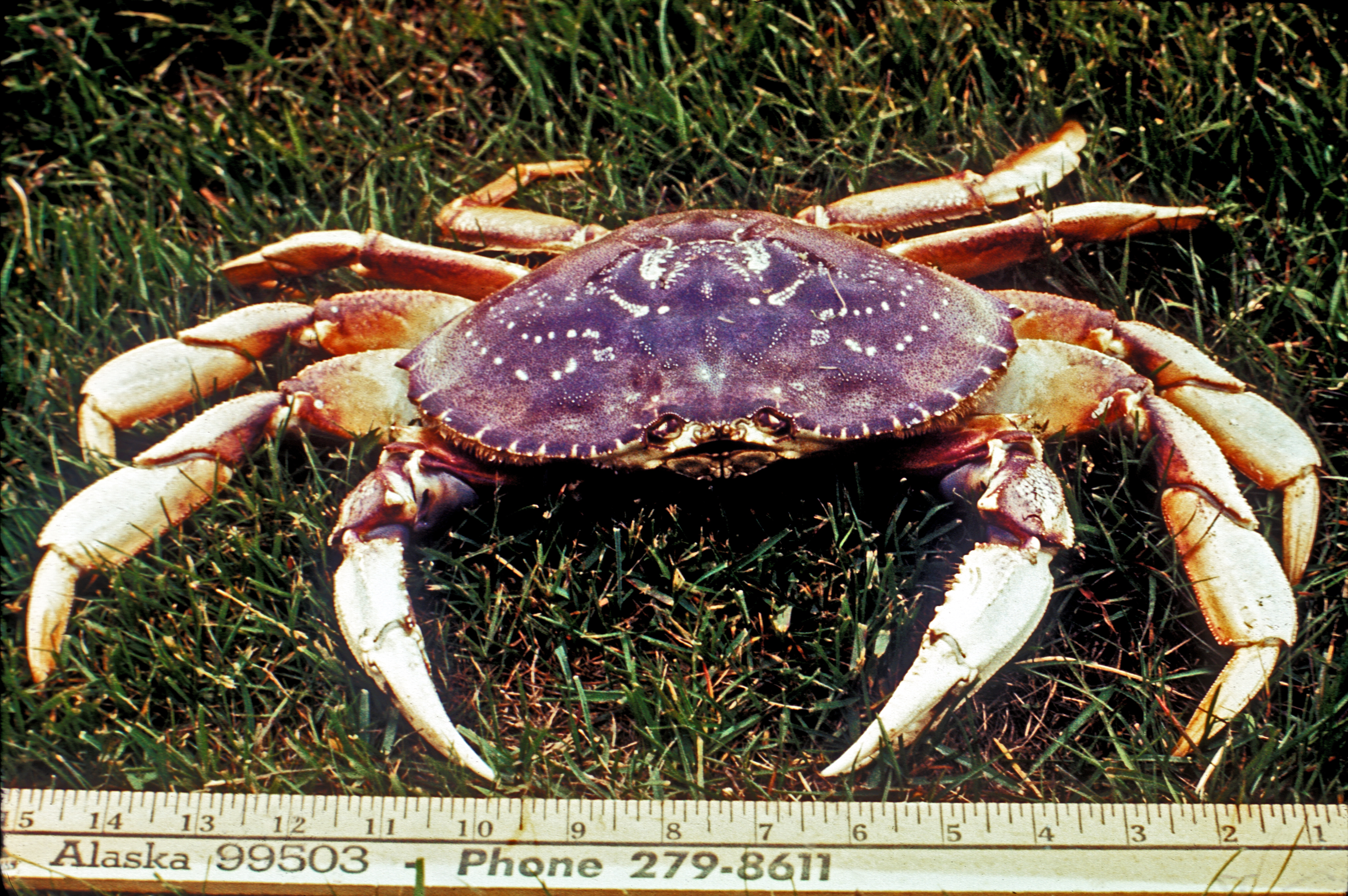
A medium-large Pacific crab. Major commercial and recreational fishery on Pacific coast.
§ Quick facts
§ Encyclopedia
The Dungeness crab makes up one of the most important seafood industries along the west coast of North America. Its typical range extends from Alaska's Aleutian Islands to Point Conception, near Santa Barbara, California. Dungeness typically grow 6–7 in (150–180 mm) at their widest point and inhabit eelgrass beds and sandy bottoms. Its common name comes from the Dungeness Spit in the Strait of Juan de Fuca, Washington state, United States, which shelters a shallow bay inhabited by the crabs.
Source: Wikipedia — Dungeness crab Licensed under CC BY-SA 4.0
§ Identification
Field marks. Purple-brown crab with cream-spotted carapace, "smile-shape" curve at front, large cream-colored claws with white tips. Walks sideways like other true crabs.
Similar species. Red Rock Crab (smaller, redder, hairy claws). Blue Crab (Atlantic; differently shaped). Sheep Crab (much spinier).
Voice. N/A
§ Diet & behavior
Diet. Bivalves (clams, mussels), small fish, shrimp, worms, dead matter — important shoreline scavenger.
Behavior. Named for the tiny coastal village of Dungeness, Washington — the first commercial Dungeness crab fishery was developed there in the 1840s. Now the most economically valuable crab fishery on the West Coast (CA-WA), averaging $200M+ in landings annually. Pacific coast commercial harvest is sustainably managed using the "3-S" rule: only Sex (males), Size (16 cm minimum), Season (typically November–June). Domoic acid (a marine toxin) periodically closes fisheries to protect public health.
§ Range
Pacific coast from Alaska to California
§ Habitat
Coastal waters
§ Threats
Habitat loss, climate change, water-quality decline.
§ Conservation status
According to the IUCN Red List, the dungeness crab is currently classified as Least Concern.
§ What helps
Buy MSC-certified Dungeness crab.
§ Further reading
- Wikipedia — Dungeness crab
- www.nwf.org — authoritative profile of Cancer magister
- iNaturalist · taxon 61017
- IUCN Red List — search for Cancer magister
- GBIF occurrence records
- Encyclopedia of Life — Cancer magister
§ Sources cited
- Pacific States Marine Fisheries Commission
- California Department of Fish and Wildlife
- Oregon Department of Agriculture (domoic acid monitoring)


