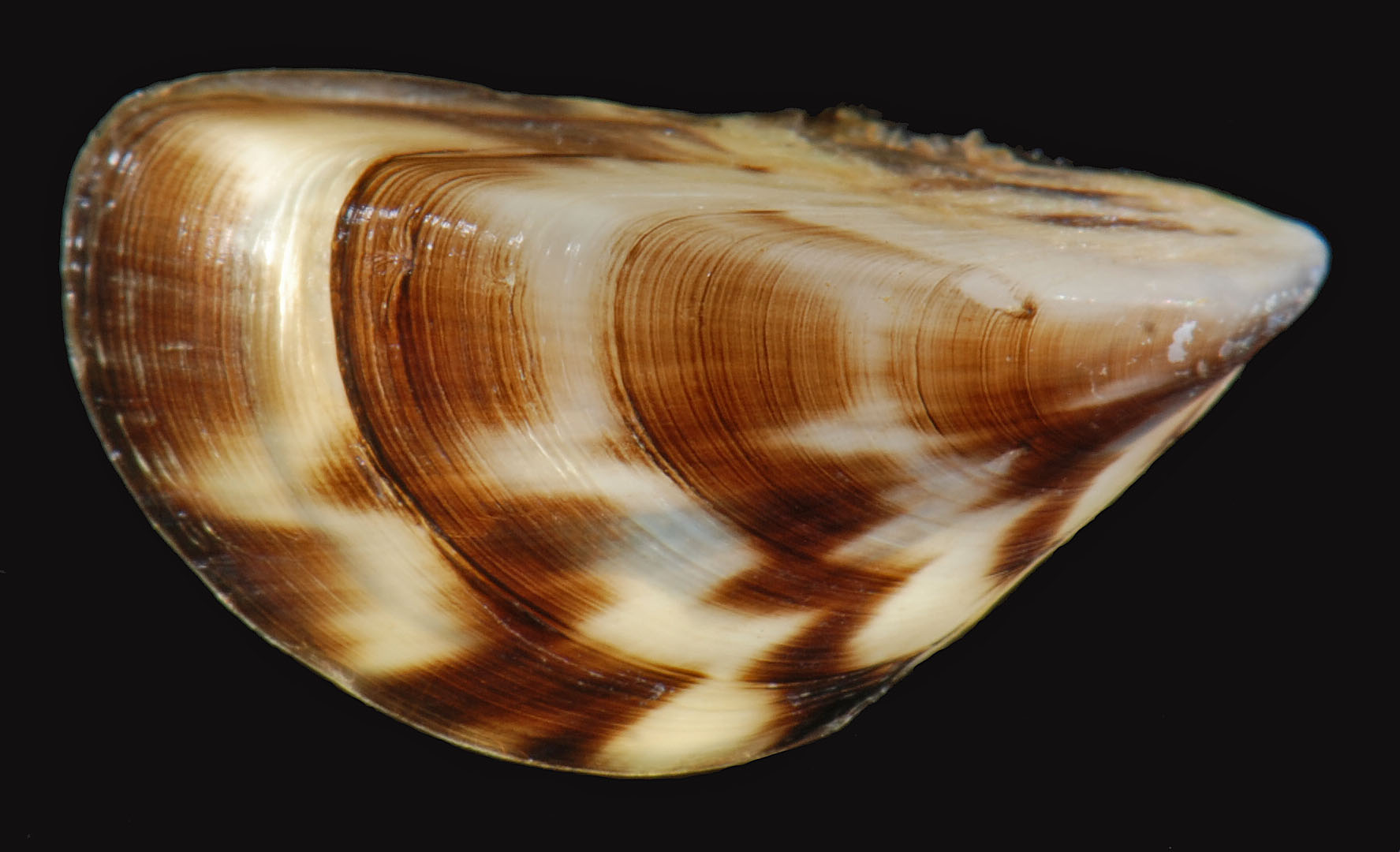
A small invasive mussel introduced via ballast water from European ships. Devastating to native mussels and water quality systems.
§ Quick facts
§ Encyclopedia
The zebra mussel is a small freshwater mussel, an aquatic bivalve mollusc in the family Dreissenidae. The species originates from the lakes of southwestern Russia and southeastern Europe, but has been accidentally introduced to numerous other areas and has become an invasive species in many countries in the Northern Hemisphere. Since the 1980s, the species has invaded the Great Lakes, Hudson River, Lake Travis, Finger Lakes, Lake Bonaparte, and Lake Simcoe. The adverse effects of dreissenid mussels on freshwater systems have led to their classification as among the world's most invasive aquatic species.
Source: Wikipedia — Zebra mussel Licensed under CC BY-SA 4.0
§ Identification
Field marks. Small striped triangular freshwater mussel; characteristic zebra-like dark stripes on cream background (variable pattern); attaches to hard substrates with sticky byssal threads.
Similar species. Quagga Mussel (D. rostriformis; rounder shell, attaches less firmly). Native unionid mussels (much larger, no byssal threads).
Voice. N/A
§ Diet & behavior
Diet. Filter-feeds phytoplankton, bacteria, dissolved organic matter from the water column.
Behavior. Native to Black and Caspian seas; first detected in Great Lakes (Lake St. Clair) in 1988, likely arriving in ballast water. Has since spread to 30+ US states and caused billions of dollars of damage clogging water intakes, encrusting boat hulls, and devastating native unionid (freshwater) mussel populations. Single adult filters ~1 liter of water per day; population effects of trillions filtering simultaneously have caused dramatic increases in water clarity in Great Lakes (with cascading ecological effects). Cannot detach to move once attached by byssal threads.
§ Range
Native to Eurasia; invasive in Great Lakes
§ Habitat
Lakes and rivers with hard substrates
§ Threats
In Great Lakes: they're the threat to native species.
§ Conservation status
According to the IUCN Red List, the zebra mussel (invasive) is currently classified as Least Concern.
§ What helps
Support ballast water regulations. Don't move boats between waterways without cleaning.
§ Further reading
- Wikipedia — Zebra mussel
- www.nwf.org — authoritative profile of Dreissena polymorpha
- IUCN Red List · taxon 6897
- iNaturalist · taxon 51517
- GBIF occurrence records
- Encyclopedia of Life — Dreissena polymorpha
§ Sources cited
- USGS Nonindigenous Aquatic Species
- Great Lakes Commission
- National Park Service Aquatic Nuisance Species


