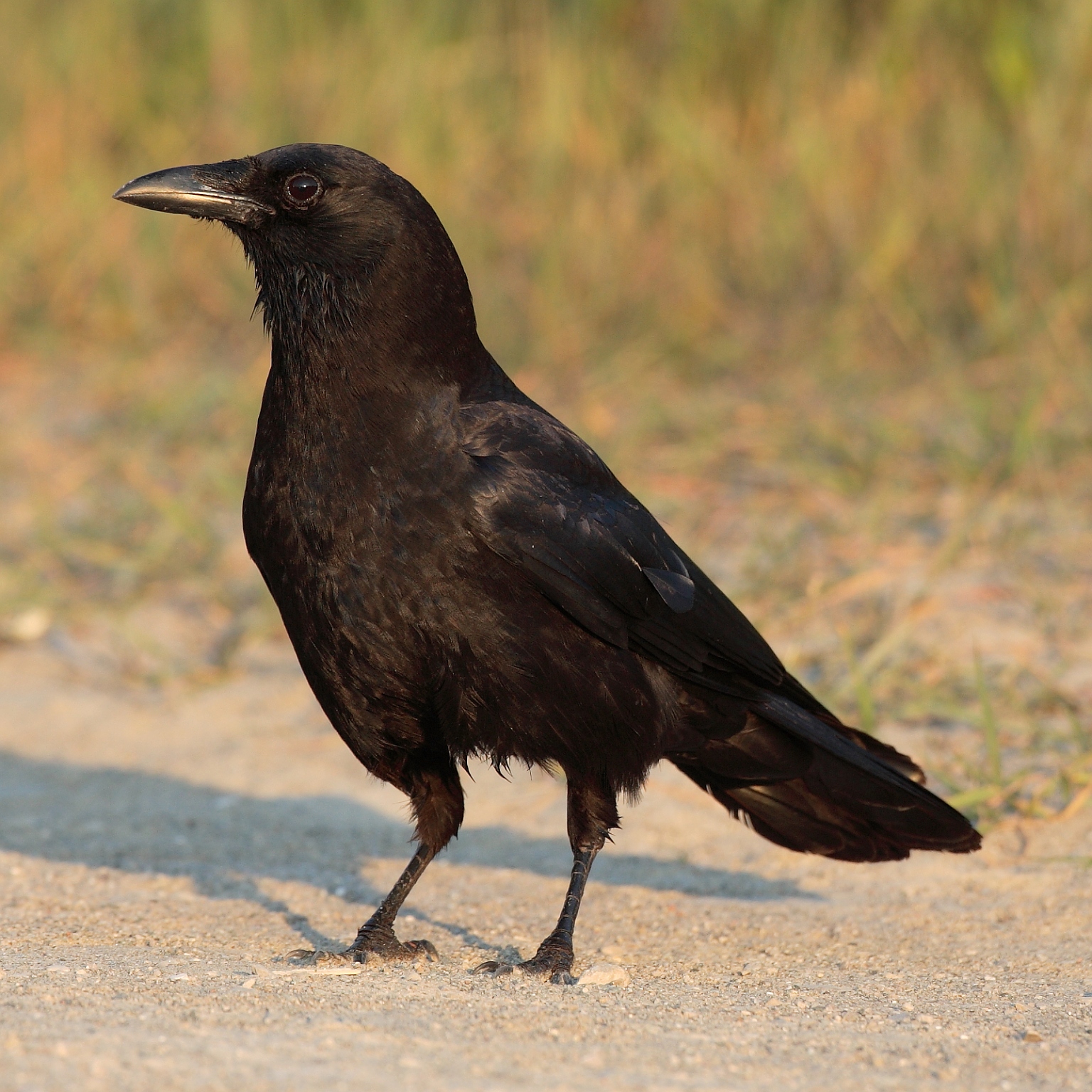
A common all-black bird that's among the most adaptable and intelligent of North American birds. Forms loose roosts of thousands in autumn.
§ Quick facts
§ Encyclopedia
The American crow is a large passerine bird species of the family Corvidae. It is a common bird found throughout much of North America, only absent from the tundra biome. The American crow is the New World counterpart to the carrion crow and the hooded crow of Eurasia, occupying similar ecological niches.
Source: Wikipedia — American crow Licensed under CC BY-SA 4.0
§ Identification
Field marks. Familiar all-black bird with fan-shaped tail (vs. raven's wedge). Slightly smaller and more slender than raven.
Similar species. Common Raven (larger, wedge-shaped tail, shaggy throat). Fish Crow (smaller, "ah-uh" call).
Voice. Iconic "caw-caw" call; complex vocabulary with many variations.
§ Diet & behavior
Diet. Omnivorous: insects, fruits, eggs, nestlings, carrion, garbage.
Behavior. Highly intelligent; can recognize and remember individual human faces. Forms loose roosts of thousands in autumn.
§ Range
Across most of North America
§ Habitat
Diverse: agricultural areas, forests, suburbs, cities
§ Threats
West Nile virus (crows are particularly susceptible), corn baiting programs, vehicle strikes.
§ Conservation status
According to the IUCN Red List, the american crow is currently classified as Least Concern.
§ What helps
Skip yard pesticides. Tolerate crow flocks. Report dead birds to local wildlife agencies.
§ Further reading
- Wikipedia — American crow
- www.allaboutbirds.org — authoritative profile of Corvus brachyrhynchos
- IUCN Red List · taxon 22705990
- iNaturalist · taxon 13851
- eBird · amecro
- GBIF occurrence records
- Encyclopedia of Life — Corvus brachyrhynchos
§ Sources cited
- Cornell Lab — All About Birds
- National Audubon Society
- iNaturalist
- IUCN Red List 2018


