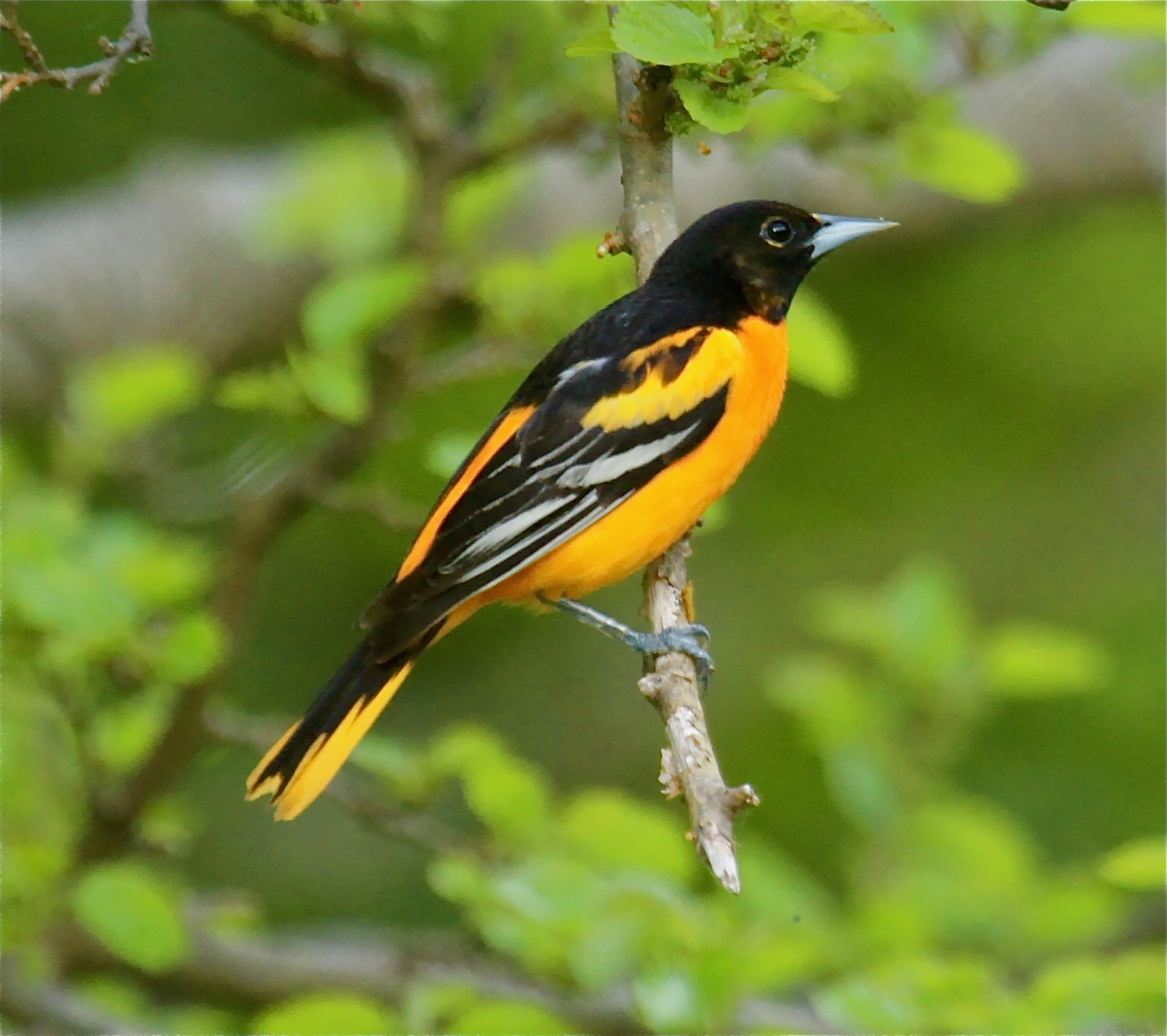
Vivid orange-and-black icons of eastern summers. Their woven hanging nests are architectural marvels — some last for years after abandonment.
§ Quick facts
§ Encyclopedia
The Baltimore oriole is a small icterid blackbird common in eastern North America as a migratory breeding bird. It received its name from the resemblance of the male's colors to those on the coat-of-arms of 17th-century Lord Baltimore. Observations of interbreeding between the Baltimore oriole and the western Bullock's oriole Icterus bullockii, led to both being classified as a single species, called the northern oriole, from 1973 to 1995. Research by James Rising, a professor of zoology at the University of Toronto, and others showed that the two birds actually did not interbreed significantly.
Source: Wikipedia — Baltimore oriole Licensed under CC BY-SA 4.0
§ Identification
Field marks. Medium oriole. Adult males: brilliant orange body, black head and back, orange tail base with black tip; white wing bar. Females and immature males: olive-yellow with grayish wings and white wing bars.
Similar species. Bullock's Oriole (different range; males have orange face with thin black eye line, large white wing patch). Orchard Oriole (smaller, chestnut not orange).
Voice. Rich whistled flute-like song; harsh "chuk" alarm calls.
§ Diet & behavior
Diet. Insects (especially caterpillars), fruit, nectar; readily visits oranges, grape jelly, and sugar-water feeders.
Behavior. Named for the colors of George Calvert (Lord Baltimore), founder of Maryland — and still the state bird of Maryland and namesake of its MLB team. Weaves elaborate hanging pouch nests of plant fibers, often suspended from drooping branch tips at considerable height. Long-distance migrant to Central America. Was lumped with Bullock's Oriole 1973–1995 as "Northern Oriole," then split again based on song, behavior, and minimal hybridization.
§ Range
Eastern and central US in summer; Central America in winter
§ Habitat
Open deciduous woodland edges, parks, riparian forest
§ Threats
Loss of large hardwood trees (especially American elm), pesticides reducing caterpillar prey, climate disruption.
§ Conservation status
According to the IUCN Red List, the baltimore oriole is currently classified as Least Concern.
§ What helps
Plant native trees like American elm (disease-resistant cultivars), sycamore. Hang oranges and grape jelly in spring. Avoid pesticides on flowering trees.
§ Further reading
- Wikipedia — Baltimore oriole
- www.allaboutbirds.org — authoritative profile of Icterus galbula
- IUCN Red List · taxon 22724108
- iNaturalist · taxon 10095
- eBird · balori
- GBIF occurrence records
- Encyclopedia of Life — Icterus galbula
§ Sources cited
- Cornell Lab — All About Birds
- Project FeederWatch
- National Audubon Society
- IUCN Red List 2018


