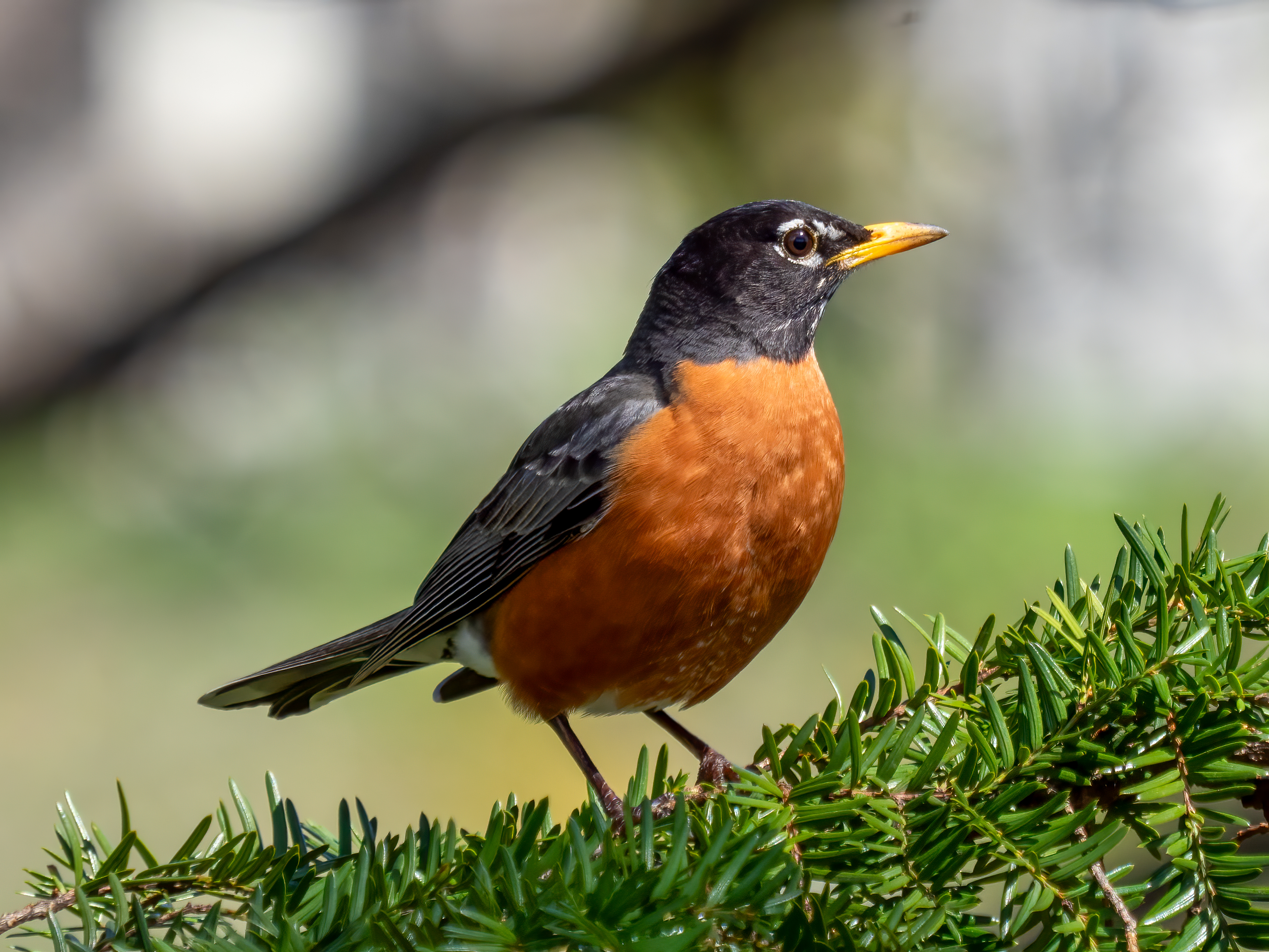
The familiar red-breasted thrush whose dawn chorus is the unofficial soundtrack of the North American suburbs. Despite the name, robins are often around all winter — they just shift from worm-hunting on lawns to berry-eating in trees.
§ Quick facts
§ Encyclopedia
The American robin is a migratory bird of the true thrush genus and Turdidae, the wider thrush family. It is named after the European robin because of its reddish-orange breast, though the two species are not closely related, with the European robin belonging to the Old World flycatcher family. The American robin is widely distributed throughout North America, wintering from southern Canada to central Mexico and along the Pacific coast.
Source: Wikipedia — American robin Licensed under CC BY-SA 4.0
§ Identification
Field marks. Familiar large thrush with brick-red breast, dark gray back, white throat with dark streaks, yellow bill. Females and immature birds duller.
Similar species. Eastern Towhee (rufous flanks, white belly). Spotted Towhee (similar pattern, smaller). Hermit Thrush and Wood Thrush (spotted breast).
Voice. Cheery whistled "cheerily-cheery-cheerily" song; sharp "tut tut" alarm calls; "yeep!" flight call.
§ Diet & behavior
Diet. Earthworms and insects in spring/summer (~40% of diet); fruits and berries dominate fall/winter (juniper, holly, crabapple, sumac, mountain ash).
Behavior. State bird of three US states (Michigan, Connecticut, Wisconsin). Among the most common and adaptable songbirds — equally at home in dense forest, suburban lawn, or desert oasis. Northern populations migrate, southern populations resident. Famously hunts worms by listening — tilts head sideways to detect prey through hearing, not the often-claimed seeing.
§ Range
Throughout most of North America; partial migrant
§ Habitat
Lawns, parks, woodlands, gardens
§ Threats
West Nile Virus has caused regional crashes, vehicle strikes, lawn pesticides, window collisions.
§ Conservation status
According to the IUCN Red List, the american robin is currently classified as Least Concern.
§ What helps
Skip lawn pesticides. Plant native berry shrubs (winterberry, sumac, hawthorn). Use bird-safe window decals.
§ Further reading
- Wikipedia — American robin
- www.allaboutbirds.org — authoritative profile of Turdus migratorius
- IUCN Red List · taxon 22708567
- iNaturalist · taxon 12727
- eBird · amerob
- GBIF occurrence records
- Encyclopedia of Life — Turdus migratorius
§ Sources cited
- Cornell Lab — All About Birds
- Project FeederWatch
- National Audubon Society
- IUCN Red List 2018


