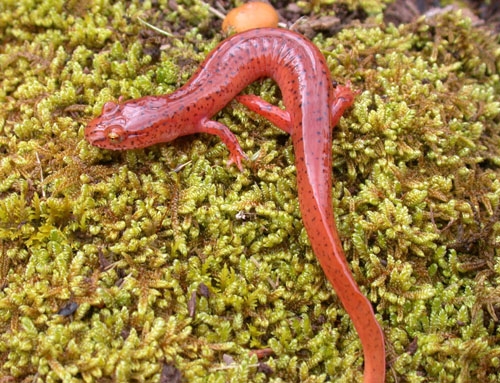
A medium-sized salamander of clean spring streams.
§ Quick facts
§ Encyclopedia
The spring salamander is a species of salamander in the family Plethodontidae. It is found in Canada and the United States. The genus, Gyrinophilus, means "tadpole lover" and refers to the long period of time it spends as a gilled larva before maturing. The specific epithet, porphyriticus, is Latin from Greek, meaning the color of porphyry, a purple stone, and this salamander has also been called the purple salamander.
Source: Wikipedia — Spring salamander Licensed under CC BY-SA 4.0
§ Identification
Field marks. Stout reddish-brown salamander; pale belly; broad flat head; muscular tail.
Similar species. Red Salamander (more uniform red). Other large stream salamanders.
Voice. Silent.
§ Diet & behavior
Diet. Aquatic invertebrates, smaller salamanders.
Behavior. Among the largest stream salamanders in eastern North America. Lives in cold clear seepage streams and brooks.
§ Range
Eastern North America
§ Habitat
Cold spring streams
§ Threats
Spring habitat degradation.
§ Conservation status
According to the IUCN Red List, the northern spring salamander is currently classified as Least Concern.
§ What helps
Support clean cool stream conservation.
§ Further reading
- Wikipedia — Spring salamander
- www.nwf.org — authoritative profile of Gyrinophilus porphyriticus
- IUCN Red List · taxon 59445
- iNaturalist · taxon 27548
- GBIF occurrence records
- Encyclopedia of Life — Gyrinophilus porphyriticus
§ Sources cited
- AmphibiaWeb
- Davidson College Herpetology Lab
- IUCN Red List 2014


