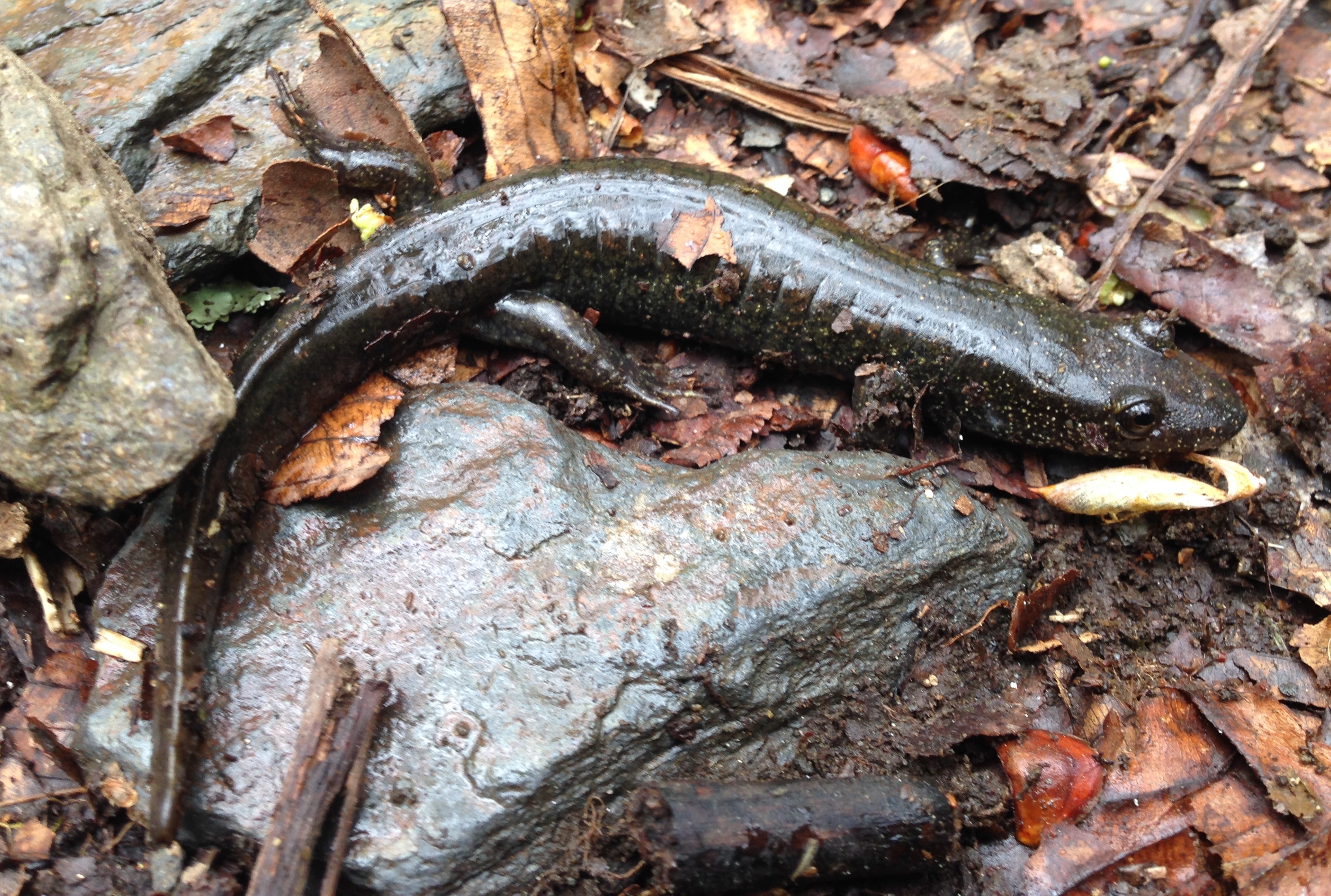
A medium-sized salamander of southern Appalachian streams.
§ Quick facts
§ Encyclopedia
The blackbelly salamander is a species of salamander in the family Plethodontidae. It is endemic to the United States. The genus Desmognathus contains 20 different species, making up the second largest genus of plethodontid salamanders in the eastern United States. Its natural habitats are rivers, intermittent rivers, and freshwater springs. It is threatened by habitat loss. A 2022 study found that Desmognathus quadramaculatus was actually a synonym of the Northern Dusky Salamander, and it is no longer considered a valid name for the Blackbelly Salamanders. Instead, the group has been split into multiple species, including Desmognathus amphileucus, Desmognathus folkertsi, Desmognathus gvnigeusgwotli, Desmognathus kanawha, and Desmognathus mavrokoilius.
Source: Wikipedia — Blackbelly salamander Licensed under CC BY-SA 4.0
§ Identification
Field marks. Stout aquatic salamander; black or dark gray body with pale belly; broad flat head; muscular tail.
Similar species. Other large Desmognathus species. Hellbenders (much larger).
Voice. Silent.
§ Diet & behavior
Diet. Small invertebrates, smaller salamanders.
Behavior. Aquatic salamander of southern Appalachian streams; among the largest "stream salamanders." Restricted to clear cold gravel/rocky streams; sensitive to siltation.
§ Range
Southern Appalachian Mountains
§ Habitat
Mountain streams
§ Threats
Stream degradation.
§ Conservation status
According to the IUCN Red List, the black-bellied salamander is currently classified as Least Concern.
§ What helps
Support Appalachian stream conservation.
§ Further reading
- Wikipedia — Blackbelly salamander
- www.nwf.org — authoritative profile of Desmognathus quadramaculatus
- IUCN Red List · taxon 59227
- iNaturalist · taxon 27557
- GBIF occurrence records
- Encyclopedia of Life — Desmognathus quadramaculatus
§ Sources cited
- AmphibiaWeb
- Davidson College Herpetology Lab
- IUCN Red List 2014


