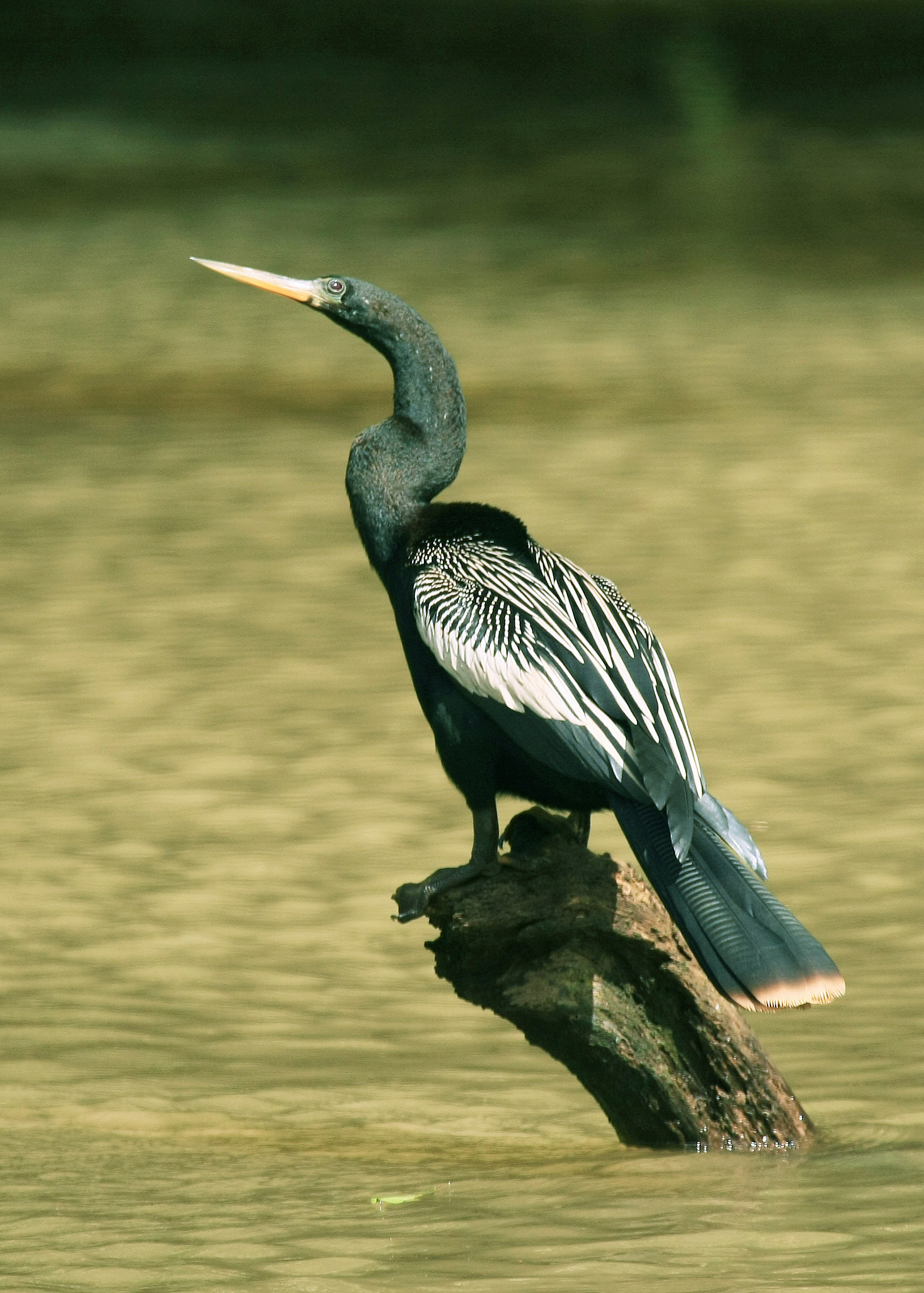
A long slender water bird often called the "snake bird" — when swimming with only the head and neck above water, they look exactly like a slow-moving snake. Unlike ducks, their feathers don't waterproof, so they perch wings spread to dry.
§ Quick facts
§ Encyclopedia
The anhinga, sometimes called darter, American darter, snakebird, or water turkey, is a water bird of the warmer parts of the Americas. The word anhinga comes from a'ñinga in the Brazilian Tupi language and means "devil bird" or "snake bird". The origin of the name is apparent when swimming: only the neck appears above water, so the bird looks like a snake ready to strike. They do not have external nares (nostrils) and breathe solely through their epiglottis, via small opercula at the corners of the beak.
Source: Wikipedia — Anhinga Licensed under CC BY-SA 4.0
§ Identification
Field marks. Long-necked dark waterbird with sharp dagger-bill. White stripes on wing.
Similar species. Double-crested Cormorant (similar pose; different bill shape). Snake Birds (other anhinga species).
Voice. Generally silent; grunts at colonies.
§ Diet & behavior
Diet. Fish, amphibians.
Behavior. Often called "snake bird" — swims with only head and neck above water. Doesn't have waterproof feathers; perches wings spread to dry.
§ Range
Southeastern US and into Mexico/Central/South America
§ Habitat
Slow rivers, lakes, swamps, mangroves
§ Threats
Loss of cypress swamp habitat, pesticide bioaccumulation, water level management.
§ Conservation status
According to the IUCN Red List, the anhinga is currently classified as Least Concern.
§ What helps
Support cypress swamp protection. Maintain natural water-level fluctuations. Skip pesticides.
§ Further reading
- Wikipedia — Anhinga
- www.allaboutbirds.org — authoritative profile of Anhinga anhinga
- IUCN Red List · taxon 22696741
- iNaturalist · taxon 4941
- eBird · anhing
- GBIF occurrence records
- Encyclopedia of Life — Anhinga anhinga
§ Sources cited
- Cornell Lab — All About Birds
- National Audubon Society
- iNaturalist
- IUCN Red List 2018


