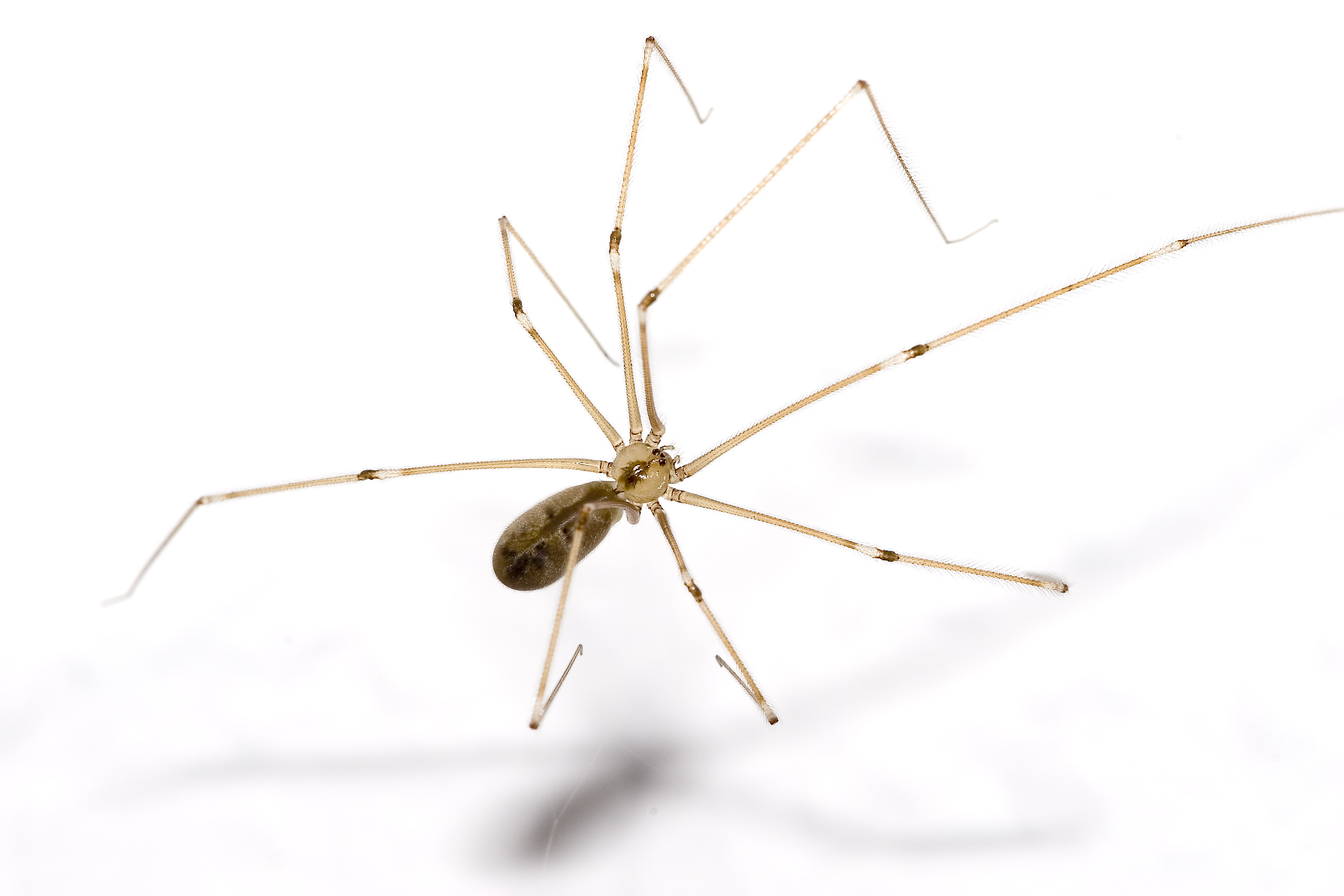
Common indoor spider often called "daddy long legs" but is a true spider. Eats other spiders.
§ Quick facts
§ Encyclopedia
Pholcus phalangioides, commonly known as the cosmopolitan cellar spider, long-bodied cellar spider, or one of various types called a daddy long-legs spider, is a spider of the family Pholcidae. It was first described in 1775 by the Swiss entomologist Johann Kaspar Füssli as Aranea phalangoides. Its common name of "daddy long-legs" should not be confused with a different arachnid group with the same common name, the harvestman (Opiliones), or the crane flies of the superfamily Tipuloidea.
Source: Wikipedia — Pholcus phalangioides Licensed under CC BY-SA 4.0
§ Identification
Field marks. Small spider with pale brown-tan elongated body; extremely long thin legs; messy tangled web in dark corners of basements, garages, cellars, and outbuildings.
Similar species. Harvestmen ("daddy long-legs"; not spiders; single body segment, no spinnerets). Crane flies ("mosquito hawks"; insects with wings).
Voice. N/A
§ Diet & behavior
Diet. Insects and other spiders captured in tangled web. Famously preys on Black Widow spiders and other dangerous species.
Behavior. The folk-name "Daddy Long-Legs" is applied to three completely unrelated arthropods: cellar spiders (true spiders), harvestmen (order Opiliones; not actually spiders), and crane flies (insects). The persistent myth that they have "the most powerful venom but fangs too short to bite humans" is FALSE on both counts: they can bite humans (rarely, and the bite is mild), and their venom is not particularly potent. Cellar spiders shake their webs violently when disturbed, blurring their outline to confuse predators.
§ Range
Native to Europe; cosmopolitan
§ Habitat
Indoor corners, basements, cellars
§ Threats
Pesticide spraying, fear-driven killing.
§ Conservation status
According to the IUCN Red List, the cellar spider (daddy long legs) is currently classified as Least Concern.
§ What helps
Tolerate cellar spiders — they eat other spiders. Skip pesticides.
§ Further reading
- Wikipedia — Pholcus phalangioides
- www.nwf.org — authoritative profile of Pholcus phalangioides
- iNaturalist · taxon 49337
- IUCN Red List — search for Pholcus phalangioides
- GBIF occurrence records
- Encyclopedia of Life — Pholcus phalangioides
§ Sources cited
- American Arachnological Society
- University of California IPM
- Burke Museum of Natural History (UW) Daddy Long-Legs myth-busting


