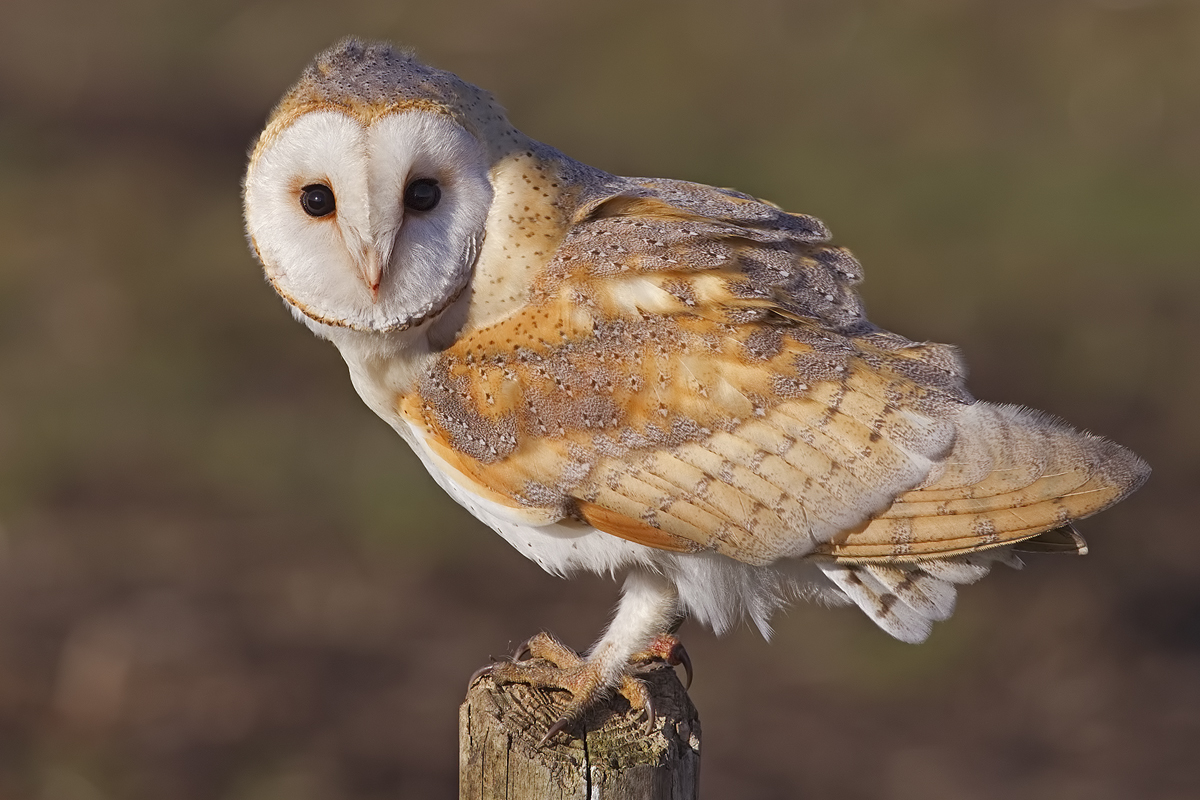
A heart-faced specialist of catching rodents in total darkness using only sound. A single family of barn owls can take 3,000+ rodents from a farm in one breeding season.
§ Quick facts
§ Encyclopedia
The western barn owl is a species of barn owl native to Europe, southwestern Asia, and Africa. It was formerly considered a subspecies group together with barn owls native to other parts of the world, but this classification was found to be paraphyletic with respect to some other members of the genus.
Source: Wikipedia — Western barn owl Licensed under CC BY-SA 4.0
§ Identification
Field marks. Heart-shaped white face, golden-buff back, pure white underparts.
Similar species. Other owl species (different facial disk shapes).
Voice. Piercing rasping shriek.
§ Diet & behavior
Diet. Almost entirely small mammals.
Behavior. Nocturnal. Hunts by silent flight. Heart-shaped white face.
§ Range
Worldwide; throughout most of the US except northern interior
§ Habitat
Open agricultural country with cavity nest sites — barns, hollow trees, cliffs
§ Threats
Rodenticide poisoning is THE major threat (some studies show 80%+ of dead barn owls have rodenticide in tissues), vehicle strikes, loss of nest sites.
§ Conservation status
According to the IUCN Red List, the barn owl is currently classified as Least Concern.
§ What helps
Install a barn owl nest box in agricultural areas. Eliminate second-generation rodenticides. Support owl-as-rodent-control programs in vineyards.
§ Further reading
- Wikipedia — Western barn owl
- www.allaboutbirds.org — authoritative profile of Tyto alba
- IUCN Red List · taxon 22688504
- iNaturalist · taxon 19350
- eBird · brnowl
- GBIF occurrence records
- Encyclopedia of Life — Tyto alba
§ Sources cited
- Cornell Lab — All About Birds
- Barn Owl Trust
- IUCN Red List 2019


