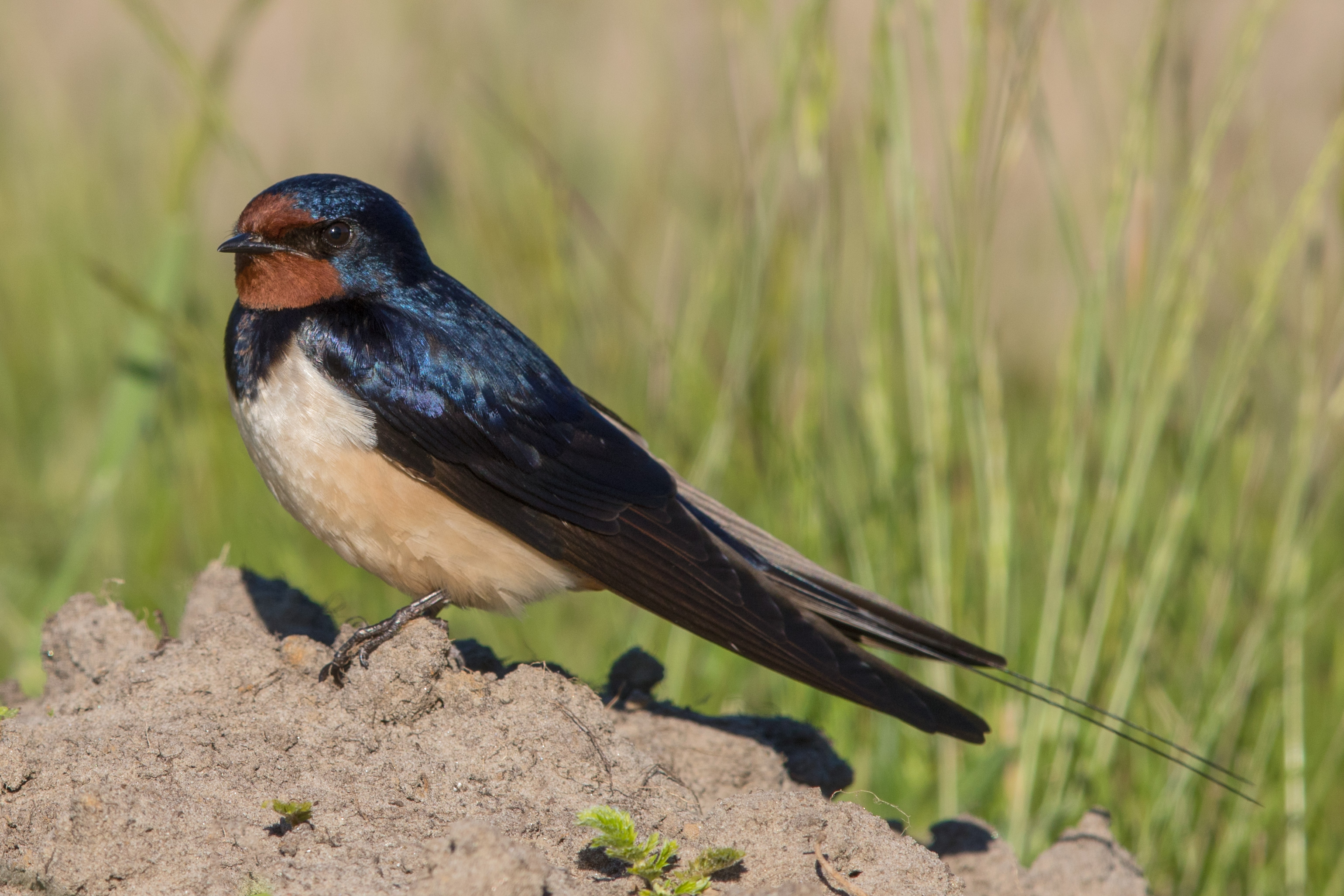
The deep-forked, steel-blue swallow that nests under bridges and inside barns worldwide. Their cup-shaped mud nests stuck under eaves are a familiar sight in agricultural country.
§ Quick facts
§ Encyclopedia
The barn swallow is the most widespread species of swallow in the world, occurring on all continents, with vagrants reported even in Antarctica. It is a distinctive passerine bird with blue upperparts and a long, deeply forked tail. In Anglophone Europe, it is just called the swallow; in northern Europe, it is the only member of family Hirundinidae called a "swallow" rather than a "martin".
Source: Wikipedia — Barn swallow Licensed under CC BY-SA 4.0
§ Identification
Field marks. Steel-blue back, buff underparts, distinctive long deeply forked tail.
Similar species. Cliff Swallow (square tail, similar color). Tree Swallow (no orange).
Voice. Squeaky chattering calls.
§ Diet & behavior
Diet. Insects caught in flight.
Behavior. Iconic deep-forked tail. Builds mud nests under eaves and bridges. Among the most widespread birds on Earth.
§ Range
Across North America in summer; winters in South America
§ Habitat
Open habitats with structures for nesting (barns, bridges, eaves)
§ Threats
Loss of nesting structures (barn demolition, eave sealing), pesticide-driven insect declines.
§ Conservation status
According to the IUCN Red List, the barn swallow is currently classified as Least Concern.
§ What helps
Tolerate mud nests under eaves. Leave a barn door open during nesting. Skip pesticides.
§ Further reading
- Wikipedia — Barn swallow
- www.allaboutbirds.org — authoritative profile of Hirundo rustica
- IUCN Red List · taxon 22712252
- iNaturalist · taxon 14858
- eBird · barswa
- GBIF occurrence records
- Encyclopedia of Life — Hirundo rustica
§ Sources cited
- Cornell Lab — All About Birds
- National Audubon Society
- iNaturalist
- IUCN Red List 2018


