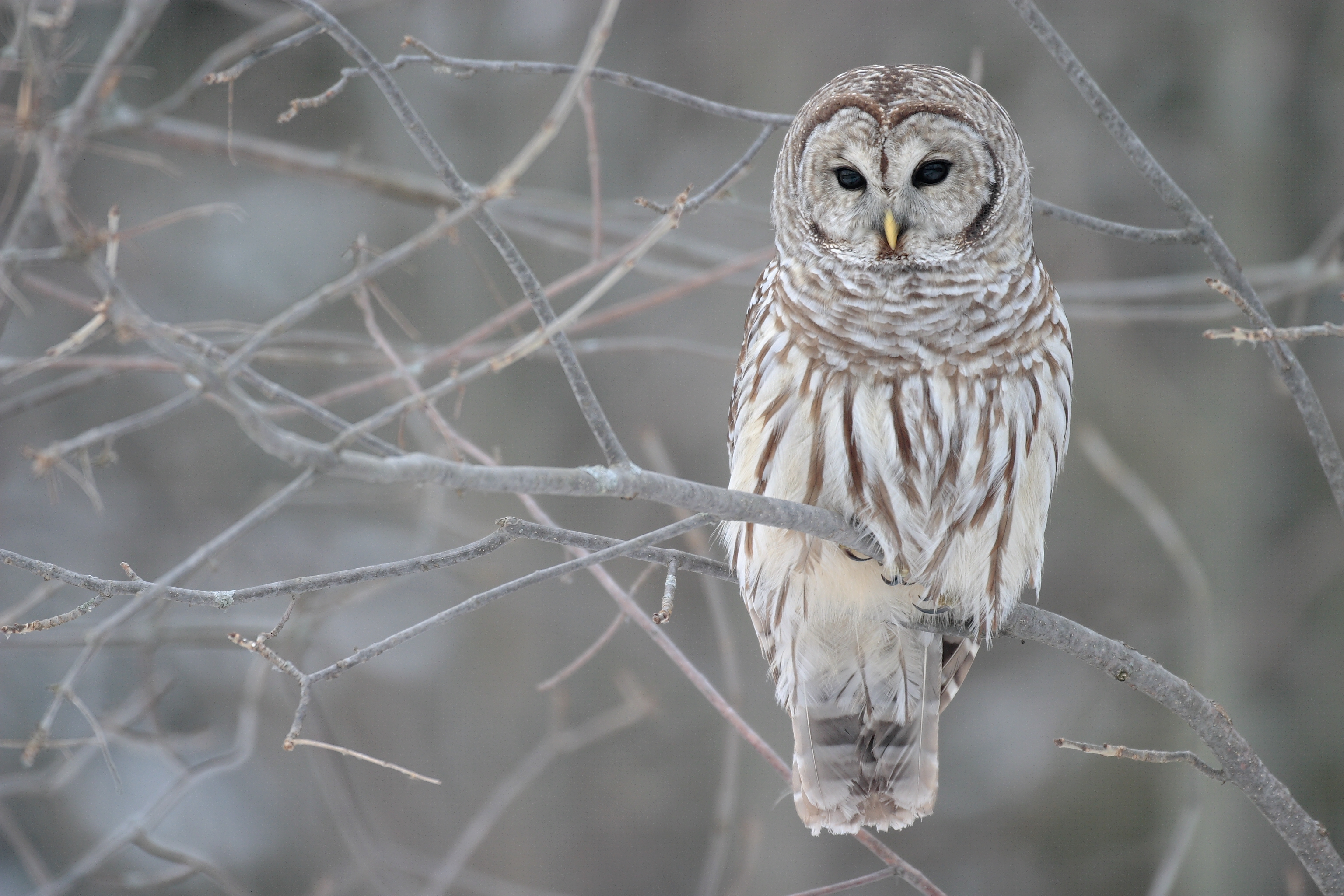
A medium-sized owl with vertical brown bars on the chest and a distinctive "Who cooks for you? Who cooks for you all?" call. They've expanded westward dramatically and are now competing with — and out-competing — the federally Threatened Spotted Owl.
§ Quick facts
§ Encyclopedia
The barred owl, also known as the northern barred owl, striped owl or, more informally, hoot owl or eight-hooter owl, is a North American large species of owl. A member of the true owl family, Strigidae, they belong to the genus Strix, which is also the origin of the family's name under Linnaean taxonomy. Barred owls are largely native to eastern North America, but have expanded their range to the west coast of North America where they are considered invasive. Mature forests are their preferred habitat, but they can also acclimatise to various gradients of open woodlands. Their diet consists mainly of small mammals, but this species is an opportunistic predator and is known to prey upon other small vertebrates such as birds, reptiles, and amphibians, as well as a variety of invertebrates.
Source: Wikipedia — Barred owl Licensed under CC BY-SA 4.0
§ Identification
Field marks. Medium-large owl, brown above with vertical streaking; dark eyes; round head.
Similar species. Spotted Owl (smaller, white spots). Great Horned Owl (yellow eyes, ear tufts).
Voice. Famous "Who cooks for YOU" hoot — easy to identify.
§ Diet & behavior
Diet. Diverse: rodents, rabbits, snakes, songbirds.
Behavior. Nocturnal but increasingly active during day. Has displaced spotted owls across Pacific Northwest.
§ Range
Eastern US and Canada; expanded into Pacific Northwest
§ Habitat
Mature forests, especially with rivers and swamps
§ Threats
Forest fragmentation in eastern range; competition pressure they're causing in western range.
§ Conservation status
According to the IUCN Red List, the barred owl is currently classified as Least Concern.
§ What helps
Support old-growth forest protection. Avoid second-generation rodenticides. Donate to research on barred-spotted owl management.
§ Further reading
- Wikipedia — Barred owl
- www.allaboutbirds.org — authoritative profile of Strix varia
- IUCN Red List · taxon 61803960
- iNaturalist · taxon 4665
- eBird · brdowl
- GBIF occurrence records
- Encyclopedia of Life — Strix varia
§ Sources cited
- Cornell Lab — All About Birds
- Owl Research Institute
- IUCN Red List 2017


