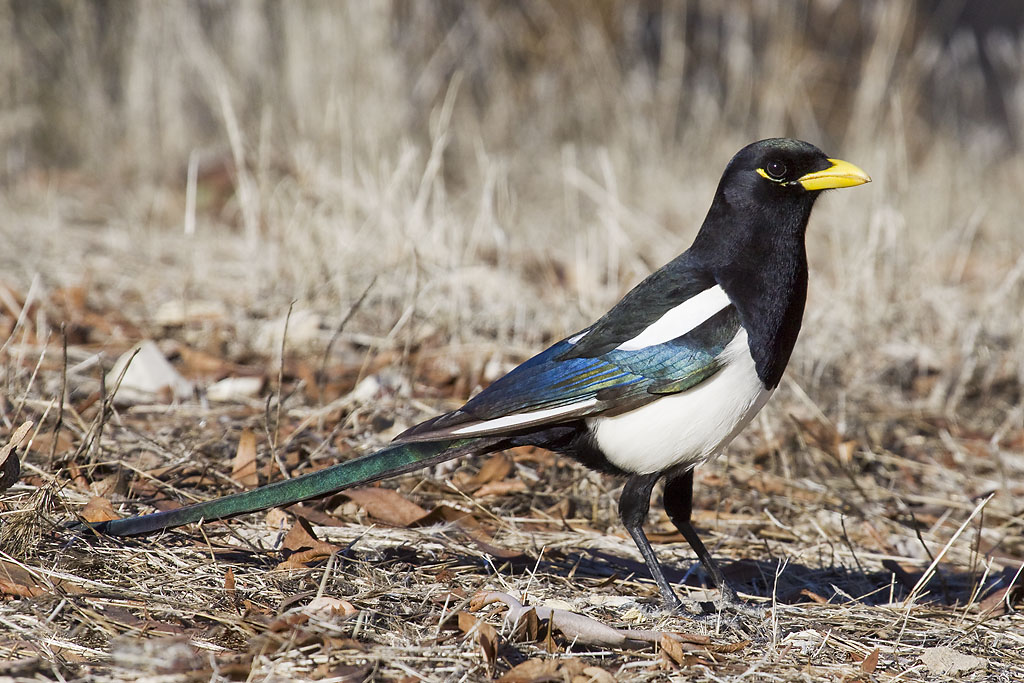
A medium black-and-white magpie with yellow bill. Endemic to California Central Valley.
§ Quick facts
§ Encyclopedia
The yellow-billed magpie, also known as the California magpie, is a bird that is endemic to California's Central Valley and the adjacent chaparral foothills and mountains. Apart from its having a yellow bill and a yellow streak around the eye and being slightly smaller, it is virtually identical to the black-billed magpie found in much of the rest of western North America. The scientific name commemorates the English naturalist Thomas Nuttall.
Source: Wikipedia — Yellow-billed magpie Licensed under CC BY-SA 4.0
§ Identification
Field marks. Large black-and-white magpie with a very long iridescent tail, bold white wing patches, and a yellow bill and yellow facial skin (the only magpie with a yellow bill).
Similar species. Black-billed Magpie is nearly identical but has a black bill and a wider range; the yellow bill and California range are diagnostic for Yellow-billed.
Voice. A nasal, rising 'mag? mag?' and chattering calls, slightly higher than Black-billed Magpie.
§ Diet & behavior
Diet. Omnivorous: nuts, seeds, insects, eggs, carrion, small vertebrates.
Behavior. A magpie found only in California's Central Valley and coastal valleys; a social bird of oak savanna that nests in loose colonies and forages on the ground in flocks.
§ Range
California Central Valley
§ Habitat
Oak savannas, valley grasslands
§ Threats
Habitat loss to development.
§ Conservation status
According to the IUCN Red List, the yellow-billed magpie is currently classified as Least Concern.
§ What helps
Support California Central Valley conservation.
§ Further reading
- Wikipedia — Yellow-billed magpie
- www.allaboutbirds.org — authoritative profile of Pica nuttalli
- IUCN Red List — search for Pica nuttalli
- GBIF occurrence records
- Encyclopedia of Life — Pica nuttalli
§ Sources cited
- Cornell Lab of Ornithology — All About Birds
- National Audubon Society
- iNaturalist
- IUCN Red List


