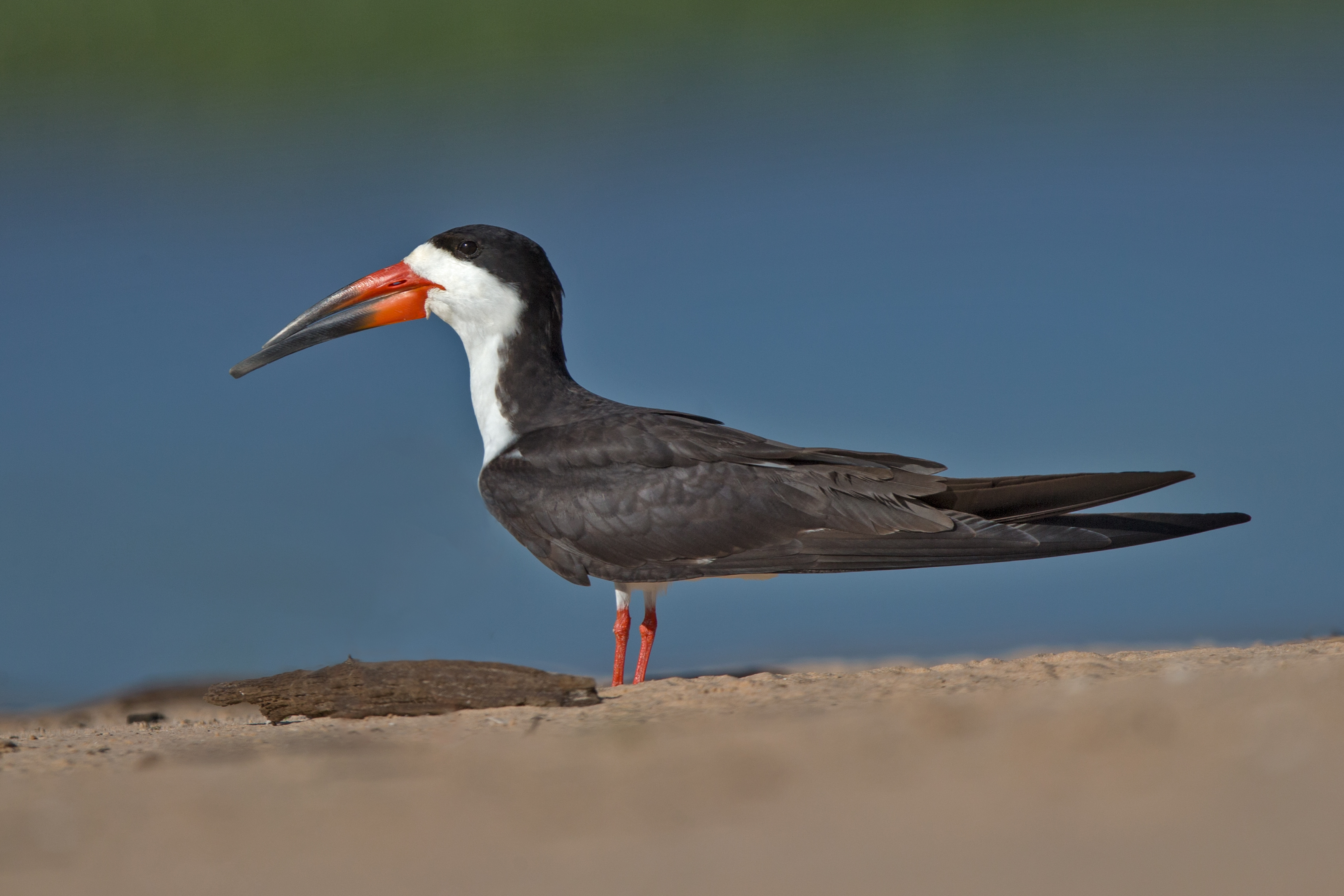
A boldly black-above, white-below tern relative with a distinctive bill — the lower mandible is significantly longer than the upper. They feed by flying low and "skimming" the water surface, snapping shut on contact with fish.
§ Quick facts
§ Encyclopedia
The black skimmer is a tern-like seabird, one of three similar bird species in the skimmer genus Rynchops in the gull family Laridae. It breeds in North and South America. Northern populations winter in the warmer waters of the Caribbean and the tropical and subtropical Pacific and Atlantic coasts, but South American populations make only shorter movements in response to annual floods which extend their feeding areas in the river shallows.
Source: Wikipedia — Black skimmer Licensed under CC BY-SA 4.0
§ Identification
Field marks. Striking black-above, white-below seabird with a long red-and-black bill, the lower mandible jutting well past the upper. Cat-slit pupils (unique among birds).
Similar species. Unmistakable — no other North American bird has the uneven 'scissor' bill and skimming flight.
Voice. A nasal, barking 'kaup-kaup' and yapping notes around colonies.
§ Diet & behavior
Diet. Small fish caught by plunge-diving or surface-snatching.
Behavior. The only bird with a lower mandible longer than the upper; flies low with the blade-like lower bill slicing the water surface to snap up fish by touch, often at dusk.
§ Range
Atlantic and Gulf coasts; inland along Salton Sea
§ Habitat
Coastal sandbars, beaches, salt marshes
§ Threats
Coastal disturbance, beach nest predation by raccoons and foxes, sea-level rise.
§ Conservation status
According to the IUCN Red List, the black skimmer is currently classified as Least Concern.
§ What helps
Respect beach closures during nesting. Support coastal predator management. Donate to coastal Audubon chapters.
§ Further reading
- Wikipedia — Black skimmer
- www.allaboutbirds.org — authoritative profile of Rynchops niger
- IUCN Red List — search for Rynchops niger
- GBIF occurrence records
- Encyclopedia of Life — Rynchops niger
§ Sources cited
- Cornell Lab of Ornithology — All About Birds
- National Audubon Society
- iNaturalist
- IUCN Red List


