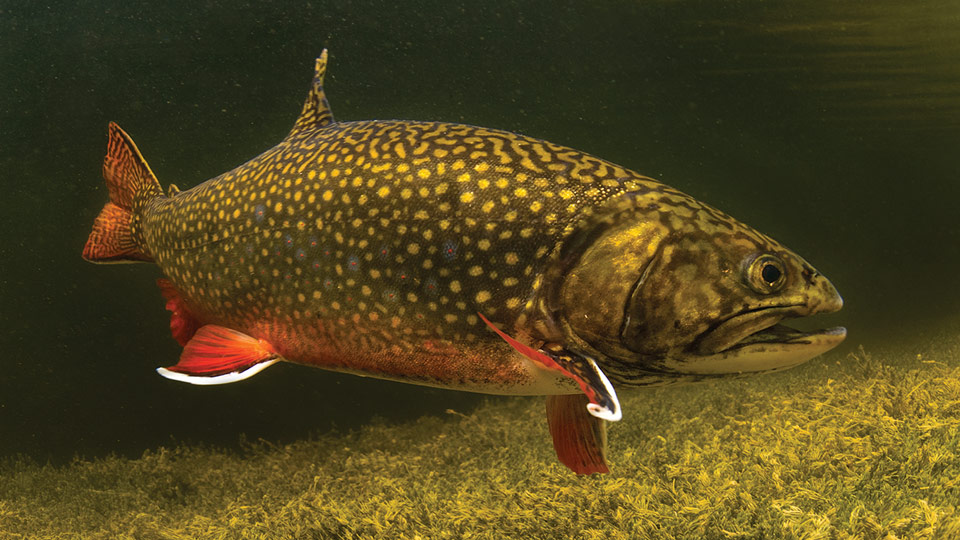
A char (not a true trout) with dark olive backs, worm-like vermiculations, and pale spots ringed in red. The official state fish of nine eastern states and a marker of pristine cold-water habitat.
§ Quick facts
§ Encyclopedia
The brook trout is a species of freshwater fish in the char genus Salvelinus of the salmon family Salmonidae native to Eastern North America in the United States and Canada. Two ecological forms of brook trout have been recognized by the US Forest Service. One ecological form is long-lived potamodromous populations in Lake Superior known as coaster trout or coasters. The second ecological form is the short-living predaceous anadromous populations which are found in northern lakes and coastal rivers from Long Island to Hudson Bay, which are referred to as salters. In parts of its range, it is also known as the eastern brook trout, speckled trout, brook char, squaretail, brookie, or mud trout, among others. Adult coaster brook trout are capable of reaching sizes over 2 feet in length and weigh up to 6.8 kg (15 lb), whereas adult salters average between 6 and 15 inches in length and weigh between 0.5 and 2.3 kg. The brook trout is characterized by its distinctive olive-green body with yellow and blue-rimmed red spots, white and black edged orange fins, and dorsal vermiculation. The diet of the brook trout is restrictive to the season and location of the fish, but will typically consist of terrestrial and aquatic insects, fry, crustaceans, zooplankton, and worms.
Source: Wikipedia — Brook trout Licensed under CC BY-SA 4.0
§ Identification
Field marks. Olive-green to dark brown with worm-like vermiculations on back and red spots ringed in blue on sides.
Similar species. Bull Trout (larger, no red spots). Lake Trout (deeper-bodied, lake habitat).
Voice. Silent.
§ Diet & behavior
Diet. Aquatic insects, small fish, crustaceans.
Behavior. Most cold-water-restricted of US trout — needs water below 65°F. Indicator of pristine stream health.
§ Range
Native to eastern North America; stocked widely
§ Habitat
Cold pristine headwater streams, alpine ponds
§ Threats
Stream warming from deforestation, acid deposition, hatchery rainbow/brown competition, sedimentation.
§ Conservation status
According to the IUCN Red List, the brook trout is currently classified as Least Concern.
§ What helps
Maintain forested stream buffers. Support brookies-only management in headwaters. Don't stock browns or rainbows over wild brookies.
§ Further reading
- Wikipedia — Brook trout
- www.nwf.org — authoritative profile of Salvelinus fontinalis
- IUCN Red List · taxon 62203
- iNaturalist · taxon 49671
- GBIF occurrence records
- Encyclopedia of Life — Salvelinus fontinalis
§ Sources cited
- Trout Unlimited
- USDA Forest Service
- American Fisheries Society
- IUCN Red List 2014


