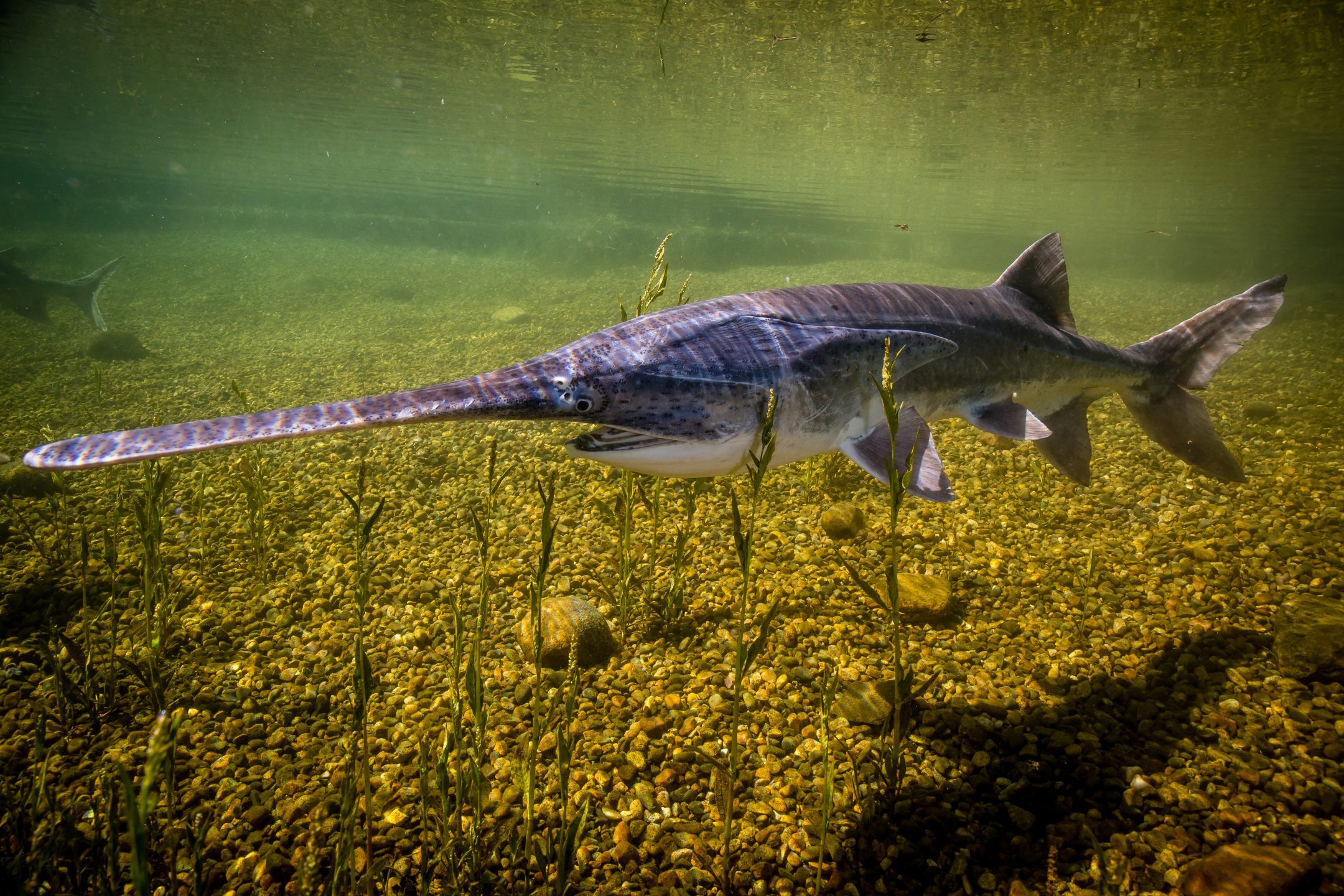
A primitive plankton-eating fish with a paddle-like rostrum and a body unchanged for 300+ million years. They swim with mouth agape, filtering zooplankton through gill rakers.
§ Quick facts
§ Encyclopedia
The American paddlefish, also known as a Mississippi paddlefish, spoon-billed cat, or spoonbill, is a species of ray-finned fish. It is the last living species of paddlefish (Polyodontidae). This family is most closely related to the sturgeons; together they make up the order Acipenseriformes, which are one of the most basal living groups of ray-finned fish. Fossil records of other paddlefish species date back 125 million years to the Early Cretaceous, with records of Polyodon extending back 65 million years to the early Paleocene. The American paddlefish is a smooth-skinned freshwater fish with an almost entirely cartilaginous skeleton and a paddle-shaped rostrum (snout), which extends nearly one-third its body length. It has been referred to as a freshwater shark because of its heterocercal tail or caudal fin resembling that of sharks, though it is not closely related. The American paddlefish is a highly derived fish because it has evolved specialised adaptations, such as filter feeding. Its rostrum and cranium are covered with tens of thousands of sensory receptors for locating swarms of zooplankton, its primary food source. The only other species of paddlefish that survived to modern times was the Chinese paddlefish, last sighted in 2003 in the Yangtze River in China and considered to have gone extinct no later than 2010.
Source: Wikipedia — American paddlefish Licensed under CC BY-SA 4.0
§ Identification
Field marks. Distinctive paddle-shaped rostrum (up to 1/3 body length); smooth gray-brown body; large mouth.
Similar species. Sturgeon (bony plates, smaller snout). Bowfin (no paddle).
Voice. Silent.
§ Diet & behavior
Diet. Plankton (zooplankton) filtered through gill rakers. Swims with mouth open through dense plankton clouds.
Behavior. Slow-growing, late-maturing. Major declines from dams, overharvest for caviar.
§ Range
Mississippi and Missouri River drainages
§ Habitat
Large rivers, oxbow lakes, reservoirs
§ Threats
Dams blocking spawning migrations, overharvest for caviar (paddlefish roe is a substitute for beluga sturgeon caviar), pollution.
§ Conservation status
According to the IUCN Red List, the american paddlefish is currently classified as Vulnerable.
§ What helps
Support dam removals on Missouri/Mississippi tribs. Buy paddlefish caviar only from regulated sources. Practice catch-and-release.
§ Further reading
- Wikipedia — American paddlefish
- www.fws.gov — authoritative profile of Polyodon spathula
- IUCN Red List · taxon 17938
- iNaturalist · taxon 49554
- GBIF occurrence records
- Encyclopedia of Life — Polyodon spathula
§ Sources cited
- NOAA Fisheries
- USFWS Paddlefish Working Group
- The Paddlefish Foundation
- IUCN Red List 2018


