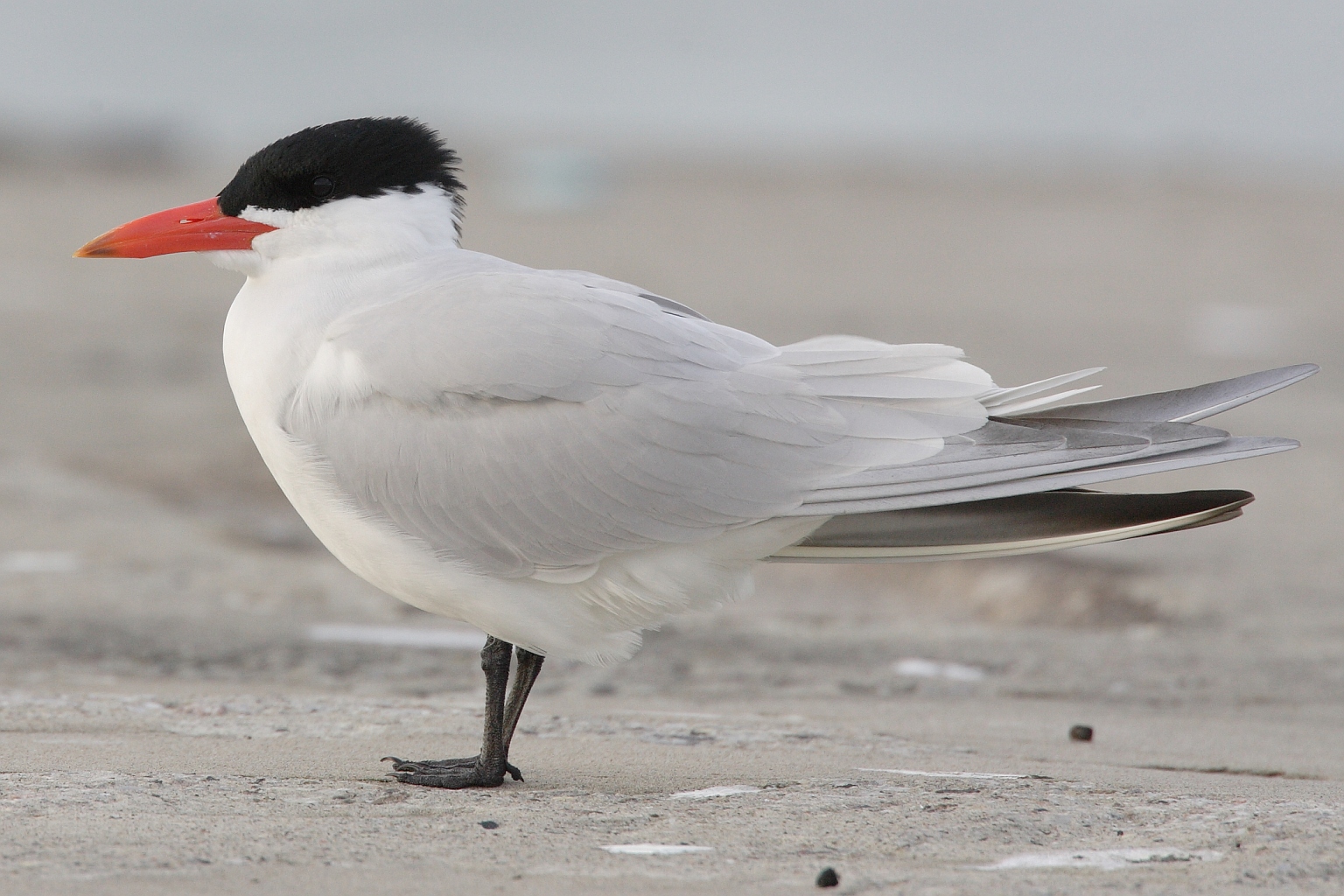
The largest tern in the world — wingspan over 1.4 m. Massive bright red bill; black cap. Highly vocal.
§ Quick facts
§ Encyclopedia
The Caspian tern is the world's largest species of tern, with a subcosmopolitan but scattered distribution. Despite its extensive range, it is monotypic of its genus, and has no accepted subspecies. The genus name is from Ancient Greek hudro-, "water-", and Latin progne, "swallow". The specific caspia is from Latin and, like the English name, refers to the Caspian Sea.
Source: Wikipedia — Caspian tern Licensed under CC BY-SA 4.0
§ Identification
Field marks. Big, gull-sized tern with a thick, blood-red bill (often with a dark tip), a black cap (streaked in winter), and pale gray wings with dusky undersides to the primaries.
Similar species. Royal Tern is slimmer with an orange bill and a white forehead for most of the year; Caspian is bulkier with a darker, redder bill and more black on the underwing.
Voice. A loud, harsh, low 'kraaa' and grating notes; begging young give whistling calls.
§ Diet & behavior
Diet. Small fish caught by plunge-diving or surface-snatching.
Behavior. The world's largest tern; plunges for fish in lakes, rivers, and coasts and aggressively defends its nesting colonies. Has a worldwide distribution.
§ Range
Across North America during migration
§ Habitat
Coastal areas, large lakes, rivers
§ Threats
Coastal habitat loss, climate change.
§ Conservation status
According to the IUCN Red List, the caspian tern is currently classified as Least Concern.
§ What helps
Support coastal protection. Reduce pollution.
§ Further reading
- Wikipedia — Caspian tern
- www.allaboutbirds.org — authoritative profile of Hydroprogne caspia
- IUCN Red List — search for Hydroprogne caspia
- GBIF occurrence records
- Encyclopedia of Life — Hydroprogne caspia
§ Sources cited
- Cornell Lab of Ornithology — All About Birds
- National Audubon Society
- iNaturalist
- IUCN Red List


