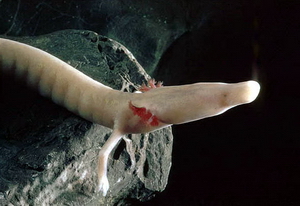
A bright orange-red salamander with a long prehensile tail that climbs cave walls and ceilings. They specialize in the "twilight zone" of caves — where some surface light reaches.
§ Quick facts
§ Encyclopedia
A cave salamander is a type of salamander that primarily or exclusively inhabits caves, a group that includes several species. Some of these animals have developed special, even extreme, adaptations to their subterranean environments. Some species have only rudimentary eyes. Others lack pigmentation, rendering them a pale yellowish or pinkish color.
Source: Wikipedia — Cave salamander Licensed under CC BY-SA 4.0
§ Identification
Field marks. Slender orange-red salamander with prominent dark spots and long tail. Distinctive cave-mouth appearance.
Similar species. Long-tailed Salamander (similar but no cave specialty). Red Salamander (no spots).
Voice. Silent.
§ Diet & behavior
Diet. Small invertebrates.
Behavior. Forages in cool cave entrances and rocky areas. Active by day. Among the most distinctive cave-dwelling salamanders.
§ Range
Karst regions of central and southeastern US
§ Habitat
Cave entrances, twilight zone of caves, springs, sinkholes
§ Threats
Cave-water pollution from agricultural runoff, recreational caving disturbing populations, white-nose-syndrome management actions in caves.
§ Conservation status
According to the IUCN Red List, the cave salamander is currently classified as Least Concern.
§ What helps
Support karst water-quality protection. Stay on designated paths in caves. Don't handle salamanders.
§ Further reading
- Wikipedia — Cave salamander
- www.nwf.org — authoritative profile of Eurycea lucifuga
- IUCN Red List · taxon 59281
- iNaturalist · taxon 27548
- GBIF occurrence records
- Encyclopedia of Life — Eurycea lucifuga
§ Sources cited
- USGS ARMI
- AmphibiaWeb
- iNaturalist
- IUCN Red List 2014


