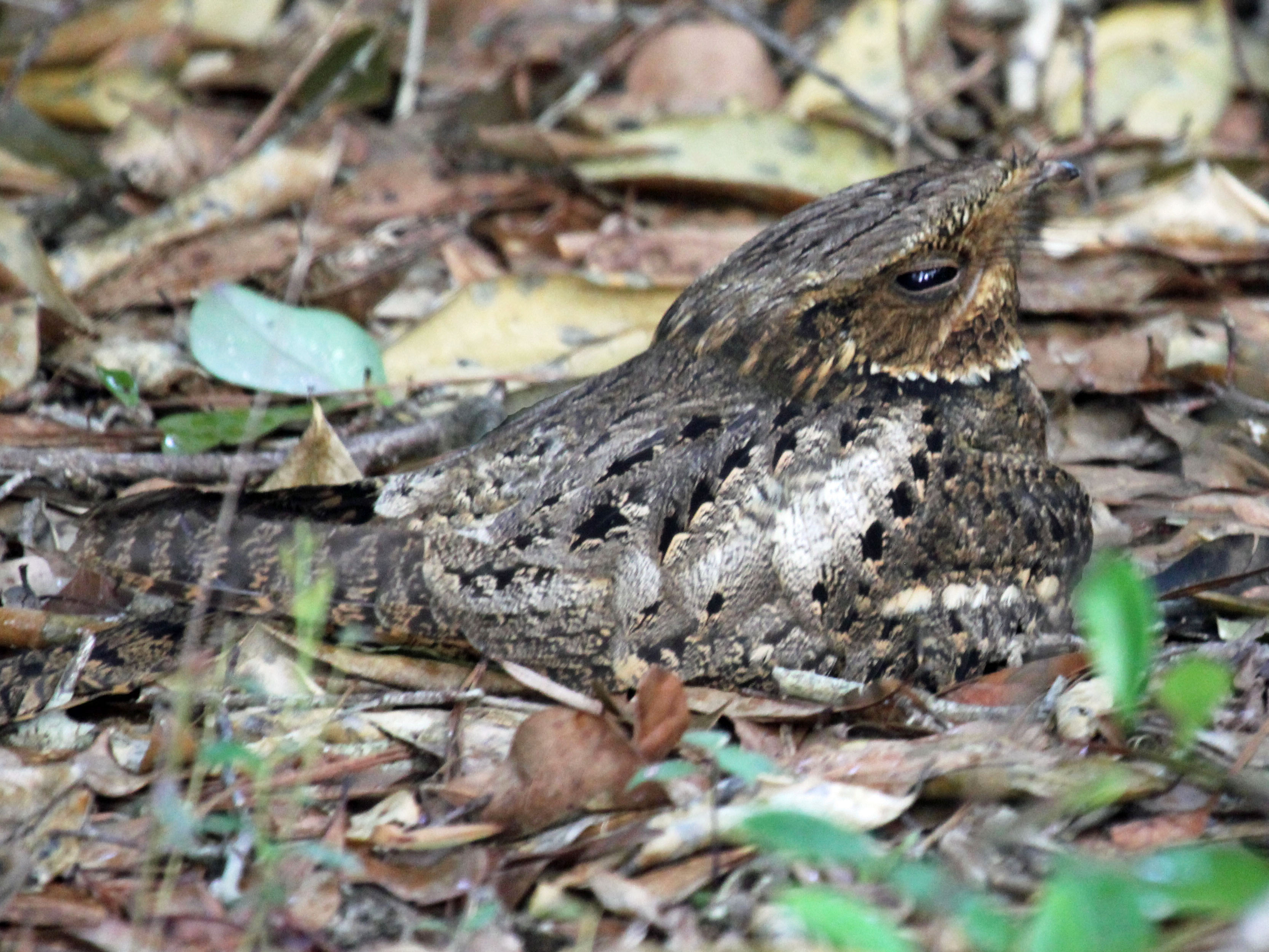
The largest North American nightjar, named for its loud nocturnal "chuck-will's-widow" call. Bigger but less common than its cousin the whip-poor-will.
§ Quick facts
§ Encyclopedia
The chuck-will's-widow is a nocturnal bird of the nightjar family Caprimulgidae. It is mostly found in the southeastern United States near swamps, rocky uplands, and pine woods. It migrates to the West Indies, Central America, and northwestern South America.
Source: Wikipedia — Chuck-will's-widow Licensed under CC BY-SA 4.0
§ Identification
Field marks. Large, cryptic mottled rufous-brown nightjar with a big flat head, tiny bill with an enormous gape, and long rounded wings; males show white in the inner tail.
Similar species. Eastern Whip-poor-will is smaller and grayer with more white in the tail; Chuck-will's-widow is larger and browner with a distinct song.
Voice. A rich, whistled, four-parted 'chuck-will's-WID-ow' repeated on warm nights.
§ Diet & behavior
Diet. Small mammals, birds, insects; hunting style varies by species.
Behavior. The largest North American nightjar; a nocturnal aerial insectivore that rests on the ground or lengthwise on branches by day, perfectly camouflaged, and hunts moths and beetles (even small birds) at night.
§ Range
Southeastern US in summer; winters Caribbean, Central America
§ Habitat
Pine forests, oak woodlands, mixed woods
§ Threats
Forest loss, insect decline, light pollution.
§ Conservation status
According to the IUCN Red List, the chuck-will's-widow is currently classified as Least Concern.
§ What helps
Maintain mature pine forests. Skip pesticides. Reduce outdoor lighting near woodlots.
§ Further reading
- Wikipedia — Chuck-will's-widow
- www.allaboutbirds.org — authoritative profile of Antrostomus carolinensis
- IUCN Red List — search for Antrostomus carolinensis
- GBIF occurrence records
- Encyclopedia of Life — Antrostomus carolinensis
§ Sources cited
- Cornell Lab of Ornithology — All About Birds
- National Audubon Society
- iNaturalist
- IUCN Red List


