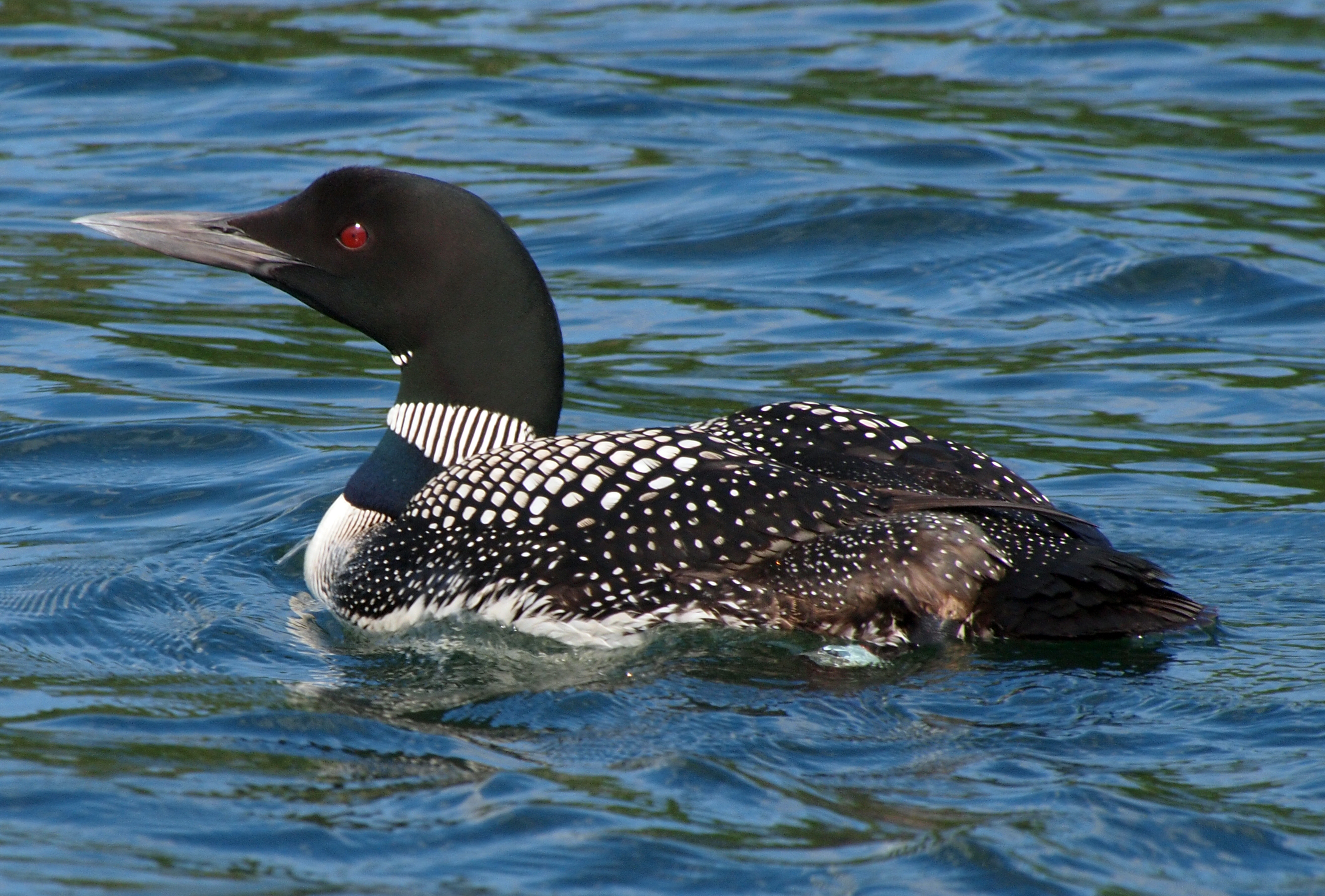
The mournful tremolo call of the common loon defines northern wilderness lakes. They're excellent swimmers — bones are denser than most birds, helping them dive 200+ feet — but their legs are placed so far back they can barely walk on land.
§ Quick facts
§ Encyclopedia
The common loon or great northern diver is a large member of the loon, or diver, family of birds. Breeding adults have a plumage that includes a broad black head and neck with a greenish, purplish, or bluish sheen, blackish or blackish-grey upperparts, and pure white underparts except some black on the undertail coverts and vent. Non-breeding adults are brownish with a dark neck and head marked with dark grey-brown. Their upperparts are dark brownish-grey with an unclear pattern of squares on the shoulders, and the underparts, lower face, chin, and throat are whitish. The sexes look alike, though males are significantly heavier than females. During the breeding season, loons live on lakes and other waterways in Canada, the northern United States, and southern parts of Greenland and Iceland. Small numbers breed on Svalbard and sporadically elsewhere in Arctic Eurasia. Common loons winter on both coasts of North America as far north as Newfoundland and Alaska, and as far south as Mexico, as well as on the Atlantic coast of Europe.
Source: Wikipedia — Common loon Licensed under CC BY-SA 4.0
§ Identification
Field marks. Large dark waterbird. Breeding: black head, white-checkered back, broken white "necklace." Winter: gray-brown above, white below. Dagger-like bill held horizontal (vs. cormorants, which hold bills upturned).
Similar species. Other loon species (different bill shapes/sizes, head patterns). Cormorants (different bill, hold head upturned). Mergansers (different bill shape).
Voice. Iconic eerie yodels, tremolos, and wails carrying across northern lakes — among the most evocative sounds in nature.
§ Diet & behavior
Diet. Small fish (yellow perch, sunfish, suckers — eats up to 1 kg of fish per day per adult); crayfish, frogs, aquatic insects.
Behavior. Among the most ancient bird lineages — fossils nearly identical to modern loons from 65 million years ago. Solid bones (unlike most birds, which have hollow bones) reduce buoyancy for deep diving. Cannot take off from land — needs a long water "runway" of up to 600 m. Migrates to coastal saltwater in winter; molts all flight feathers simultaneously, becoming flightless for weeks. State bird of Minnesota; provincial bird of Ontario.
§ Range
Northern North America in summer; coasts in winter
§ Habitat
Quiet northern lakes (breeding); coastal marine waters (winter)
§ Threats
Lead poisoning from fishing tackle (ingested with rocks for gizzard grinding), shoreline development, climate-driven lake disruption, mercury in fish.
§ Conservation status
According to the IUCN Red List, the common loon is currently classified as Least Concern.
§ What helps
Use lead-free fishing tackle. Maintain shoreline buffers. Reduce coal-derived mercury emissions.
§ Further reading
- Wikipedia — Common loon
- www.allaboutbirds.org — authoritative profile of Gavia immer
- IUCN Red List · taxon 22697842
- iNaturalist · taxon 4136
- eBird · comloo
- GBIF occurrence records
- Encyclopedia of Life — Gavia immer
§ Sources cited
- Cornell Lab — All About Birds
- Loon Preservation Committee
- Bird Studies Canada
- IUCN Red List 2018


