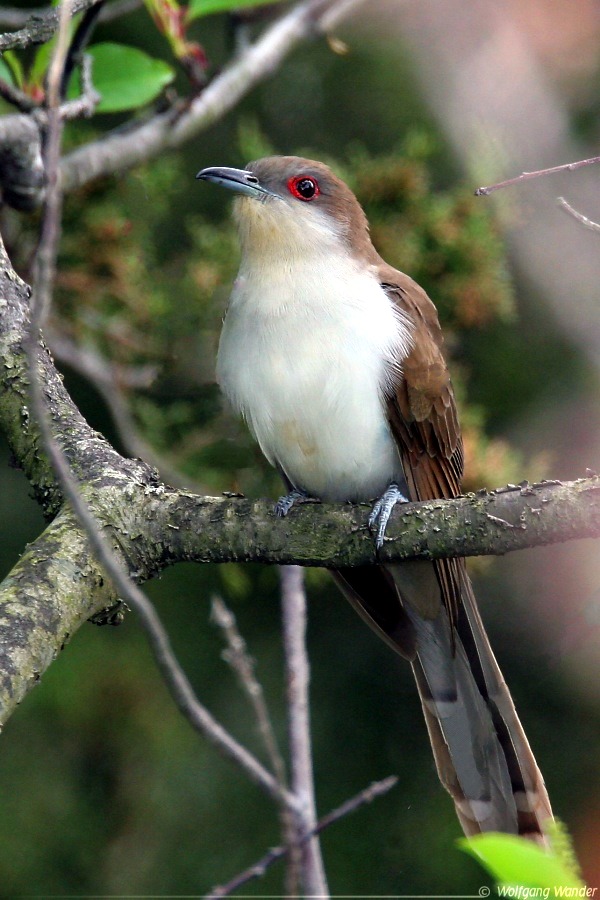
A medium-sized cuckoo closely related to yellow-billed.
§ Quick facts
§ Encyclopedia
The black-billed cuckoo is a New World species in the Cuculidae (cuckoo) family. The scientific name is from Ancient Greek. The genus name, kokkuzo, means to call like a common cuckoo, and erythropthalmus is from eruthros, "red" and ophthalmos, "eye".
Source: Wikipedia — Black-billed cuckoo Licensed under CC BY-SA 4.0
§ Identification
Field marks. Slender brown-above, white-below cuckoo with an all-dark (black) bill, a narrow red eye ring, and small white tail spots (not the bold black-and-white tail of Yellow-billed).
Similar species. Yellow-billed Cuckoo has a yellow lower bill, rufous in the wings, and big bold white tail spots; Black-billed has a dark bill, a red eye ring, and small tail spots.
Voice. A soft, rhythmic, far-carrying 'cu-cu-cu' in groups of 2–5 notes, often at night.
§ Diet & behavior
Diet. Caterpillars (especially hairy species), insects, lizards.
Behavior. A slim, skulking cuckoo of deciduous woods and thickets that feeds heavily on hairy caterpillars (even tent caterpillars); numbers rise during caterpillar outbreaks.
§ Range
Eastern North America
§ Habitat
Deciduous forests
§ Threats
Forest loss.
§ Conservation status
According to the IUCN Red List, the black-billed cuckoo is currently classified as Least Concern.
§ What helps
Support eastern forest conservation.
§ Further reading
- Wikipedia — Black-billed cuckoo
- www.allaboutbirds.org — authoritative profile of Coccyzus erythropthalmus
- IUCN Red List — search for Coccyzus erythropthalmus
- GBIF occurrence records
- Encyclopedia of Life — Coccyzus erythropthalmus
§ Sources cited
- Cornell Lab of Ornithology — All About Birds
- National Audubon Society
- iNaturalist
- IUCN Red List


