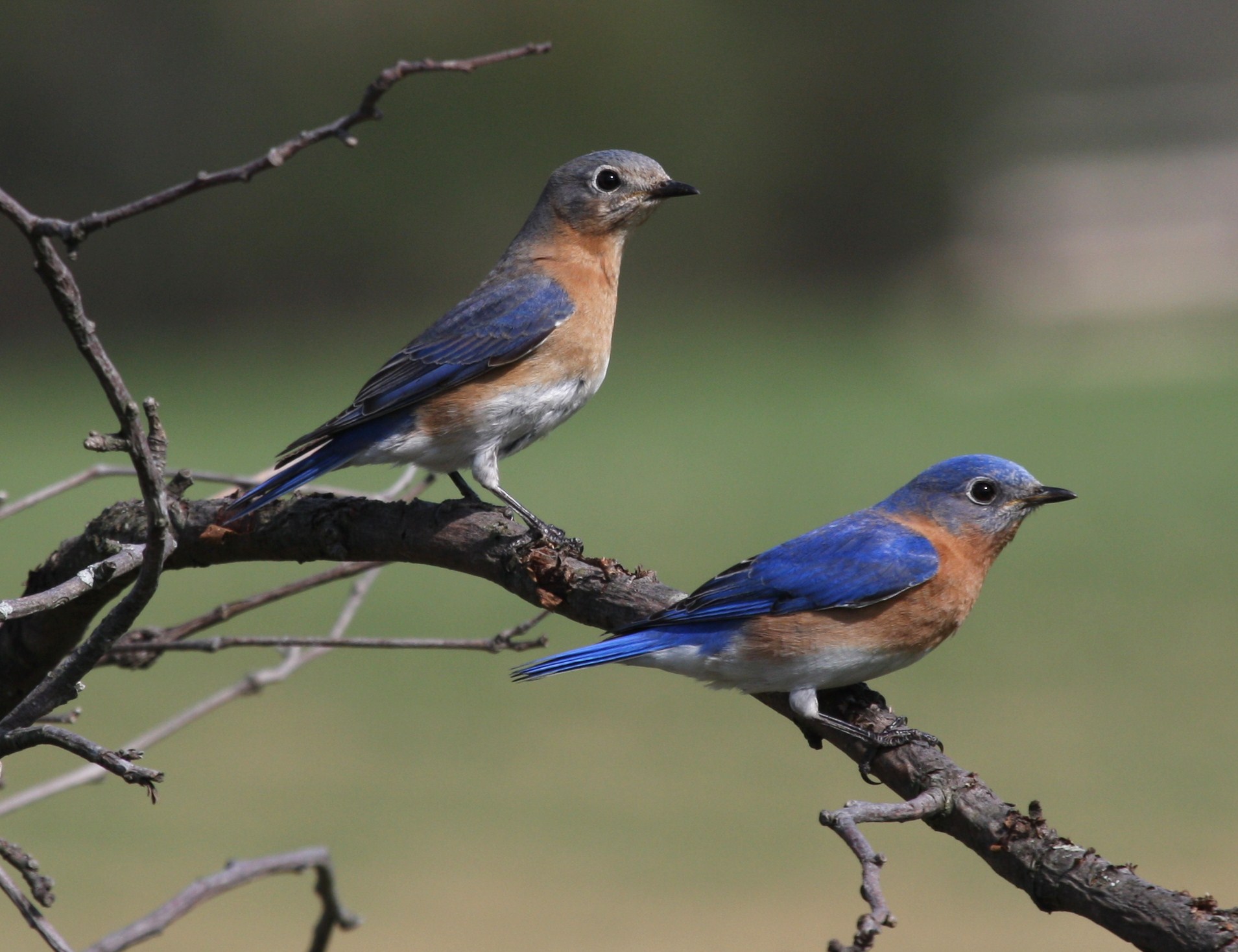
A vivid blue-and-rust thrush that nearly vanished from the eastern US in the mid-1900s due to nest competition with introduced starlings and house sparrows. Citizen-led nest box programs have dramatically restored populations.
§ Quick facts
§ Encyclopedia
The eastern bluebird is a small North American migratory thrush found in open woodlands, farmlands, and orchards.
Source: Wikipedia — Eastern bluebird Licensed under CC BY-SA 4.0
§ Identification
Field marks. Small thrush with deep blue back and head; rusty-orange throat and breast; white belly. Females duller — grayish back with blue wings and tail.
Similar species. Western Bluebird (blue throat). Mountain Bluebird (no rusty breast). Indigo Bunting (entirely blue, no orange).
Voice. Soft warbled "chur-wi" song; rich "chir-rup" calls.
§ Diet & behavior
Diet. Insects (caterpillars, beetles, grasshoppers) in warm months; berries (mistletoe, holly, sumac, dogwood) in winter.
Behavior. Cavity-nester that depends almost entirely on old woodpecker holes and (since the 1970s) backyard nest boxes. The North American Bluebird Society and the spread of nest-box trails rescued populations from severe declines caused by competition with introduced House Sparrows and European Starlings. State bird of Missouri and New York.
§ Range
Eastern North America from southern Canada to Nicaragua
§ Habitat
Open woodlands, orchards, parks, fields with scattered trees
§ Threats
Nest cavity competition with non-native birds, pesticide-driven insect declines, habitat loss.
§ Conservation status
According to the IUCN Red List, the eastern bluebird is currently classified as Least Concern.
§ What helps
Install a properly designed bluebird nest box. Skip lawn pesticides. Join the North American Bluebird Society monitoring network.
§ Further reading
- Wikipedia — Eastern bluebird
- www.allaboutbirds.org — authoritative profile of Sialia sialis
- IUCN Red List · taxon 22708557
- iNaturalist · taxon 8211
- eBird · easblu
- GBIF occurrence records
- Encyclopedia of Life — Sialia sialis
§ Sources cited
- Cornell Lab — All About Birds
- North American Bluebird Society
- National Audubon Society
- IUCN Red List 2018


