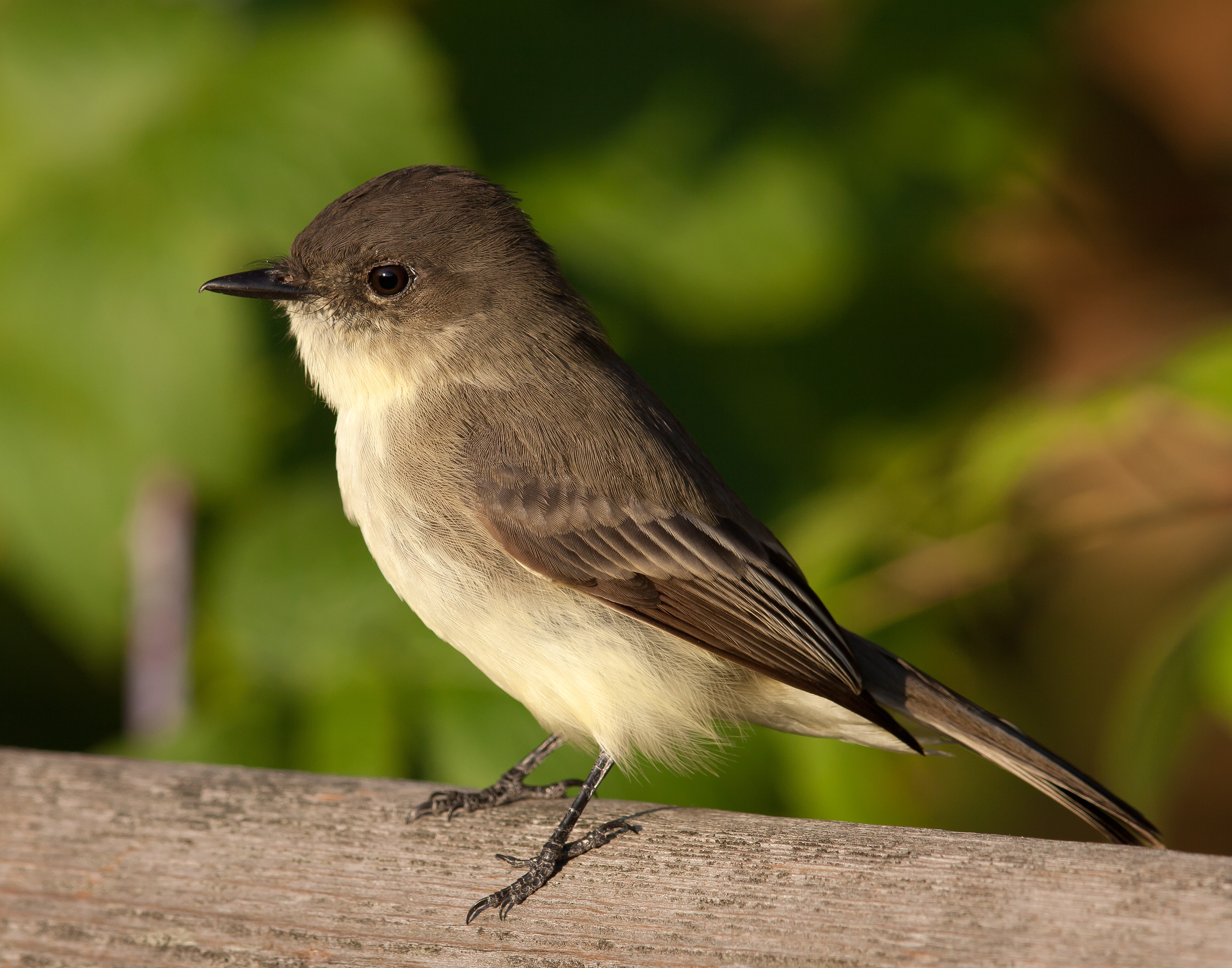
A small flycatcher that wags its tail. Builds nests of moss and mud on rocky ledges, under bridges, on buildings — comfortable around humans.
§ Quick facts
§ Encyclopedia
The eastern phoebe is a small passerine bird. The genus name Sayornis is constructed from the specific part of Charles Lucien Bonaparte's name for Say's phoebe, Muscicapa saya, and Ancient Greek ornis, "bird". Phoebe is an alternative name for the Roman moon-goddess Diana, but it may also have been chosen to imitate the bird's call.
Source: Wikipedia — Eastern phoebe Licensed under CC BY-SA 4.0
§ Identification
Field marks. Small drab gray-brown flycatcher with grayer head, white throat, pale underparts; lacks wing bars or eye ring (unlike Empidonax flycatchers). Wags tail constantly when perched.
Similar species. Empidonax flycatchers (have wing bars and eye rings). Wood-Pewees (no tail wag). Eastern Kingbird (much bolder, white tail tip).
Voice. Buzzy harsh "FEE-bee" (the second syllable lower, scratchy) — repeated emphatically from prominent perch.
§ Diet & behavior
Diet. Flying insects (caught on the wing or sallied from a perch); occasional small fruits and seeds in late fall.
Behavior. In 1804, John James Audubon attached silver wires to the legs of Eastern Phoebe nestlings near his Pennsylvania home — making them the first wild birds ever banded in North America. Two of those banded birds returned to nest near the original nest site the following year, providing the first scientific evidence of site fidelity in songbirds. Builds mud-and-moss nests on rocky ledges and increasingly on bridges, eaves, and porch lights.
§ Range
Eastern North America
§ Habitat
Open woods, forest edges, suburban yards
§ Threats
Pesticide-driven insect decline, habitat loss.
§ Conservation status
According to the IUCN Red List, the eastern phoebe is currently classified as Least Concern.
§ What helps
Maintain forest edges. Install nesting platforms under eaves. Skip pesticides.
§ Further reading
- Wikipedia — Eastern phoebe
- www.allaboutbirds.org — authoritative profile of Sayornis phoebe
- IUCN Red List · taxon 22699953
- iNaturalist · taxon 9492
- eBird · easpho
- GBIF occurrence records
- Encyclopedia of Life — Sayornis phoebe
§ Sources cited
- Cornell Lab — All About Birds
- Smithsonian Migratory Bird Center
- National Audubon Society
- IUCN Red List 2018


