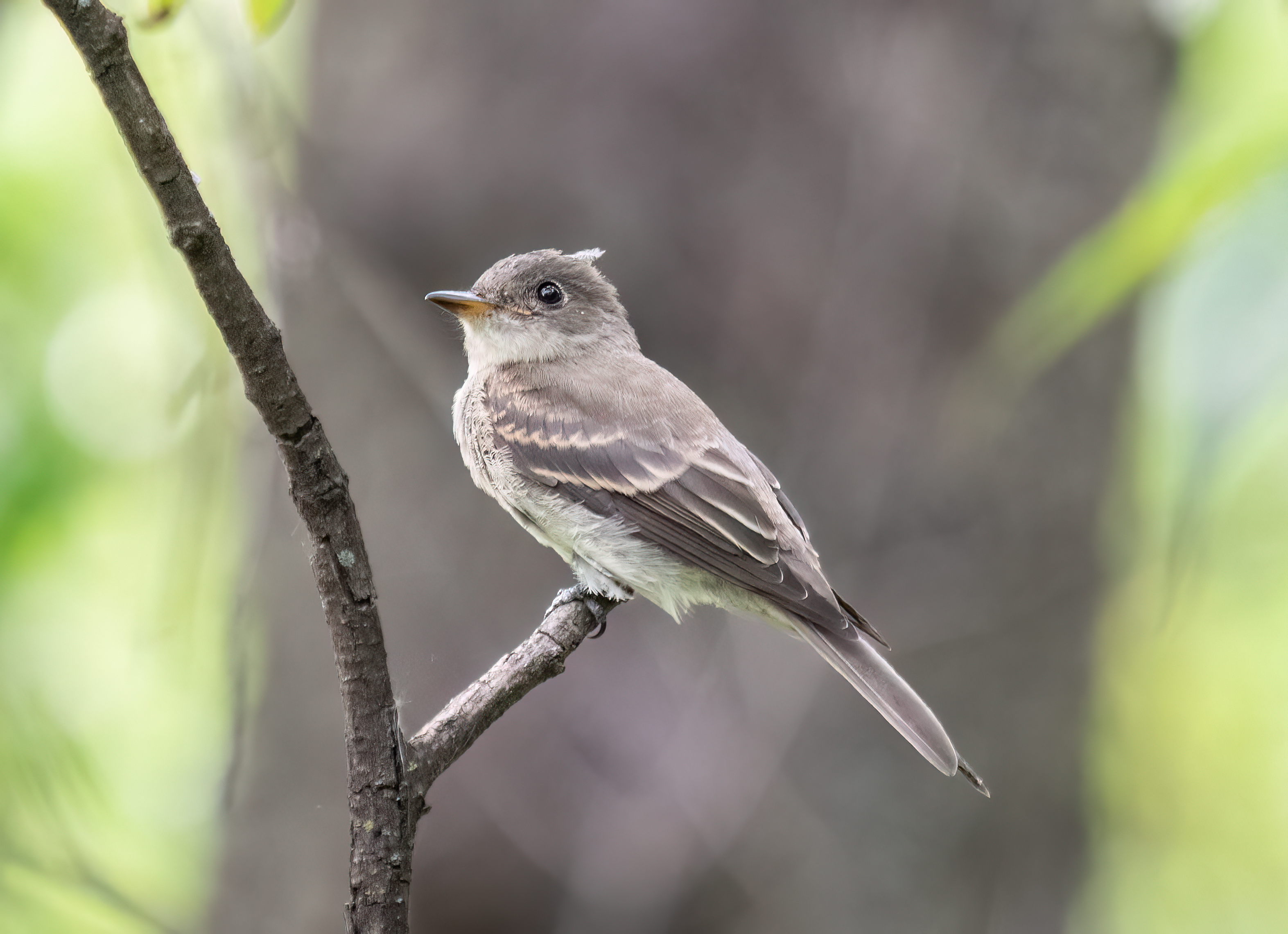
A small flycatcher whose plaintive "pee-a-wee, pee-oh" whistle is THE summer voice of eastern woods. Subtle gray-olive plumage makes them more often heard than seen.
§ Quick facts
§ Encyclopedia
The eastern wood pewee is a small tyrant flycatcher from North, Central and South America. This bird and the western wood pewee were formerly considered a single species. The two species are virtually identical in appearance, and can be distinguished most easily by their calls.
Source: Wikipedia — Eastern wood pewee Licensed under CC BY-SA 4.0
§ Identification
Field marks. Grayish-olive flycatcher with two whitish wing bars, long wings, no eye ring, and a peaked head; lower mandible mostly orange. Often appears 'vested' on the breast.
Similar species. Empidonax flycatchers (e.g., Least) are smaller with eye rings and shorter wings; pewees lack an eye ring and have longer wings.
Voice. A slow, plaintive, whistled 'pee-a-wee' ... 'pee-yur', often heard at midday.
§ Diet & behavior
Diet. Flying insects caught on the wing.
Behavior. A flycatcher of forest interiors and edges that sallies from mid-canopy perches; its plaintive whistled song is one of the most characteristic summer sounds of eastern woods.
§ Range
Eastern US and Canada in summer; winters in northern South America
§ Habitat
Deciduous and mixed forest interiors and edges
§ Threats
Mature forest loss, fragmentation, decline of large flying insects.
§ Conservation status
According to the IUCN Red List, the eastern wood-pewee is currently classified as Least Concern.
§ What helps
Maintain mature forest cover. Leave large limbs. Reduce neighborhood pesticide use.
§ Further reading
- Wikipedia — Eastern wood pewee
- www.allaboutbirds.org — authoritative profile of Contopus virens
- IUCN Red List — search for Contopus virens
- GBIF occurrence records
- Encyclopedia of Life — Contopus virens
§ Sources cited
- Cornell Lab of Ornithology — All About Birds
- National Audubon Society
- iNaturalist
- IUCN Red List


