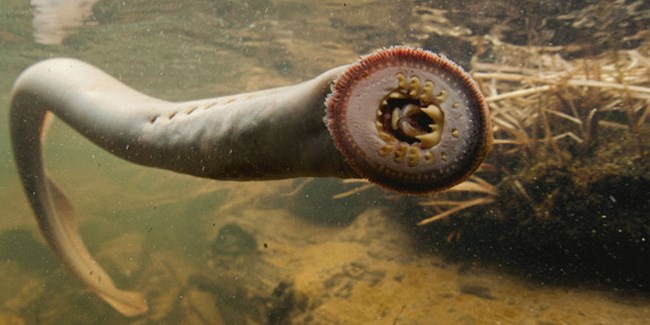
A primitive eel-like fish with circular sucker mouth and rasping tongue. Migrates between fresh and salt water.
§ Quick facts
§ Encyclopedia
The Pacific lamprey is an anadromous parasitic lamprey from the Pacific Coast of North America and Asia in an area called the Pacific Rim. It is a member of the Petromyzontidae family. The Pacific lamprey is also known as the three-tooth lamprey and tridentate lamprey.
Source: Wikipedia — Pacific lamprey Licensed under CC BY-SA 4.0
§ Identification
Field marks. Long eel-shaped fish (NOT actually an eel — different lineage); large round suctorial mouth lined with horny "teeth"; seven gill openings on each side; no paired fins.
Similar species. Other lamprey species (different ranges, sizes). Eels (different mouth, jaws, gill structure). Hagfish (also jawless but different family).
Voice. Silent.
§ Diet & behavior
Diet. Larvae: filter-feed on detritus, algae, microorganisms in stream substrate. Adults at sea: parasitic on fish (lampreys attach to host with suctorial mouth and rasp through skin to feed on flesh and blood).
Behavior. Among the most ancient living vertebrates — lineage essentially unchanged for 400+ million years. Native species of Pacific Coast rivers from Alaska to Baja. Critical cultural species for many Pacific Northwest Native American tribes (e.g., Yurok, Karuk, Yakama) — harvested traditionally for food, medicine, and ceremony for thousands of years. Populations in some river systems have declined 90%+ since the mid-1900s due to dam construction blocking migration; tribal-state-federal partnerships are restoring populations through dam modifications, lamprey-specific passage, and translocations.
§ Range
Pacific Coast
§ Habitat
Coastal rivers and Pacific Ocean
§ Threats
Dams blocking migration, pollution.
§ Conservation status
According to the IUCN Red List, the pacific lamprey is currently classified as Near Threatened.
§ What helps
Support Pacific Coast river restoration.
§ Further reading
- Wikipedia — Pacific lamprey
- www.fws.gov — authoritative profile of Entosphenus tridentatus
- IUCN Red List · taxon 11910
- iNaturalist · taxon 49551
- GBIF occurrence records
- Encyclopedia of Life — Entosphenus tridentatus
§ Sources cited
- USFWS Pacific Lamprey Conservation Initiative
- Columbia River Inter-Tribal Fish Commission
- Yakama Nation Fisheries
- IUCN Red List 2014


