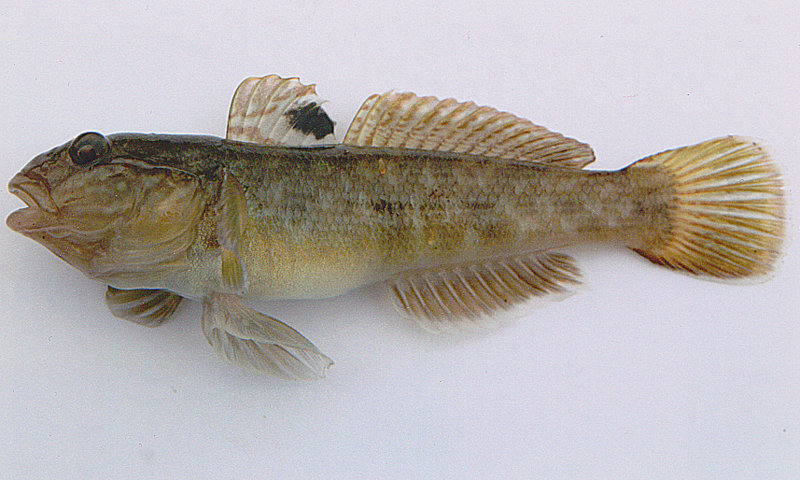
A small invasive fish from the Black Sea region. Now extremely abundant in Great Lakes; outcompetes native bottom-feeders.
§ Quick facts
§ Encyclopedia
The round goby is a euryhaline bottom-dwelling species of fish of the family Gobiidae. It is native to Central Eurasia, including the Black Sea and the Caspian Sea. Round gobies have established large non-native populations in the Baltic Sea, several major Eurasian rivers, and the North American Great Lakes.
Source: Wikipedia — Round goby Licensed under CC BY-SA 4.0
§ Identification
Field marks. Stout-bodied gray-brown fish with fused pelvic fins forming a sucker disc; large mouth; black spot on dorsal fin.
Similar species. Native sculpins (no fused pelvic disc). Native shiners and minnows (different shape).
Voice. Males make grunting sounds during territorial defense.
§ Diet & behavior
Diet. Aquatic insects, small fish, fish eggs (devastating to native fish reproduction), mollusks.
Behavior. Native to Black/Caspian/Azov Seas; introduced to Great Lakes via ballast water in early 1990s. Now extremely abundant — among the most successful aquatic invasive species in US history. Eats eggs and fry of native fish, contributing to declines of darters, sculpins, and sport fish. Has spread into all Great Lakes plus Mississippi, Hudson, and other Atlantic-draining systems.
§ Range
Native to Eurasia; invasive in Great Lakes
§ Habitat
Bottoms of Great Lakes, rivers
§ Threats
In Great Lakes: they're the threat to native species.
§ Conservation status
According to the IUCN Red List, the round goby (invasive) is currently classified as Least Concern.
§ What helps
In Great Lakes: support invasive species management.
§ Further reading
- Wikipedia — Round goby
- www.nwf.org — authoritative profile of Neogobius melanostomus
- IUCN Red List · taxon 154984
- iNaturalist · taxon 49585
- GBIF occurrence records
- Encyclopedia of Life — Neogobius melanostomus
§ Sources cited
- USGS Nonindigenous Aquatic Species
- Great Lakes Commission
- Sea Grant Programs
- IUCN Red List 2014


