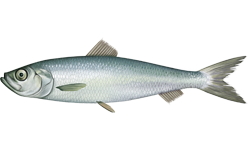
Major commercial fish of Atlantic. Critical forage species.
§ Quick facts
§ Encyclopedia
Atlantic herring is a herring in the family Clupeidae. It is one of the most abundant fish species in the world. Atlantic herrings can be found on both sides of the northern Atlantic Ocean, congregating in large schools. They can grow up to 45 centimetres (18 in) in length and weigh up to 1.1 kilograms (2.4 lb). They feed on copepods, krill and small fish, while their natural predators are seals, whales, cod and other larger fish.
Source: Wikipedia — Atlantic herring Licensed under CC BY-SA 4.0
§ Identification
Field marks. Slender silvery fish with deeply forked tail, blue-green back; single dorsal fin midway; row of small "scutes" along belly midline.
Similar species. Pacific Herring (very similar; different ocean). Sardine (smaller). Menhaden (deeper-bodied; large dark shoulder spot).
Voice. Schools produce audible high-frequency "click" trains during evening feeding.
§ Diet & behavior
Diet. Zooplankton (copepods primarily), small fish, fish larvae; filter-feeds while swimming with mouth open.
Behavior. Foundation forage fish of North Atlantic marine food webs. Forms massive schools of millions of individuals; visible from satellites. Critical prey for cod, tuna, marine mammals, and seabirds. Historic basis of North Atlantic fisheries from medieval Hanseatic League through 1800s American "herring towns." Modern harvest is largely for canned product, lobster bait, and fish meal/oil. Stock has recovered significantly under quota management since 1990s.
§ Range
North Atlantic
§ Habitat
Coastal waters
§ Threats
Overfishing.
§ Conservation status
According to the IUCN Red List, the atlantic herring is currently classified as Least Concern.
§ What helps
Buy MSC-certified herring.
§ Further reading
- Wikipedia — Atlantic herring
- www.nwf.org — authoritative profile of Clupea harengus
- IUCN Red List · taxon 155123
- iNaturalist · taxon 49441
- GBIF occurrence records
- Encyclopedia of Life — Clupea harengus
§ Sources cited
- NOAA Fisheries Northeast Region
- ICES Herring Stock Assessment
- Maine Department of Marine Resources
- IUCN Red List 2018


