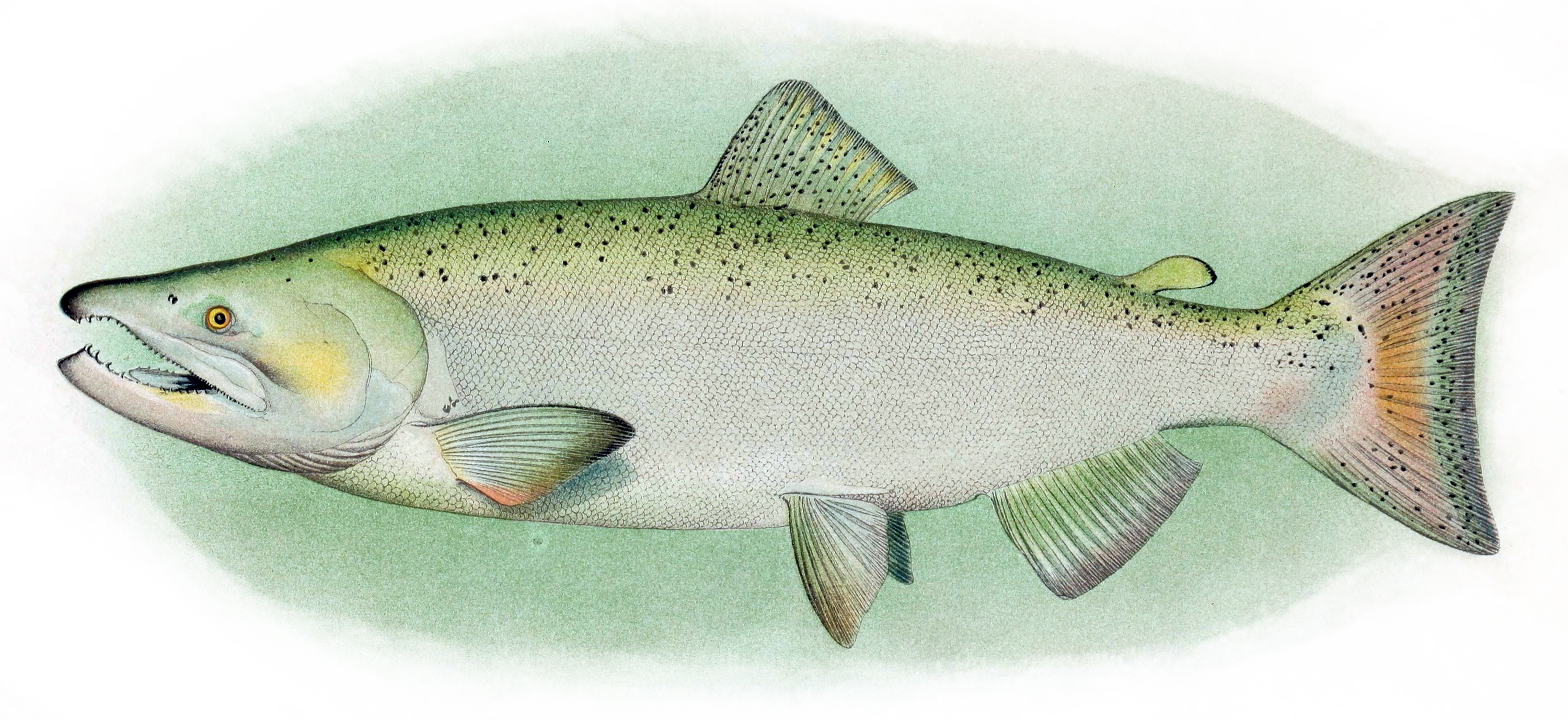
Spring-run Chinook salmon — among the most endangered salmon runs. Different populations face varied threats from dams to climate change.
§ Quick facts
§ Encyclopedia
The Chinook salmon is the largest and most valuable species of Pacific salmon. Its common name is derived from the Chinookan peoples. Other vernacular names for the species include king salmon, quinnat salmon, tsumen, spring salmon, blackmouth, and tyee salmon. The scientific species name is based on the Russian common name chavycha (чавыча).
Source: Wikipedia — Chinook salmon Licensed under CC BY-SA 4.0
§ Identification
Field marks. Olive-green back; silver sides with small black spots covering tail; black gum line ("blackmouth" — key field ID). Spawning fish develop red-brown coloration and hooked jaw in males.
Similar species. Coho Salmon (white gum line). Sockeye (different body shape, no tail spots). Pink Salmon (large oval tail spots).
Voice. Silent.
§ Diet & behavior
Diet. At sea: herring, anchovies, squid, krill. In fresh water: stops feeding entirely.
Behavior. Largest Pacific salmon species. Spring-run Chinook enter rivers in spring with bodies full of fat reserves, hold in deep pools through summer, and spawn in fall — this prolonged freshwater residency makes them uniquely vulnerable to dams, warming streams, and habitat degradation. Multiple ESA-listed populations.
§ Range
California, Pacific Northwest
§ Habitat
Pacific rivers and ocean
§ Threats
Dams blocking migration, climate change, ocean conditions.
§ Conservation status
According to the IUCN Red List, the chinook salmon (spring run) is currently classified as Endangered.
§ What helps
Support dam removals. Buy MSC-certified wild-caught salmon.
§ Further reading
- Wikipedia — Chinook salmon
- www.fws.gov — authoritative profile of Oncorhynchus tshawytscha
- IUCN Red List · taxon 135301
- iNaturalist · taxon 49583
- GBIF occurrence records
- Encyclopedia of Life — Oncorhynchus tshawytscha
§ Sources cited
- NOAA Fisheries West Coast Region
- California Department of Fish and Wildlife
- Wild Salmon Center
- IUCN Red List 2017


