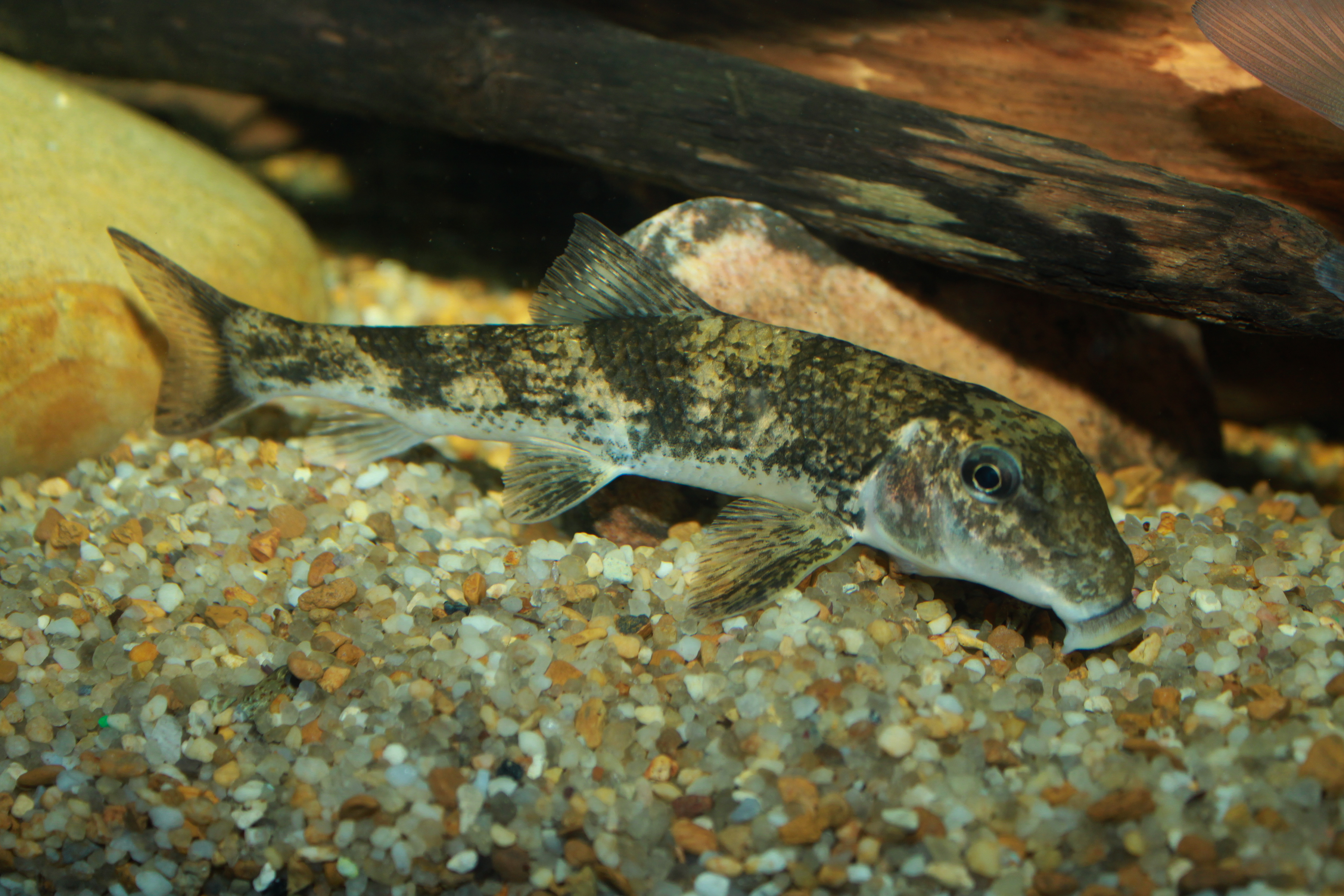
A medium-sized native sucker with distinctive long down-facing snout. Indicator of clean stream health.
§ Quick facts
§ Encyclopedia
The northern hogsucker is a freshwater ray-finned fish belonging to the family Catostomidae, the suckers. It is native to the United States and Canada where it is found in streams and rivers. It prefers clear, fast-flowing water, where it can forage on the riverbed for crustaceans, mollusks, aquatic insects, algae and detritus. It turns over small pebbles and scrapes materials off rocks and sucks up the particles, and other species of fish sometimes station themselves downstream from its activities. Breeding takes place on gravel bottoms in shallow riffles in late spring. This fish is susceptible to such man-made disturbances as channelization, sedimentation, pollution, and dam construction. However, it has a wide range and is a common species so the International Union for Conservation of Nature has rated its conservation status as being of "least concern".
Source: Wikipedia — Northern hogsucker Licensed under CC BY-SA 4.0
§ Identification
Field marks. Elongated brown-olive fish with prominent bony scutes; long pointed snout; deeply forked tail; small scales.
Similar species. Various sucker species; expert ID often needed. Logperch (different family; similar shape).
Voice. Silent.
§ Diet & behavior
Diet. Aquatic insects, snails, small crustaceans, organic detritus.
Behavior. Distinctive sucker of clean fast-flowing rivers and streams. Uses long fleshy "snout" to flip small rocks searching for aquatic insects. Among the most pollution-sensitive native fishes — a good biological indicator of healthy stream conditions. Forms small schools in clear runs.
§ Range
Eastern and central US
§ Habitat
Clear cool streams with rocky bottoms
§ Threats
Stream sedimentation, water quality decline.
§ Conservation status
According to the IUCN Red List, the northern hogsucker is currently classified as Least Concern.
§ What helps
Support clean cool streams.
§ Further reading
- Wikipedia — Northern hogsucker
- www.nwf.org — authoritative profile of Hypentelium nigricans
- IUCN Red List · taxon 202613
- iNaturalist · taxon 49595
- GBIF occurrence records
- Encyclopedia of Life — Hypentelium nigricans
§ Sources cited
- American Fisheries Society
- State wildlife agencies
- IUCN Red List 2013


