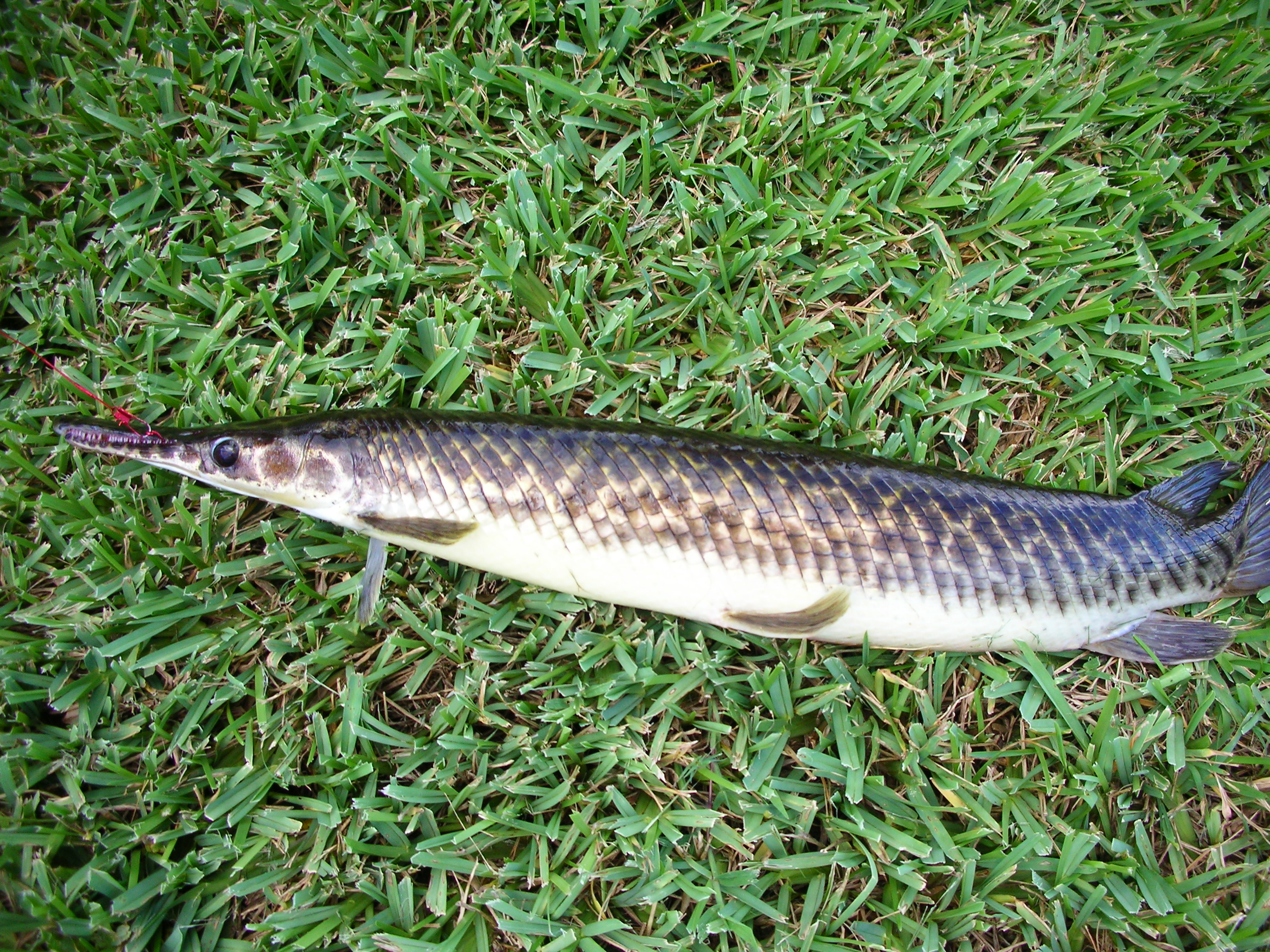
A small native gar with mottled dark patterns and a relatively short snout. Common in Florida's tannin-stained waters.
§ Quick facts
§ Encyclopedia
The Florida gar is a species of gar found in the US from the Savannah River and Ochlockonee River watersheds of Georgia and throughout peninsular Florida. Florida gar can reach a length over 3 ft (91 cm). The young feed on zooplankton and insect larvae, as well as small fish. Adults mainly eat fish, shrimp, and crayfish. Although edible, they are not popular as food. The roe is highly toxic to many animals, including humans and birds.
Source: Wikipedia — Florida gar Licensed under CC BY-SA 4.0
§ Identification
Field marks. Long slender fish with extended bony snout; armored ganoid scales; dark olive-green with dark spots on body and fins.
Similar species. Longnose Gar (different range; longer snout). Alligator Gar (much larger). Spotted Gar (broader range).
Voice. Silent.
§ Diet & behavior
Diet. Smaller fish, crustaceans, small mammals.
Behavior. Endemic to peninsular Florida and adjacent Georgia. Ambush predator with rows of needle-sharp teeth in long beak-like snout. Can breathe atmospheric air via modified swim bladder, allowing survival in oxygen-poor water bodies. Among the most ancient surviving fish lineages — gars have been on Earth ~150 million years.
§ Range
Florida and southern Georgia
§ Habitat
Lakes, ponds, slow rivers
§ Threats
Wetland drainage, water-quality decline.
§ Conservation status
According to the IUCN Red List, the florida gar is currently classified as Least Concern.
§ What helps
Maintain natural Florida waters. Don't kill native gars.
§ Further reading
- Wikipedia — Florida gar
- www.nwf.org — authoritative profile of Lepisosteus platyrhincus
- IUCN Red List · taxon 191093
- iNaturalist · taxon 49565
- GBIF occurrence records
- Encyclopedia of Life — Lepisosteus platyrhincus
§ Sources cited
- Florida FWC
- American Fisheries Society
- IUCN Red List 2010


