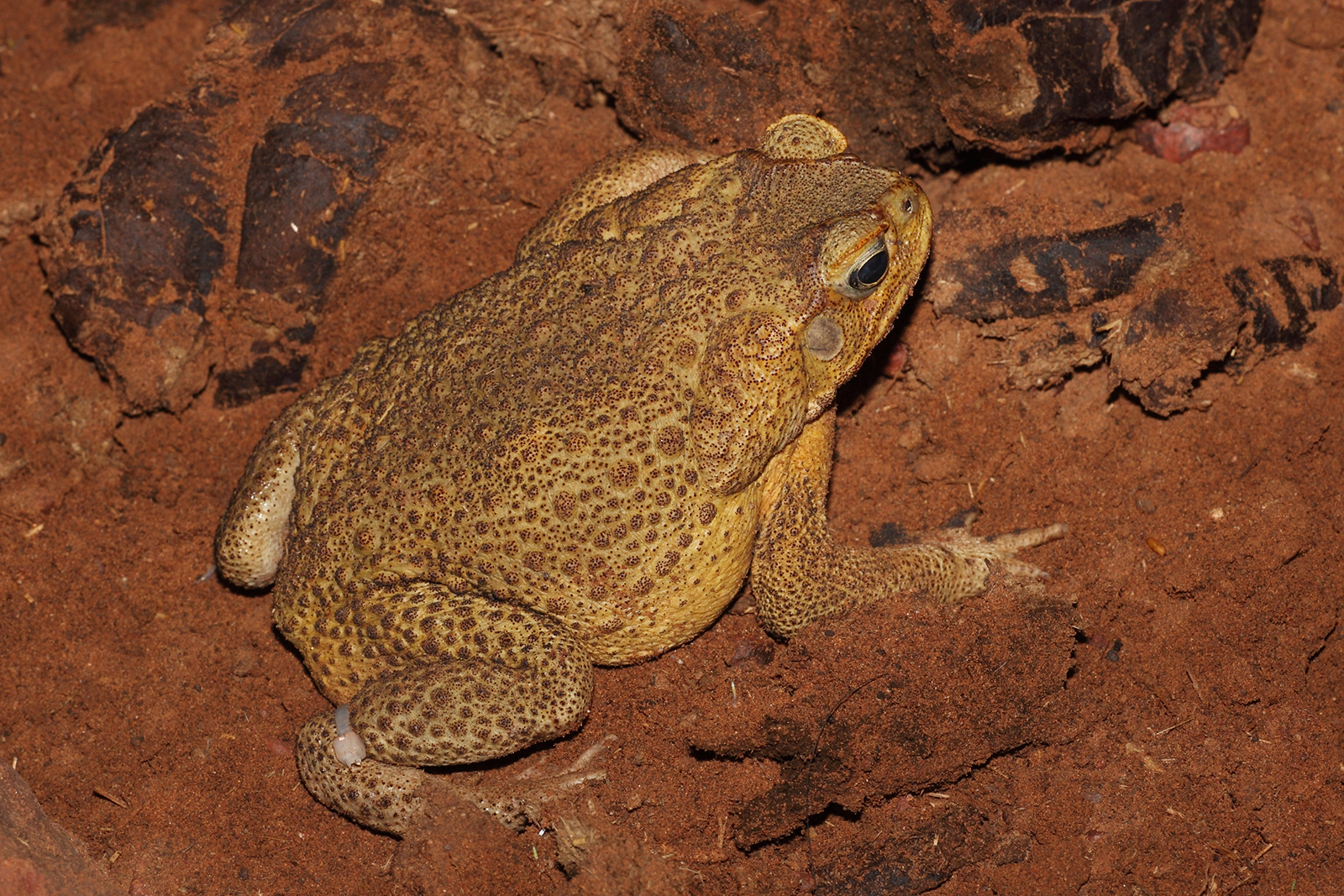
A massive invasive toad introduced to South Florida. Highly toxic — parotoid glands secrete bufotenin that can kill pets and predators.
§ Quick facts
§ Encyclopedia
The cane toad, also known as the giant neotropical toad or marine toad, is a large, terrestrial true toad native to South and mainland Central America, but which has been introduced to various islands throughout Oceania and the Caribbean, as well as Northern Australia. It is a member of the genus Rhinella, which includes many true toad species found throughout Central and South America, but it was formerly assigned to the genus Bufo.
Source: Wikipedia — Cane toad Licensed under CC BY-SA 4.0
§ Identification
Field marks. Massive warty toad with prominent triangular parotoid glands behind eyes; rough leathery brownish-tan back; pale belly with dark mottling. Much larger than any native US toad.
Similar species. Native Bufonidae (much smaller). Marine Toad (different species). No native US toad approaches this size.
Voice. Low slow trill repeated mechanically.
§ Diet & behavior
Diet. Generalist: insects, small vertebrates (small mammals, snakes, lizards), other amphibians, eggs, plants, pet food, carrion.
Behavior. Native to tropical Central and South America; introduced to many areas (including Florida and Hawaii) as biological pest control for sugarcane beetles in the early 20th century — with catastrophic consequences. Bufotoxin secreted from large parotoid glands is lethal to dogs, cats, snakes, and other native predators that try to eat them. Established invasive populations in southern Florida have spread to multiple counties.
§ Range
Native to Latin America; invasive in southern Florida
§ Habitat
Diverse: gardens, agricultural areas, suburbs
§ Threats
In Florida: they're the threat. Toxic to dogs, cats, native predators.
§ Conservation status
According to the IUCN Red List, the cane toad (invasive) is currently classified as Least Concern.
§ What helps
In Florida: report sightings to state wildlife agencies. Protect pets from contact.
§ Further reading
- Wikipedia — Cane toad
- www.nwf.org — authoritative profile of Rhinella marina
- IUCN Red List · taxon 41065
- iNaturalist · taxon 25517
- GBIF occurrence records
- Encyclopedia of Life — Rhinella marina
§ Sources cited
- USGS Nonindigenous Aquatic Species Database
- Florida Fish and Wildlife Conservation Commission
- IUCN Red List 2014


