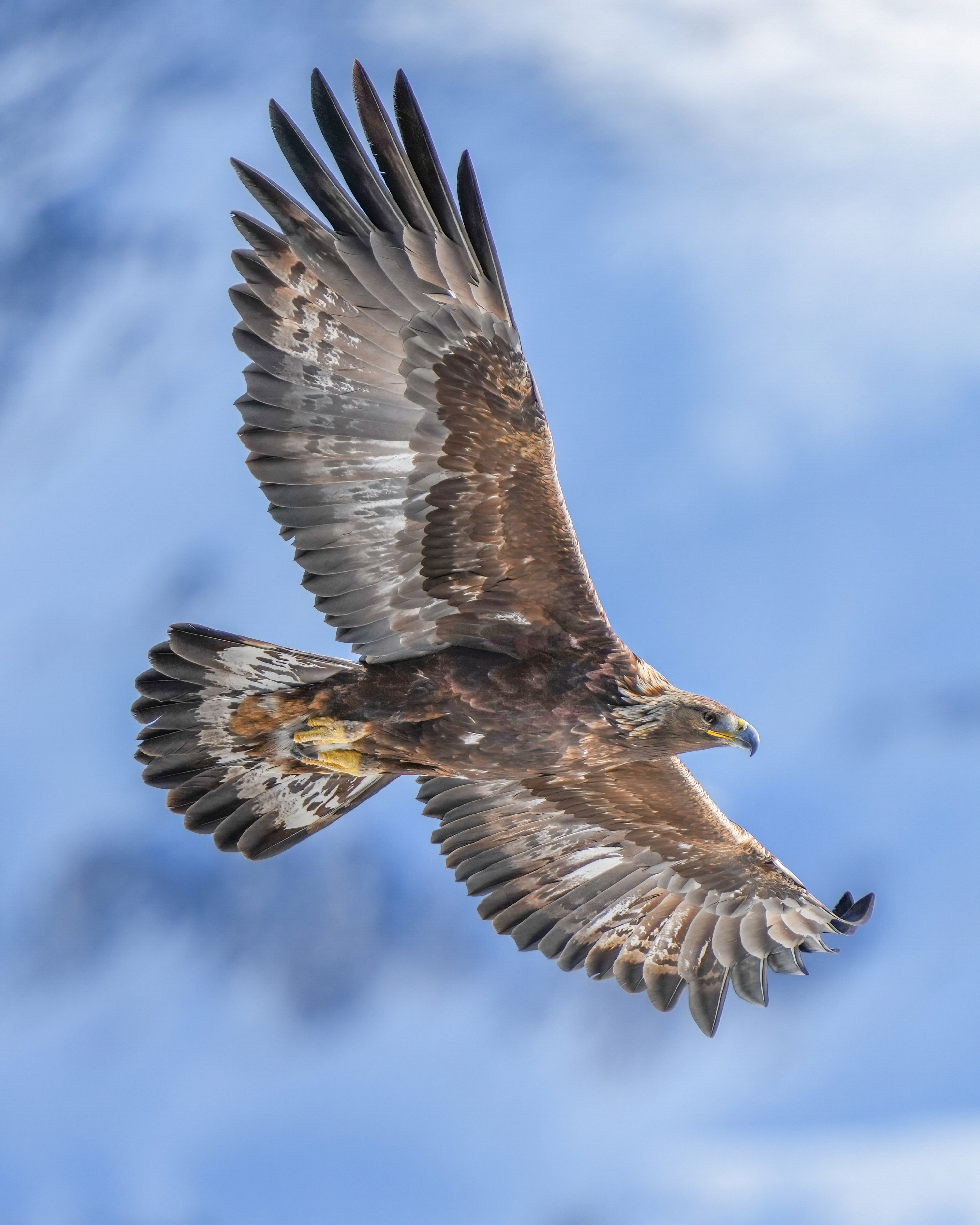
A powerful raptor with a 7-foot wingspan, the golden eagle hunts large prey from rabbits and ground squirrels to deer fawns. Native cultures across the continent regard it as sacred.
§ Quick facts
§ Encyclopedia
The golden eagle is a bird of prey living in the Northern Hemisphere. It is the most widely distributed species of eagle. Like all eagles, it belongs to the family Accipitridae. They are one of the best-known birds of prey in the Northern Hemisphere. These birds are dark brown, with lighter golden-brown plumage on their napes. Immature eagles of this species typically have white on the tail and often have white markings on the wings. Golden eagles use their agility and speed combined with powerful feet and large, sharp talons to hunt a variety of prey, mainly hares, rabbits, and marmots and other ground squirrels.
Source: Wikipedia — Golden eagle Licensed under CC BY-SA 4.0
§ Identification
Field marks. Dark brown body with golden nape; pale tan-yellow tail with darker terminal band. Massive size.
Similar species. Bald Eagle (white head and tail in adult). Turkey Vulture (red head, two-toned underwings).
Voice. Generally silent. Yelps and barks near nest.
§ Diet & behavior
Diet. Carnivorous: jackrabbits, ground squirrels, marmots, fox, occasionally newborn ungulates.
Behavior. Soars on broad wings using thermals. Migrates long distances. Pairs maintain territories over decades.
§ Range
Western North America from Alaska to Mexico, scarce in eastern US
§ Habitat
Open mountains, plateaus, canyons, prairies, and tundra
§ Threats
Wind-turbine collisions, lead poisoning from gut piles, illegal shooting, electrocution on power poles.
§ Conservation status
According to the IUCN Red List, the golden eagle is currently classified as Least Concern.
§ What helps
Use non-lead ammunition. Support raptor-safe wind farm siting. Retrofit power poles in golden eagle range.
§ Further reading
- Wikipedia — Golden eagle
- www.allaboutbirds.org — authoritative profile of Aquila chrysaetos
- IUCN Red List · taxon 22696060
- iNaturalist · taxon 5286
- eBird · goleag
- GBIF occurrence records
- Encyclopedia of Life — Aquila chrysaetos
§ Sources cited
- Cornell Lab — All About Birds
- HawkWatch International
- The Peregrine Fund
- IUCN Red List 2016


