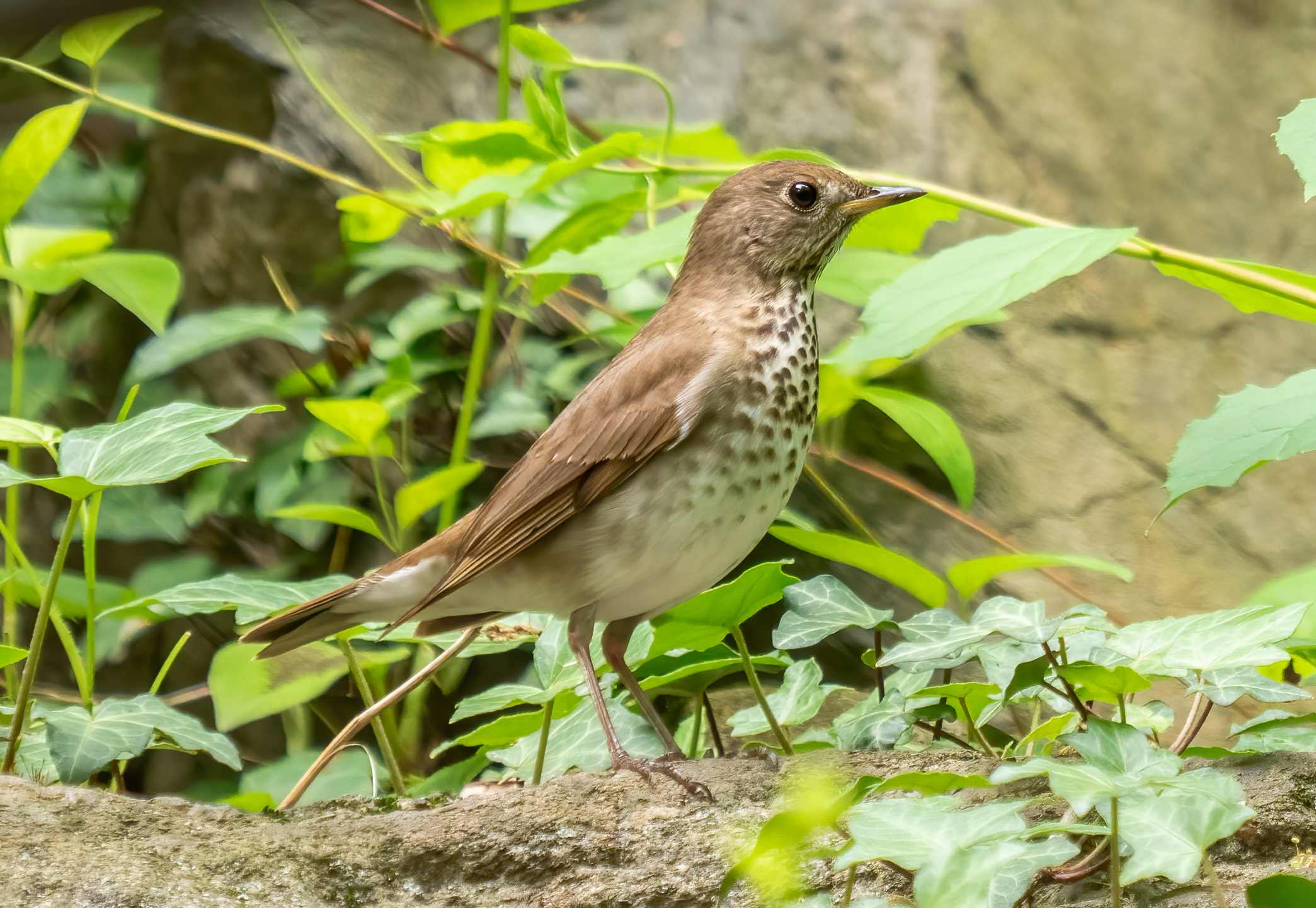
A medium-sized thrush of high-elevation boreal forests. Difficult to distinguish from Swainson's and Bicknell's thrushes; identification requires careful examination.
§ Quick facts
§ Encyclopedia
The gray-cheeked thrush is a medium-sized thrush. This species is 15–17 cm (5.9–6.7 in) in length, and has the white-dark-white underwing pattern characteristic of Catharus thrushes. It is a member of a close-knit group of migrant species together with the veery and Bicknell's thrush; it forms a cryptic species pair with the latter. The gray-cheeked thrush is all but indistinguishable from Bicknell's thrush except by its slightly larger size and different song. The two were formerly considered conspecific. Of all the American spotted thrushes, the gray-cheeked has the most northern breeding range.
Source: Wikipedia — Gray-cheeked thrush Licensed under CC BY-SA 4.0
§ Identification
Field marks. Cool gray-brown above with grayish cheeks, an indistinct grayish eye ring, and a spotted breast fading to white below; lacks warm tones.
Similar species. Swainson's Thrush has a bold buffy eye ring and buffy cheeks; Bicknell's is nearly identical and separated by range and voice; Hermit Thrush has a rusty tail.
Voice. A thin, nasal, downslurred 'wee-oh'; song a reedy, descending, slightly buzzy whirl.
§ Diet & behavior
Diet. Insects, worms, fruits.
Behavior. A shy, far-northern breeder and long-distance migrant; one of the least-known thrushes, slipping through dense cover and migrating mostly at night.
§ Range
Boreal Canada and Alaska in summer
§ Habitat
Tundra-edge forests
§ Threats
Boreal forest loss, climate change.
§ Conservation status
According to the IUCN Red List, the gray-cheeked thrush is currently classified as Least Concern.
§ What helps
Support northern boreal conservation.
§ Further reading
- Wikipedia — Gray-cheeked thrush
- www.allaboutbirds.org — authoritative profile of Catharus minimus
- IUCN Red List — search for Catharus minimus
- GBIF occurrence records
- Encyclopedia of Life — Catharus minimus
§ Sources cited
- Cornell Lab of Ornithology — All About Birds
- National Audubon Society
- iNaturalist
- IUCN Red List


