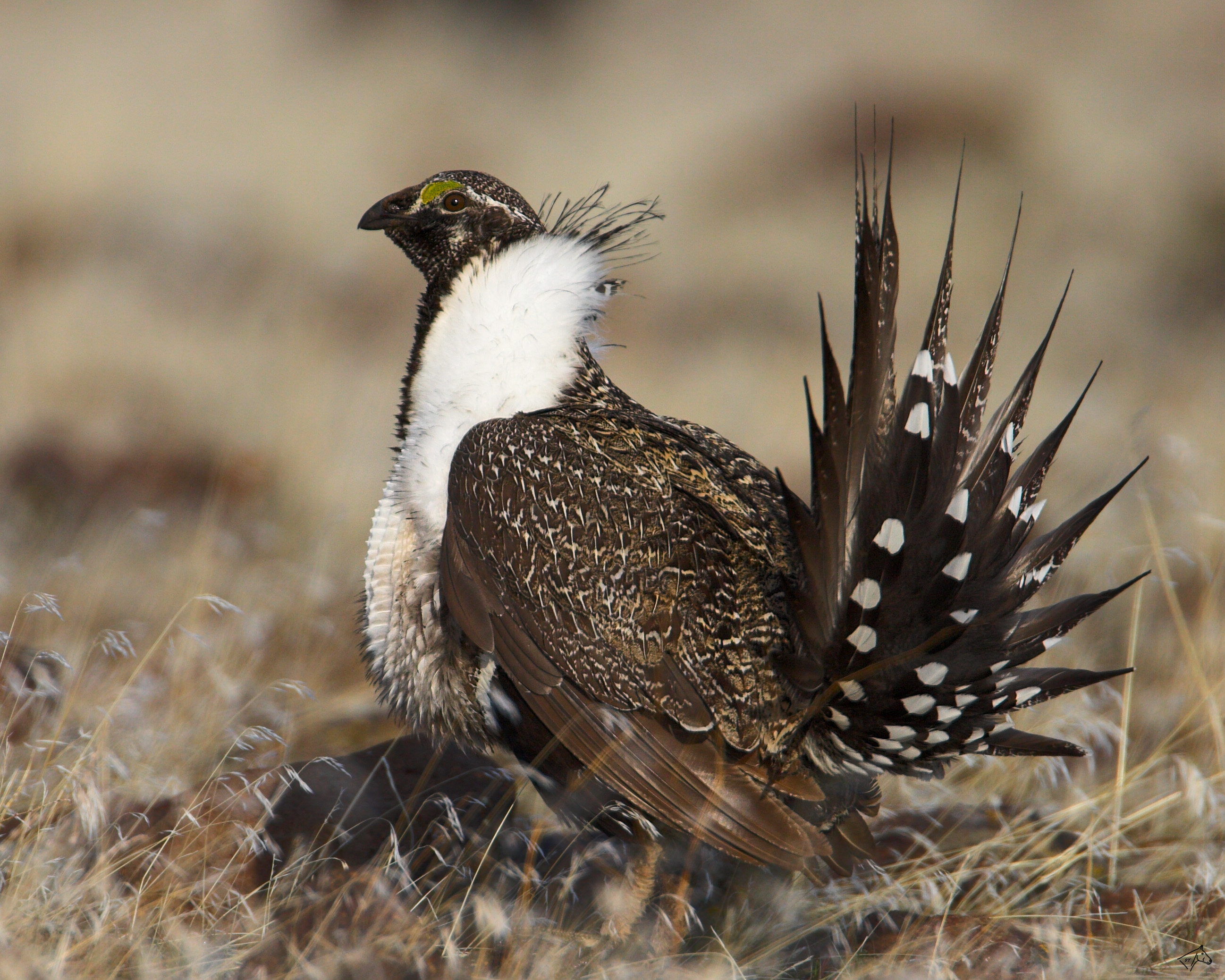
A large grouse iconic to western sagebrush country. Males perform spectacular spring displays on traditional "leks" — inflating air sacs and producing booming pops audible across miles. Habitat loss has reduced populations 80% since 1965.
§ Quick facts
§ Encyclopedia
The greater sage-grouse, also known as the sagehen, is the largest grouse in North America. Its range is sagebrush country in the western United States and southern Alberta and Saskatchewan, Canada. It was known as simply the sage grouse until the Gunnison sage-grouse was recognized as a separate species in 2000. The Mono Basin population of sage grouse may also be distinct.
Source: Wikipedia — Greater sage-grouse Licensed under CC BY-SA 4.0
§ Identification
Field marks. Massive grouse with distinctive air sacs and dramatic male displays.
Similar species. Other prairie grouse species. Greater Prairie-Chicken (less dramatic display).
Voice. Deep booming pops during lek displays.
§ Diet & behavior
Diet. Seeds, leaves, berries, insects.
Behavior. Forms large flocks in winter. Males display elaborate inflated air sacs at lek sites.
§ Range
Western sagebrush steppe (11 states)
§ Habitat
Sagebrush-dominated steppe
§ Threats
Loss of sagebrush to oil/gas, energy development, invasive cheatgrass and resulting wildfires, livestock impacts.
§ Conservation status
According to the IUCN Red List, the greater sage-grouse is currently classified as Near Threatened.
§ What helps
Support sagebrush conservation. Oppose unmitigated energy development. Donate to Western Watersheds Project.
§ Further reading
- Wikipedia — Greater sage-grouse
- www.fws.gov — authoritative profile of Centrocercus urophasianus
- IUCN Red List · taxon 22679503
- iNaturalist · taxon 896
- eBird · gnogro
- GBIF occurrence records
- Encyclopedia of Life — Centrocercus urophasianus
§ Sources cited
- Cornell Lab — All About Birds
- USFWS
- IUCN Red List 2016


