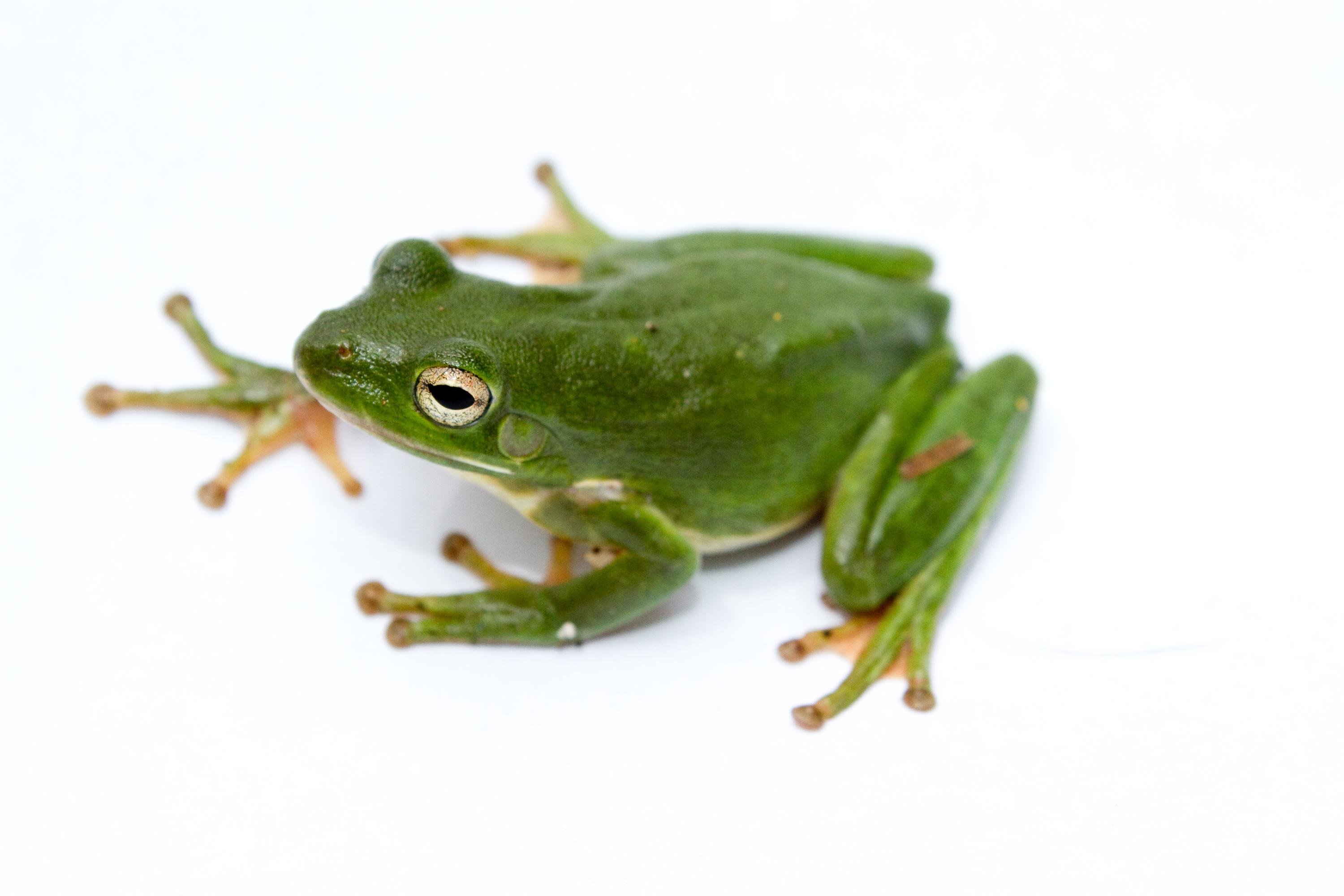
A bright lime-green frog with a creamy-white side stripe. The state amphibian of Georgia and Louisiana — and a beloved presence on porch lights, where they hunt insects drawn to the glow.
§ Quick facts
§ Encyclopedia
The American green tree frog is a common arboreal species of New World tree frog belonging to the family Hylidae. This nocturnal insectivore is moderately sized and has a bright green to reddish-brown coloration. Sometimes, light yellowish spots are present on the dorsum. Commonly found in the central and southeastern United States, the frog lives in open canopy forests with permanent water sources and abundant vegetation. The American green tree frog is strictly aquatic during the hibernating and mating seasons. When defending its territory, the frog either emits aggressive call signals or resolves to grapple with intruders, seldom leading to injury or death. To avoid predation, the frog will leap into the water or jump into the treetops.
Source: Wikipedia — American green tree frog Licensed under CC BY-SA 4.0
§ Identification
Field marks. Bright green tree frog with white or yellow lateral stripes; large adhesive toe pads.
Similar species. Squirrel Tree Frog (smaller, less green). American Green Tree Frog (vs. Cuban — much smaller).
Voice. Loud "geep-geep-geep" calls. State amphibian of Georgia and Louisiana.
§ Diet & behavior
Diet. Small insects, spiders.
Behavior. Bright green tree frog of southeastern wetlands. Males call from elevated perches above ponds.
§ Range
Coastal Plain of southeastern US — VA to TX
§ Habitat
Wetlands, swamps, gardens with water features; commonly seen on windows at night
§ Threats
Pesticides, light-pollution disruption (counterintuitively), wetland loss.
§ Conservation status
According to the IUCN Red List, the green treefrog is currently classified as Least Concern.
§ What helps
Maintain a backyard pond. Skip lawn pesticides. Use yellow "bug-light" porch bulbs to reduce attraction overload.
§ Further reading
- Wikipedia — American green tree frog
- www.nwf.org — authoritative profile of Hyla cinerea
- IUCN Red List · taxon 55530
- iNaturalist · taxon 25534
- GBIF occurrence records
- Encyclopedia of Life — Hyla cinerea
§ Sources cited
- USGS ARMI
- AmphibiaWeb
- iNaturalist
- IUCN Red List 2014


