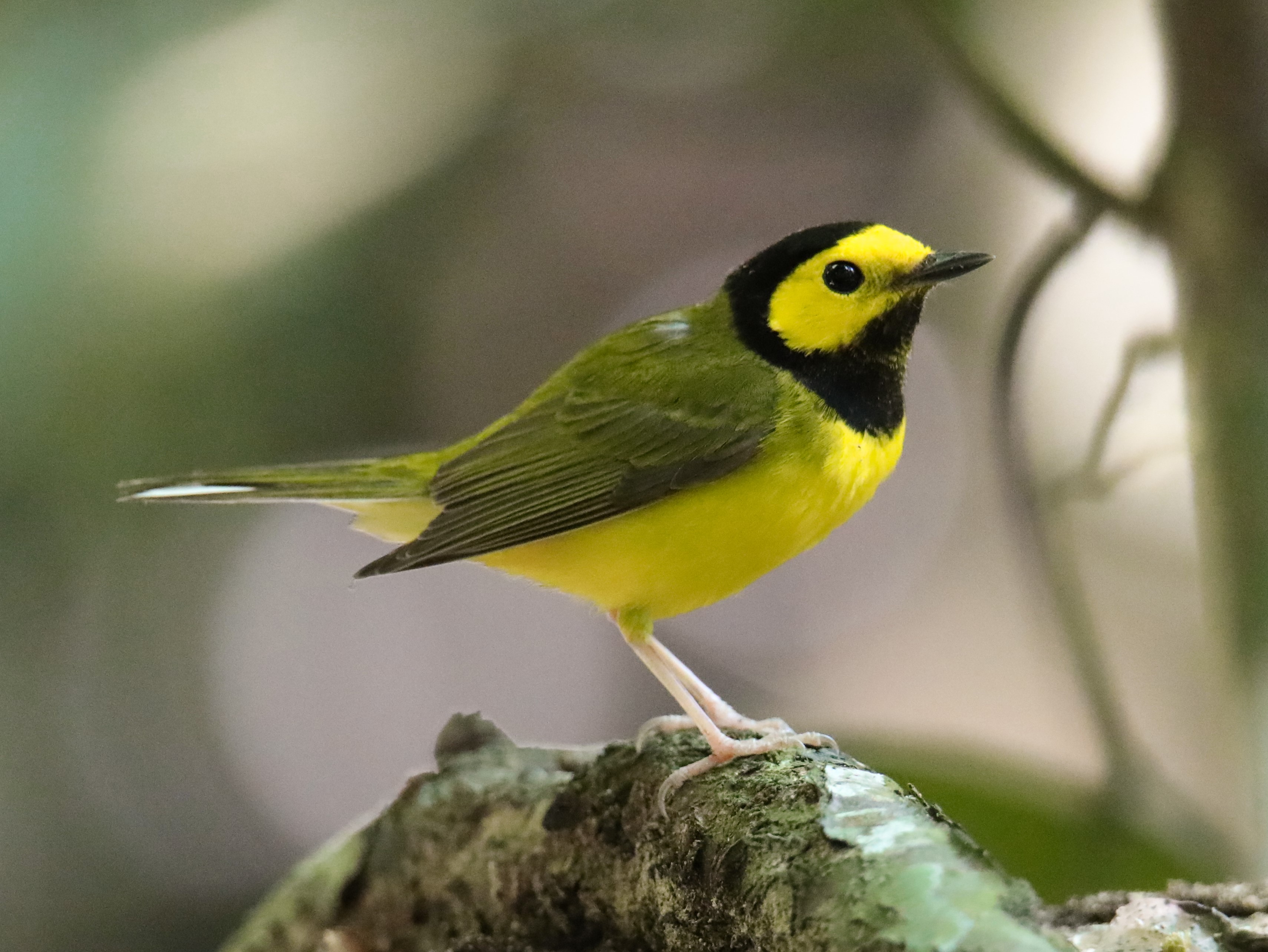
A striking warbler — males have a black hood enclosing a bright yellow face. Singers of dense understory whose ringing "weeta-weeta-wee-tee-oh" defines mature southern hardwoods.
§ Quick facts
§ Encyclopedia
The hooded warbler is a New World warbler. It breeds in eastern North America across the eastern United States and into southernmost Canada (Ontario). It is migratory, wintering in Central America and the West Indies. Hooded warblers are very rare vagrants to western Europe.
Source: Wikipedia — Hooded warbler Licensed under CC BY-SA 4.0
§ Identification
Field marks. Bright yellow face and underparts; male has a full black hood and throat surrounding the yellow face. Females show variable or no hood. Large dark eye, white tail flashes.
Similar species. Wilson's Warbler has a black cap but no hood/throat collar and lacks white in the tail.
Voice. A loud, musical, ringing 'wheeta-wheeta-whee-TEE-o'.
§ Diet & behavior
Diet. Insects (caterpillars primary), spiders, occasional berries on migration.
Behavior. A bird of the shaded forest understory; constantly fans its tail open and shut, flashing the white outer tail feathers while foraging for insects in the shrub layer.
§ Range
Eastern US in summer; winters in Central America and Caribbean
§ Habitat
Mature deciduous forest understory with dense shrub layer
§ Threats
Loss of mature deciduous forests, understory simplification by deer overbrowsing, tropical wintering forest loss.
§ Conservation status
According to the IUCN Red List, the hooded warbler is currently classified as Least Concern.
§ What helps
Support large-block forest protection. Advocate for deer population management. Maintain native shrub understory.
§ Further reading
- Wikipedia — Hooded warbler
- www.allaboutbirds.org — authoritative profile of Setophaga citrina
- IUCN Red List — search for Setophaga citrina
- GBIF occurrence records
- Encyclopedia of Life — Setophaga citrina
§ Sources cited
- Cornell Lab of Ornithology — All About Birds
- National Audubon Society
- iNaturalist
- IUCN Red List


