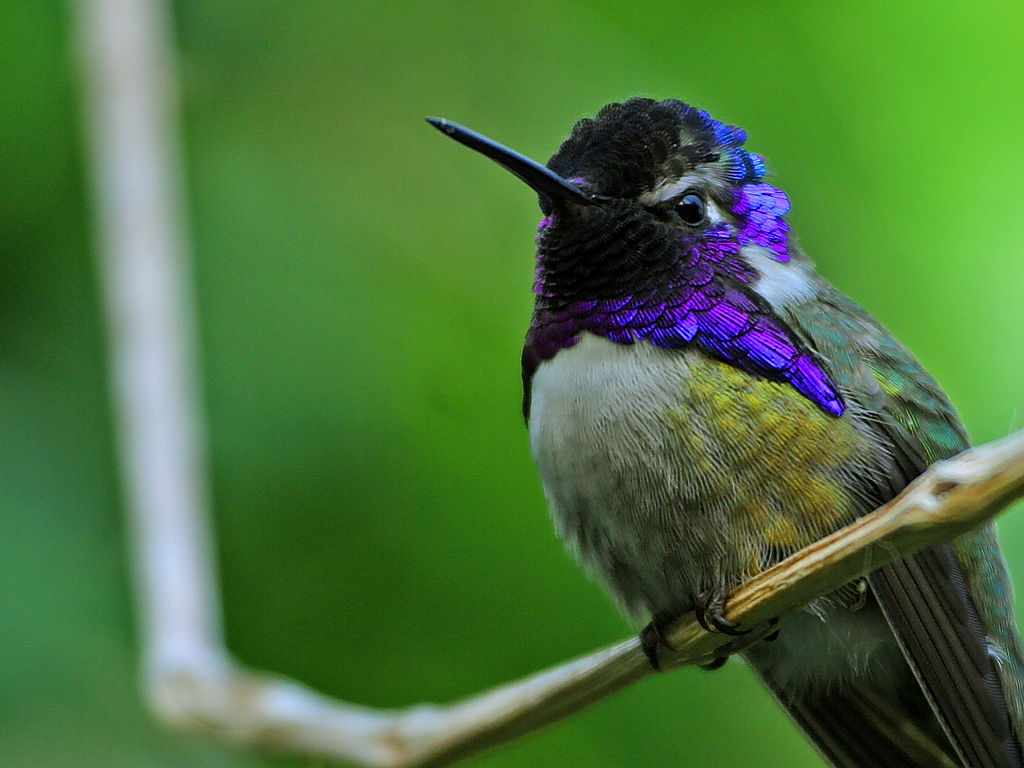
A small desert hummingbird; males have distinctive purple gorget extending below chin like a beard.
§ Quick facts
§ Encyclopedia
Costa's hummingbird is a species of hummingbird in the family Trochilidae. It breeds in the arid, semi-arid and Mediterranean climate zones of the Southwestern United States and northwestern Mexico, mainly in Southern California and the Baja California Peninsula. Like many hummingbirds in the region, it can be found on the Pacific coast, often visiting backyard hummingbird feeders and gardens with flowering plants, as well as in more wild ecosystems, such as the conifer and oak forests, chaparral, and high desert habitats found further inland. When not in the US, the species often winters in western Mexico.
Source: Wikipedia — Costa's hummingbird Licensed under CC BY-SA 4.0
§ Identification
Field marks. Compact hummingbird; male has a brilliant purple crown and a flaring purple gorget that extends far down the sides of the throat ('mustache'). Female plain grayish-green and pale below.
Similar species. Anna's Hummingbird male has a rose-red (not purple) gorget that does not flare so far; the flaring purple 'mustache' is diagnostic for Costa's.
Voice. Male gives a high, thin, whistled 'zinging' note in display; call a light 'tik'.
§ Diet & behavior
Diet. Flower nectar; small insects and spiders for protein.
Behavior. A hummingbird of the Sonoran and Mojave deserts; breeds early to match desert bloom and the male displays with a high, whistling dive.
§ Range
Southwestern US, Mexico
§ Habitat
Desert areas
§ Threats
Habitat loss to development, climate change.
§ Conservation status
According to the IUCN Red List, the costa's hummingbird is currently classified as Least Concern.
§ What helps
Maintain native desert plantings.
§ Further reading
- Wikipedia — Costa's hummingbird
- www.allaboutbirds.org — authoritative profile of Calypte costae
- IUCN Red List — search for Calypte costae
- GBIF occurrence records
- Encyclopedia of Life — Calypte costae
§ Sources cited
- Cornell Lab of Ornithology — All About Birds
- National Audubon Society
- iNaturalist
- IUCN Red List


