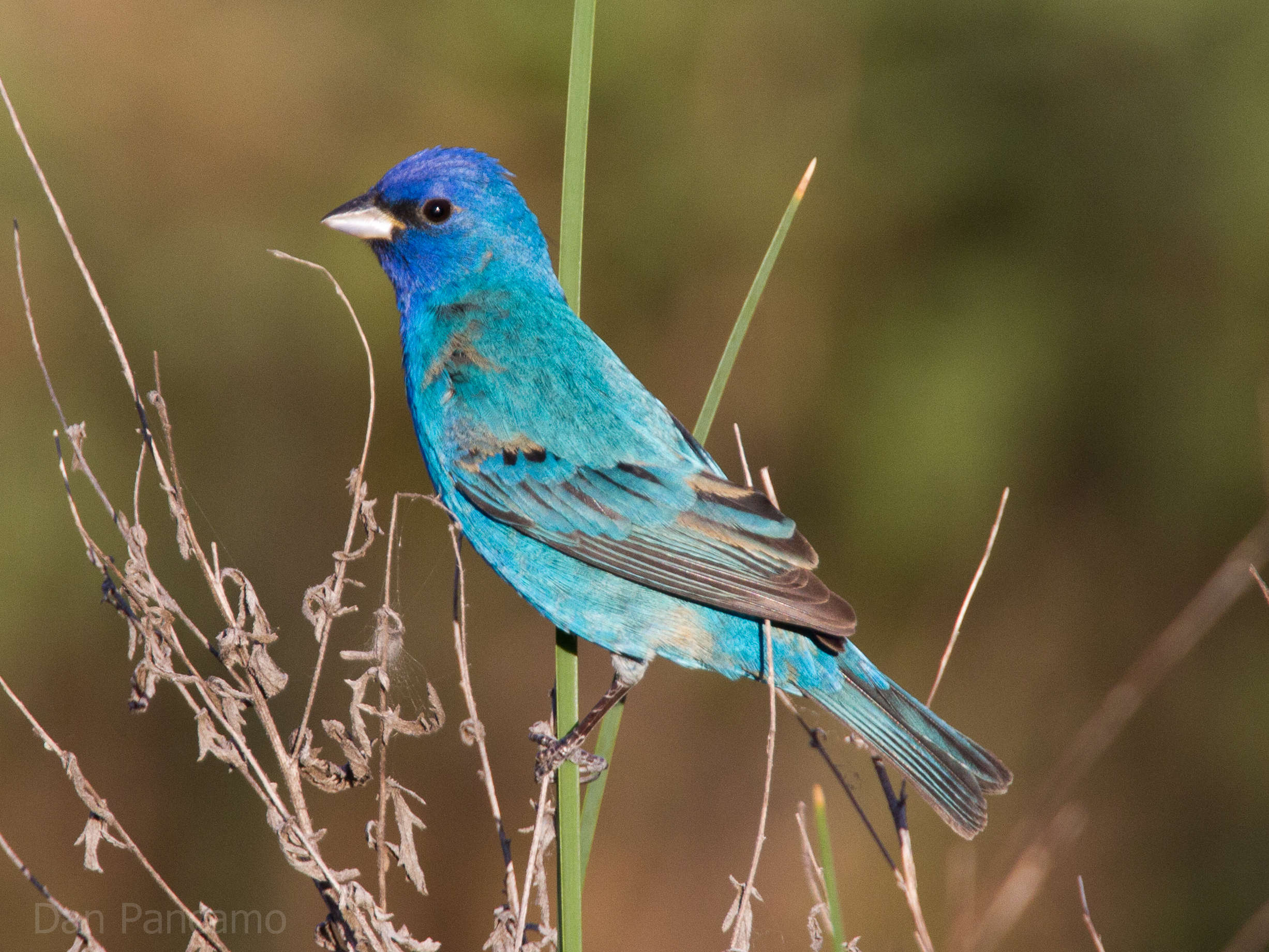
A breeding-season miracle: males are bright cobalt blue (actually a structural color, not a pigment — feathers are technically brown). Indigo buntings learn songs from neighbors and develop regional "dialects."
§ Quick facts
§ Encyclopedia
The indigo bunting is a small seed-eating bird in the cardinal family, Cardinalidae. It is migratory, ranging from southern Canada to northern Florida during the breeding season, and from southern Florida to northern South America during the winter. It often migrates by night, using the stars to navigate. Its habitat is farmland, brush areas, and open woodland. The indigo bunting is closely related to the lazuli bunting and interbreeds with the species where their ranges overlap.
Source: Wikipedia — Indigo bunting Licensed under CC BY-SA 4.0
§ Identification
Field marks. Small bunting. Adult males in breeding plumage: brilliant indigo blue all over — actually black with refractive feather structure scattering blue light. Females and immature males: warm brown, no blue.
Similar species. Blue Grosbeak (larger, rusty wing bars). Lazuli Bunting (orange chest). Bluebirds (different shape, rusty breast).
Voice. Crisp paired warbled phrases — "fire fire, where where, here here."
§ Diet & behavior
Diet. Insects and spiders in summer; seeds (small grass and weed seeds) in winter.
Behavior. Males sing from highest available perches; songs are passed down through "song neighborhoods" — males within ~500 m share virtually identical songs, while distant populations sound noticeably different. Migrates by night, navigating by the stars (verified in classic 1960s experiments using a planetarium); the polestar (Polaris) is the primary reference point.
§ Range
Eastern and central US in summer; Central America in winter
§ Habitat
Forest edges, brushy fields, hedgerows, roadsides
§ Threats
Climate-driven mismatches with insect emergence, habitat fragmentation, light pollution disrupting migration.
§ Conservation status
According to the IUCN Red List, the indigo bunting is currently classified as Least Concern.
§ What helps
Maintain forest edges and brushy field margins. Reduce nighttime light pollution during migration seasons. Plant native shrubs.
§ Further reading
- Wikipedia — Indigo bunting
- www.allaboutbirds.org — authoritative profile of Passerina cyanea
- IUCN Red List · taxon 22723954
- iNaturalist · taxon 9598
- eBird · indbun
- GBIF occurrence records
- Encyclopedia of Life — Passerina cyanea
§ Sources cited
- Cornell Lab — All About Birds
- Emlen migration navigation studies
- National Audubon Society
- IUCN Red List 2018


