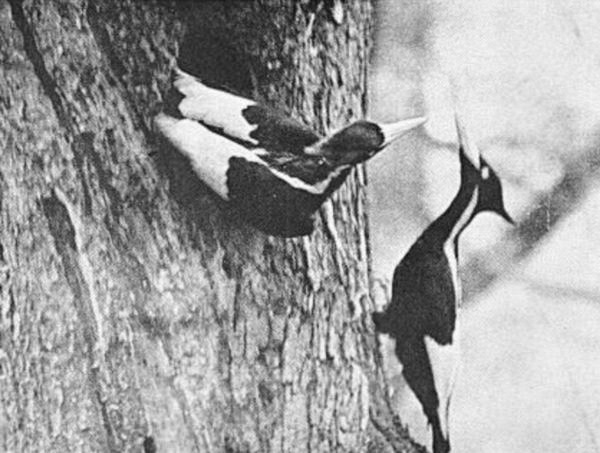
Largest woodpecker historically native to North America. Almost certainly extinct since 1944 (last confirmed sighting). USFWS declared extinct in 2021; ruling reversed pending review.
§ Quick facts
§ Encyclopedia
The ivory-billed woodpecker is a woodpecker native to the Southern United States and Cuba. Habitat destruction and hunting have reduced populations so severely that the last universally accepted sighting in the United States was in 1944, and the last universally accepted sighting in Cuba was in 1987.
Source: Wikipedia — Ivory-billed woodpecker Licensed under CC BY-SA 4.0
§ Identification
Field marks. Massive black woodpecker with broad white wing patches (most visible in flight), white back stripes, ivory-white bill. Males have brilliant red crest; females black crest. Very different from Pileated Woodpecker (mostly black wings with white only on underwing linings).
Similar species. Pileated Woodpecker (smaller, mostly-black wings in flight, dark bill). No other US woodpecker has the ivory-bill's combination of size and white wing pattern.
Voice. Historic recordings: nasal "kent" call, said to resemble a child's toy trumpet.
§ Diet & behavior
Diet. Beetle larvae from large recently-dead trees; some fruit.
Behavior. Last universally accepted US sighting was 1944 in Louisiana's Singer Tract. The bird requires vast tracts of mature bottomland hardwood forest — habitat almost entirely destroyed by 1950. Cuban subspecies last seen 1987 and presumed extinct. Periodic reported US sightings (most famously Arkansas 2004–2005) have not been confirmed with definitive evidence. USFWS proposed extinction declaration in 2021; final ruling delayed pending review.
§ Range
Southeastern US (likely extinct)
§ Habitat
Bottomland hardwood forests
§ Threats
Logging destroyed essential old-growth bottomland habitat by 1940s.
§ Conservation status
According to the IUCN Red List, the ivory-billed woodpecker (likely extinct) is currently classified as Critically Endangered.
§ What helps
Support remaining bottomland forest. Donate to USFWS extinction documentation programs.
§ Further reading
- Wikipedia — Ivory-billed woodpecker
- www.fws.gov — authoritative profile of Campephilus principalis
- IUCN Red List · taxon 22681425
- iNaturalist · taxon 18173
- eBird · ivbwoo
- GBIF occurrence records
- Encyclopedia of Life — Campephilus principalis
§ Sources cited
- USFWS Ivory-billed Woodpecker Profile
- Cornell Lab Search Project
- IUCN Red List 2020


