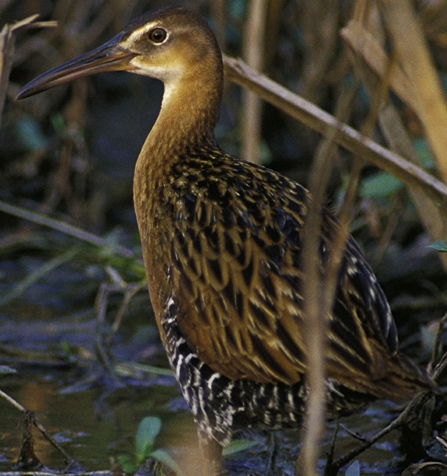
Largest North American rail. Heavy-bodied, cinnamon-brown. Difficult to spot — secretive among marsh vegetation. Populations declining 80%+ since 1966.
§ Quick facts
§ Encyclopedia
The king rail is a waterbird, the largest North American rail.
Source: Wikipedia — King rail Licensed under CC BY-SA 4.0
§ Identification
Field marks. Large rusty rail with a long slightly decurved bill, rich cinnamon breast, and boldly black-and-white barred flanks; brownish above with dark streaks.
Similar species. Clapper Rail is grayer and lives in salt marsh; Virginia Rail is much smaller. The King Rail is large, rusty, and tied to fresher marsh.
Voice. A series of harsh, grunting 'kek-kek-kek' notes, slowing at the end.
§ Diet & behavior
Diet. Omnivorous: aquatic plants, insects, small invertebrates.
Behavior. The largest North American rail, a secretive bird of freshwater and brackish marshes; far more often heard than seen as it slips through dense cattails and cordgrass.
§ Range
Eastern US wetlands
§ Habitat
Coastal salt marshes, freshwater marshes
§ Threats
Wetland drainage, sea-level rise, agricultural runoff.
§ Conservation status
According to the IUCN Red List, the king rail is currently classified as Near Threatened.
§ What helps
Support marsh restoration. Donate to wetland conservation.
§ Further reading
- Wikipedia — King rail
- www.allaboutbirds.org — authoritative profile of Rallus elegans
- IUCN Red List — search for Rallus elegans
- GBIF occurrence records
- Encyclopedia of Life — Rallus elegans
§ Sources cited
- Cornell Lab of Ornithology — All About Birds
- National Audubon Society
- iNaturalist
- IUCN Red List


