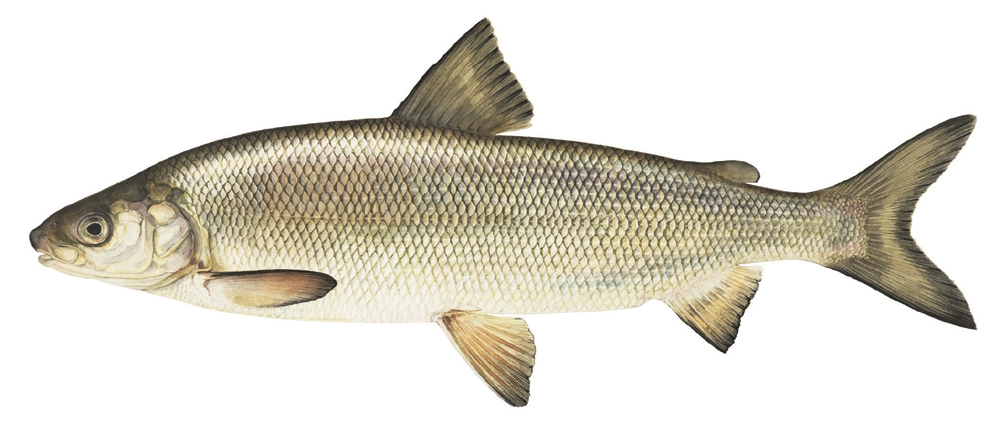
A silvery deep-bodied whitefish that's historically supported one of the most important Great Lakes commercial fisheries. Native populations are stable but declining in some Great Lakes.
§ Quick facts
§ Encyclopedia
The lake whitefish is a species of freshwater whitefish from North America. Lake whitefish are found throughout much of Canada and parts of the northern United States, including all of the Great Lakes. The lake whitefish is sometimes referred to as a "humpback" fish due because of its small head size in relation to the length of the body. It is a valuable commercial fish and also occasionally taken by sport fishermen. Smoked, refrigerated, or vacuum-packed lake whitefish fillets are available in North American grocery stores. Other vernacular names used for this fish include Otsego bass, Sault whitefish, gizzard fish, common whitefish, eastern whitefish, Great Lakes whitefish, humpback whitefish, inland whitefish and whitefish.
Source: Wikipedia — Lake whitefish Licensed under CC BY-SA 4.0
§ Identification
Field marks. Slim deep-bodied silvery fish with small head, small mouth, deeply forked tail, adipose fin between dorsal and tail. Dorsal coloration grayish-olive; flanks silvery; belly white.
Similar species. Round Whitefish (cylindrical body; smaller). Cisco/Lake Herring (similar but smaller; different mouth). Mountain Whitefish (western range; different shape).
Voice. Silent.
§ Diet & behavior
Diet. Aquatic insects (especially midge larvae), small crustaceans, snails, fish eggs.
Behavior. Most important commercial whitefish in the Great Lakes — historically supported one of the largest US freshwater fisheries. Populations devastated by sea lamprey predation (post-Welland Canal opening 1932), invasive zebra and quagga mussels (disrupting food webs since 1990s), and warming water temperatures. Spawns over rocky shoals in late fall when water cools to 4–8°C. Federally co-managed with Native American tribal nations under treaty rights.
§ Range
Great Lakes, Canadian boreal lakes
§ Habitat
Deep cold lakes
§ Threats
Sea lamprey predation, invasive mussels altering food webs, climate-driven warming.
§ Conservation status
According to the IUCN Red List, the lake whitefish is currently classified as Least Concern.
§ What helps
Support Great Lakes ecosystem protection. Buy commercial Lake Superior whitefish (sustainable). Reduce phosphorus runoff.
§ Further reading
- Wikipedia — Lake whitefish
- www.nwf.org — authoritative profile of Coregonus clupeaformis
- IUCN Red List · taxon 5377
- iNaturalist · taxon 49678
- GBIF occurrence records
- Encyclopedia of Life — Coregonus clupeaformis
§ Sources cited
- Great Lakes Fishery Commission
- Michigan Department of Natural Resources
- Chippewa Ottawa Resource Authority (CORA)
- IUCN Red List 2014


