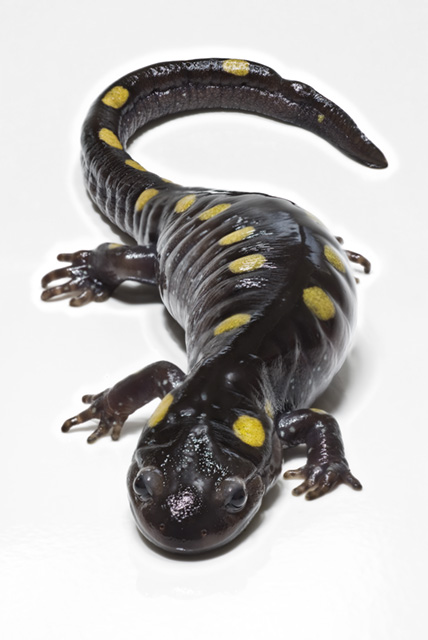
A short stocky salamander with a broad head — superficially mole-like. Most populations are entirely terrestrial after metamorphosis, but some retain larval features (paedomorphosis).
§ Quick facts
§ Encyclopedia
The mole salamanders are a group of advanced salamanders endemic to North America. The group has become famous due to the study of the axolotl in research on paedomorphosis, and the tiger salamander which is often sold as a pet, and is the official amphibian of four US states.
Source: Wikipedia — Mole salamander Licensed under CC BY-SA 4.0
§ Identification
Field marks. Small stout salamander with broad head; dull gray or light brown back with faint mottling; whitish belly.
Similar species. Other Ambystoma species (different patterns/ranges). Marbled Salamander (banded). Dusky salamanders (more slender).
Voice. Silent.
§ Diet & behavior
Diet. Earthworms, insects, small invertebrates.
Behavior. Small stocky salamander of southeastern US. Spends most of life in damp soil and leaf litter. Migrates to vernal pools and fish-free ponds in fall and winter for breeding (vs. spring for most US Ambystoma species). Populations are part of the Ambystoma kleptogenesis complex — some populations include all-female unisexual lineages that "steal" genetic material from males of other Ambystoma species.
§ Range
Southeastern US Coastal Plain
§ Habitat
Wet pine flatwoods, cypress swamps, vernal pools
§ Threats
Wetland drainage, fire suppression altering ephemeral pond hydrology, fish introduction.
§ Conservation status
According to the IUCN Red List, the mole salamander is currently classified as Least Concern.
§ What helps
Maintain ephemeral ponds. Support longleaf pine fire regime. Don't stock fish in temporary wetlands.
§ Further reading
- Wikipedia — Mole salamander
- www.nwf.org — authoritative profile of Ambystoma talpoideum
- IUCN Red List · taxon 59058
- iNaturalist · taxon 27553
- GBIF occurrence records
- Encyclopedia of Life — Ambystoma talpoideum
§ Sources cited
- AmphibiaWeb
- USGS PWRC
- Center for North American Herpetology
- IUCN Red List 2014


