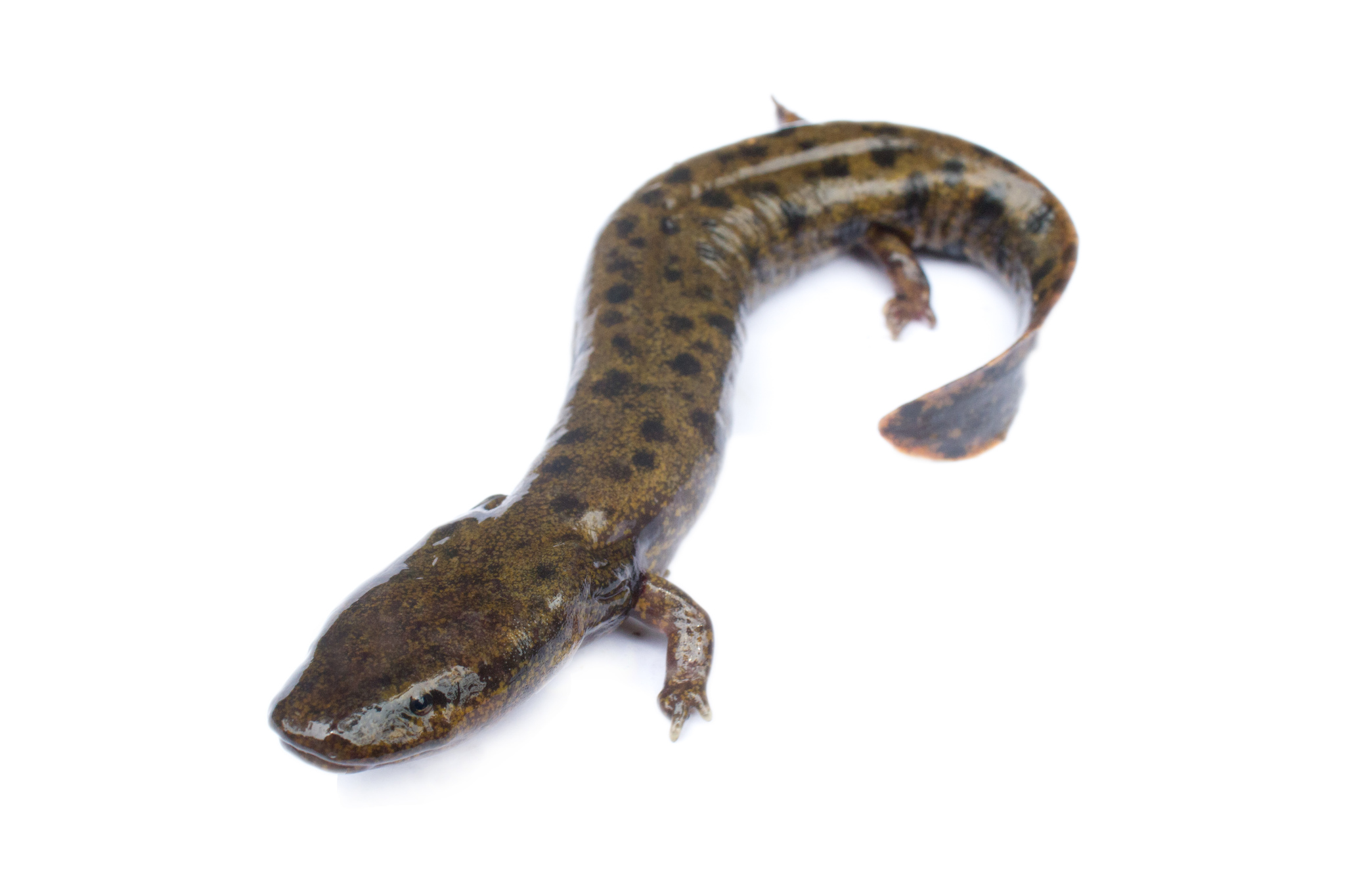
A fully aquatic salamander that retains its larval gills throughout its life — a condition called neoteny. They breathe with feathery red external gills that wave in the current.
§ Quick facts
§ Encyclopedia
Necturus is a genus of aquatic salamanders in the family Proteidae. Species of the genus are native to the eastern United States and Canada. They are commonly known as waterdogs and mudpuppies. The common mudpuppy (N. maculosus) is probably the best-known species – as an amphibian with gill slits, it is often dissected in comparative anatomy classes. The common mudpuppy has the largest distribution of any fully aquatic salamander in North America.
Source: Wikipedia — Necturus Licensed under CC BY-SA 4.0
§ Identification
Field marks. Mottled brown salamander with distinctive bushy red external gills; large flat head.
Similar species. Hellbender (much larger). Newts (smaller, no gills as adults).
Voice. Silent.
§ Diet & behavior
Diet. Carnivorous: insects, worms, small fish, crayfish.
Behavior. Entirely aquatic; retains external gills as adults (neoteny). Active hunter in clear cold streams.
§ Range
Eastern US and Canada — Great Lakes south to Mississippi
§ Habitat
Lakes, large rivers, slow-moving streams with rocky bottoms
§ Threats
Pollution-driven population declines, decline of native crayfish prey, persecution.
§ Conservation status
According to the IUCN Red List, the mudpuppy is currently classified as Least Concern.
§ What helps
Don't kill mudpuppies if hooked — gently release. Reduce sediment and chemical runoff. Support invasive species management.
§ Further reading
- Wikipedia — Necturus
- www.nwf.org — authoritative profile of Necturus maculosus
- IUCN Red List · taxon 59437
- iNaturalist · taxon 27523
- GBIF occurrence records
- Encyclopedia of Life — Necturus maculosus
§ Sources cited
- USGS ARMI
- AmphibiaWeb
- iNaturalist
- IUCN Red List 2014


