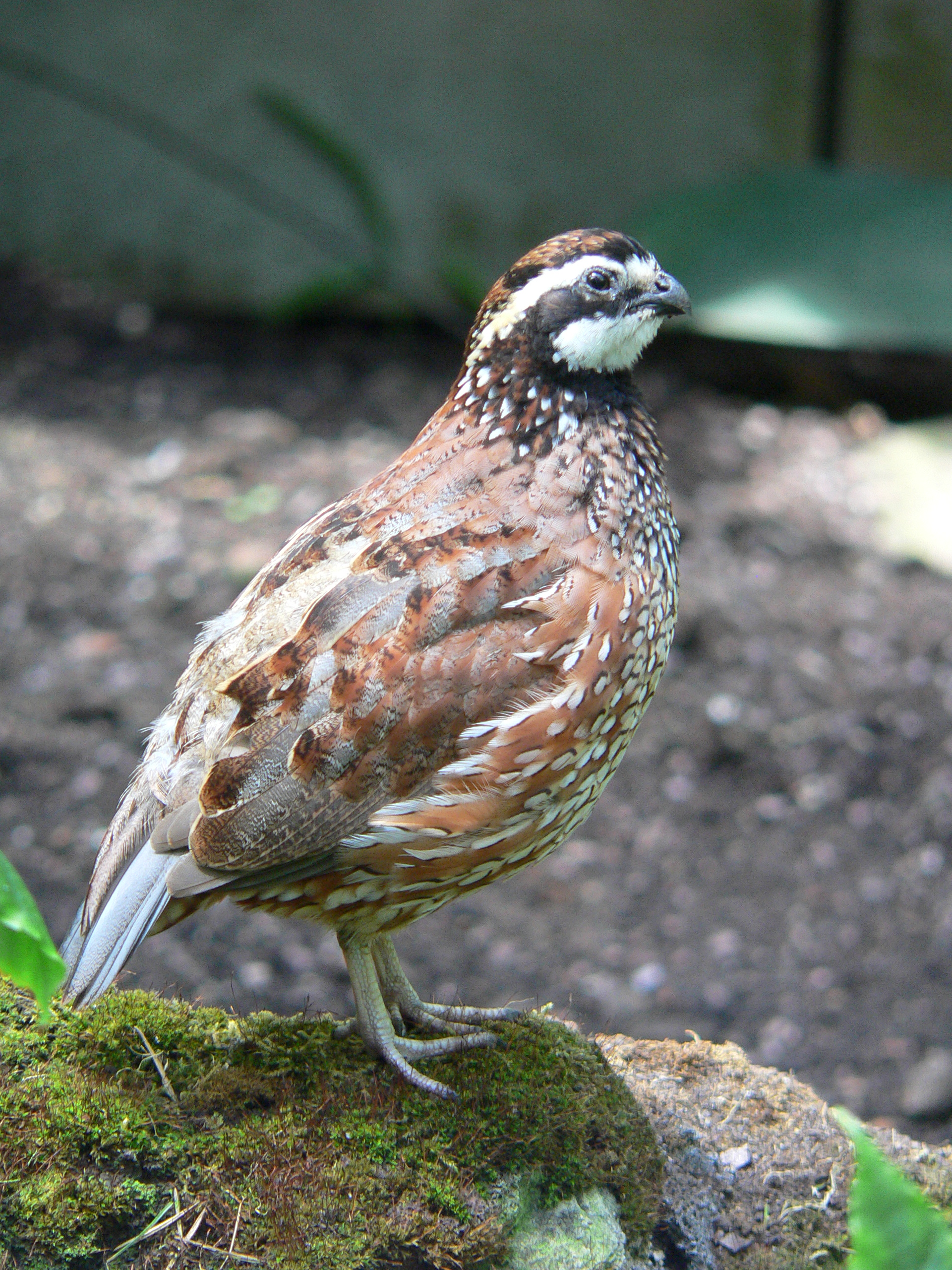
A small chunky game bird whose male whistled "bob-WHITE!" call once filled summer eastern fields. Populations have crashed ~85% since the 1960s.
§ Quick facts
§ Encyclopedia
The northern bobwhite, also known as the Virginia quail or bobwhite quail, is a ground-dwelling bird native to Canada, the United States, Mexico, and Cuba, with introduced populations elsewhere in the Caribbean, Europe, and Asia. It is a member of the group of species known as New World quail (Odontophoridae). They were initially placed with the Old World quail in the pheasant family (Phasianidae), but are not particularly closely related. The name "bobwhite" is an onomatopoeic derivation from its characteristic whistling call. Despite its secretive nature, the northern bobwhite is one of the most familiar quails in eastern North America, because it is frequently the only quail in its range. Habitat degradation has contributed to the northern bobwhite population in eastern North America declining by roughly 85% from 1966 to 2014. This population decline is apparently range-wide and continuing.
Source: Wikipedia — Northern bobwhite Licensed under CC BY-SA 4.0
§ Identification
Field marks. Small chunky game bird with brown body and bold white-on-black face pattern in males (yellow throat with thin black border in females).
Similar species. California Quail (forward-curving topknot). Mountain Quail (long straight plume).
Voice. Three-syllable "bob-WHITE!" whistle from prominent perches.
§ Diet & behavior
Diet. Seeds, berries, insects.
Behavior. Social — forms coveys of 12+ outside breeding. Defensive males "bonk" intruders. Active by day; roosts on the ground in dense cover.
§ Range
Eastern and central US into Mexico
§ Habitat
Brushy fields, native grasslands, shrubby field edges, pine savannas
§ Threats
Loss of brushy edges and early-successional habitats, pesticide drift, monoculture fields.
§ Conservation status
According to the IUCN Red List, the northern bobwhite is currently classified as Near Threatened.
§ What helps
Maintain brushy field corners. Plant native warm-season grasses. Skip pesticides.
§ Further reading
- Wikipedia — Northern bobwhite
- www.allaboutbirds.org — authoritative profile of Colinus virginianus
- IUCN Red List · taxon 22728956
- iNaturalist · taxon 897
- eBird · norbob
- GBIF occurrence records
- Encyclopedia of Life — Colinus virginianus
§ Sources cited
- Quail Forever
- Cornell Lab — All About Birds
- USDA NRCS
- IUCN Red List 2020


