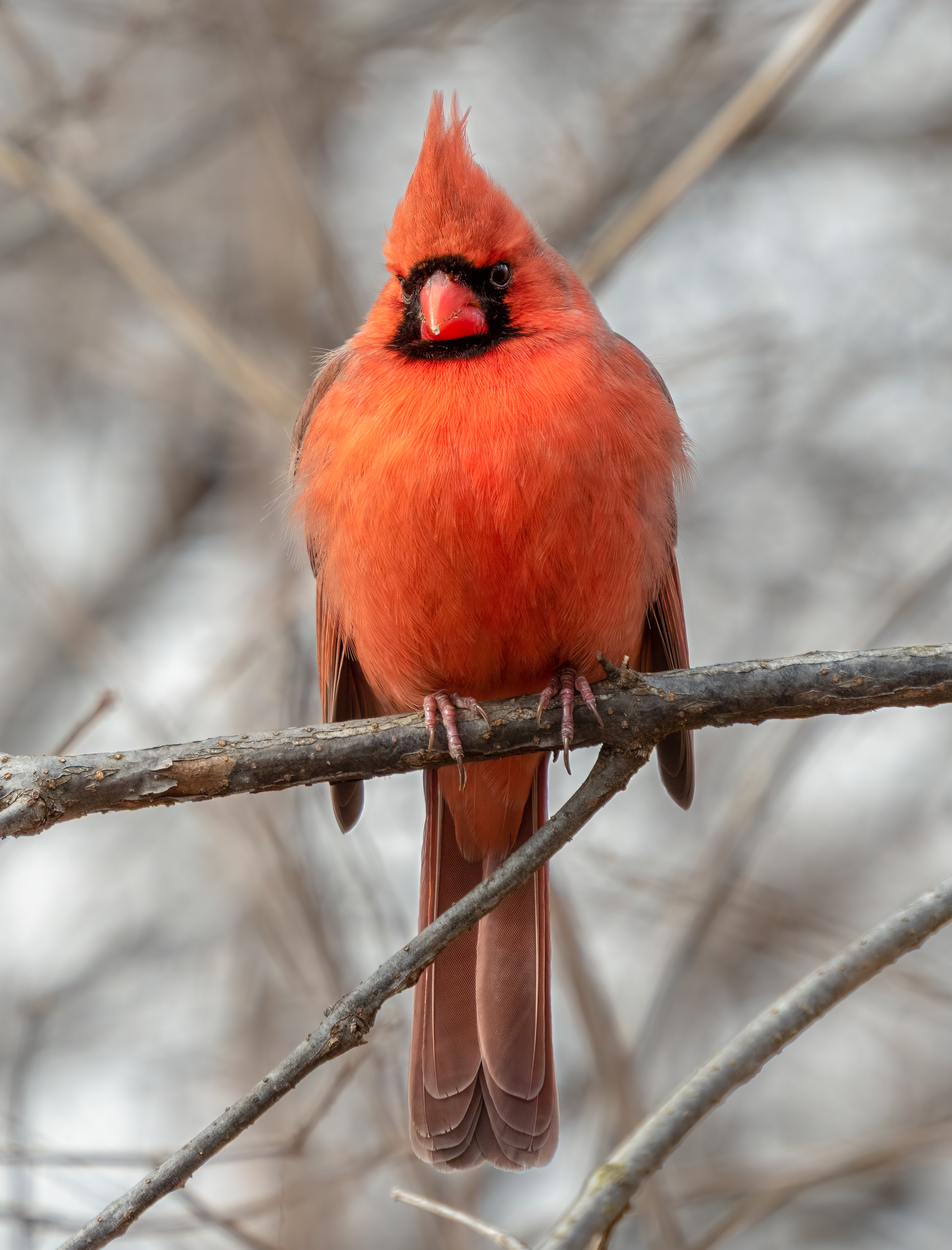
A year-round bright-red icon of the eastern US, the cardinal is the state bird of seven states and one of the few species in which both sexes sing — an unusual trait for songbirds.
§ Quick facts
§ Encyclopedia
The northern cardinal, also commonly known as the common cardinal, red cardinal, or simply cardinal, is a bird in the genus Cardinalis. It can be found in southeastern Canada, through the eastern United States from Maine to Minnesota to Texas, New Mexico, southern Arizona, southern California and south through Mexico, Belize, and Guatemala. It is also an introduced species in a few locations such as Bermuda and all major islands of Hawaii since its introduction in 1929. Its habitat includes woodlands, gardens, shrublands, and wetlands. It is the state bird of Illinois, Indiana, Kentucky, North Carolina, Ohio, Virginia, and West Virginia.
Source: Wikipedia — Northern cardinal Licensed under CC BY-SA 4.0
§ Identification
Field marks. Males: brilliant scarlet-red with black mask around bright orange bill; prominent crest. Females: warm tan-brown with red wash on crest, tail, wings.
Similar species. Pyrrhuloxia (desert SW, gray with red accents). Vermilion Flycatcher (smaller, no crest, no mask).
Voice. Loud clear whistles: "cheer-cheer-cheer" and "birdy-birdy-birdy." Pairs duet — unusual among North American songbirds.
§ Diet & behavior
Diet. Seeds (sunflower, safflower, weed seeds), fruits, and insects (especially when feeding young). One of the easiest birds to attract to feeders.
Behavior. Year-round resident; doesn't migrate. Males defend territories with loud whistled songs from prominent perches. Mated pairs share songs throughout the year.
§ Range
Eastern and central US, expanding north and west into the Great Plains
§ Habitat
Woodland edges, suburban gardens, dense shrubland, and overgrown fields
§ Threats
Window collisions, outdoor cats, pesticide exposure that depletes their preferred seed and insect prey.
§ Conservation status
According to the IUCN Red List, the northern cardinal is currently classified as Least Concern.
§ What helps
Use bird-safe window decals. Keep cats indoors. Plant native shrubs (especially eastern red cedar, dogwood, sumac).
§ Further reading
- Wikipedia — Northern cardinal
- www.allaboutbirds.org — authoritative profile of Cardinalis cardinalis
- IUCN Red List · taxon 22723819
- iNaturalist · taxon 9083
- eBird · norcar
- GBIF occurrence records
- Encyclopedia of Life — Cardinalis cardinalis
§ Sources cited
- Cornell Lab — All About Birds
- Project FeederWatch
- Audubon Field Guide
- IUCN Red List 2018


