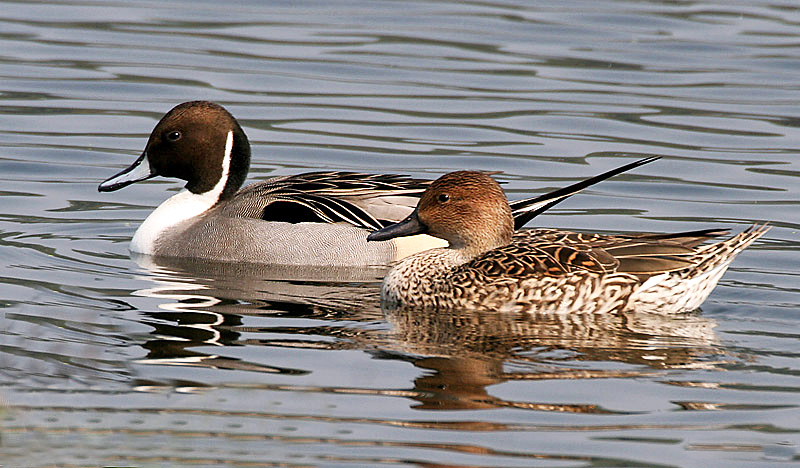
A long, slender dabbling duck with an elegantly tapered tail. Males in breeding plumage are unmistakable — chocolate-brown head, white breast and neck stripe. Continental populations have declined ~70% since 1970 from prairie loss.
§ Quick facts
§ Encyclopedia
The pintail or northern pintail is a duck species with wide geographic distribution that breeds in the northern areas of Europe and across the Palearctic and North America. It is migratory and winters south of its breeding range as far as the equator. Unusually for a bird with such a large range, it has no geographical subspecies, although the possibly conspecific duck Eaton's pintail is considered to be a separate species.
Source: Wikipedia — Northern pintail Licensed under CC BY-SA 4.0
§ Identification
Field marks. Slender duck with a long neck and pointed tail. Male has a chocolate-brown head, white neck stripe, and gray body with long black central tail feathers; female slim and mottled buff-brown.
Similar species. Female resembles other dabblers but is slimmer and longer-necked with a plain gray bill; the male's needle tail is unmistakable.
Voice. Male gives a soft, mellow whistled 'proop-proop'; female a low quack.
§ Diet & behavior
Diet. Varies by species: aquatic plants, seeds, invertebrates, fish.
Behavior. An elegant, long-necked dabbling duck of open wetlands and fields; one of the earliest spring migrants. Tips up to feed on seeds and invertebrates in shallow water.
§ Range
Across North America in winter; breeds in northern Canada and the prairie pothole region
§ Habitat
Shallow prairie wetlands, flooded fields, coastal lagoons
§ Threats
Loss of prairie pothole wetlands, conversion of nesting cover to row crops, lead shot ingestion.
§ Conservation status
According to the IUCN Red List, the northern pintail is currently classified as Least Concern.
§ What helps
Support Conservation Reserve Program. Delay haying in nesting fields. Use non-toxic shot.
§ Further reading
- Wikipedia — Northern pintail
- www.allaboutbirds.org — authoritative profile of Anas acuta
- IUCN Red List — search for Anas acuta
- GBIF occurrence records
- Encyclopedia of Life — Anas acuta
§ Sources cited
- Cornell Lab of Ornithology — All About Birds
- National Audubon Society
- iNaturalist
- IUCN Red List


