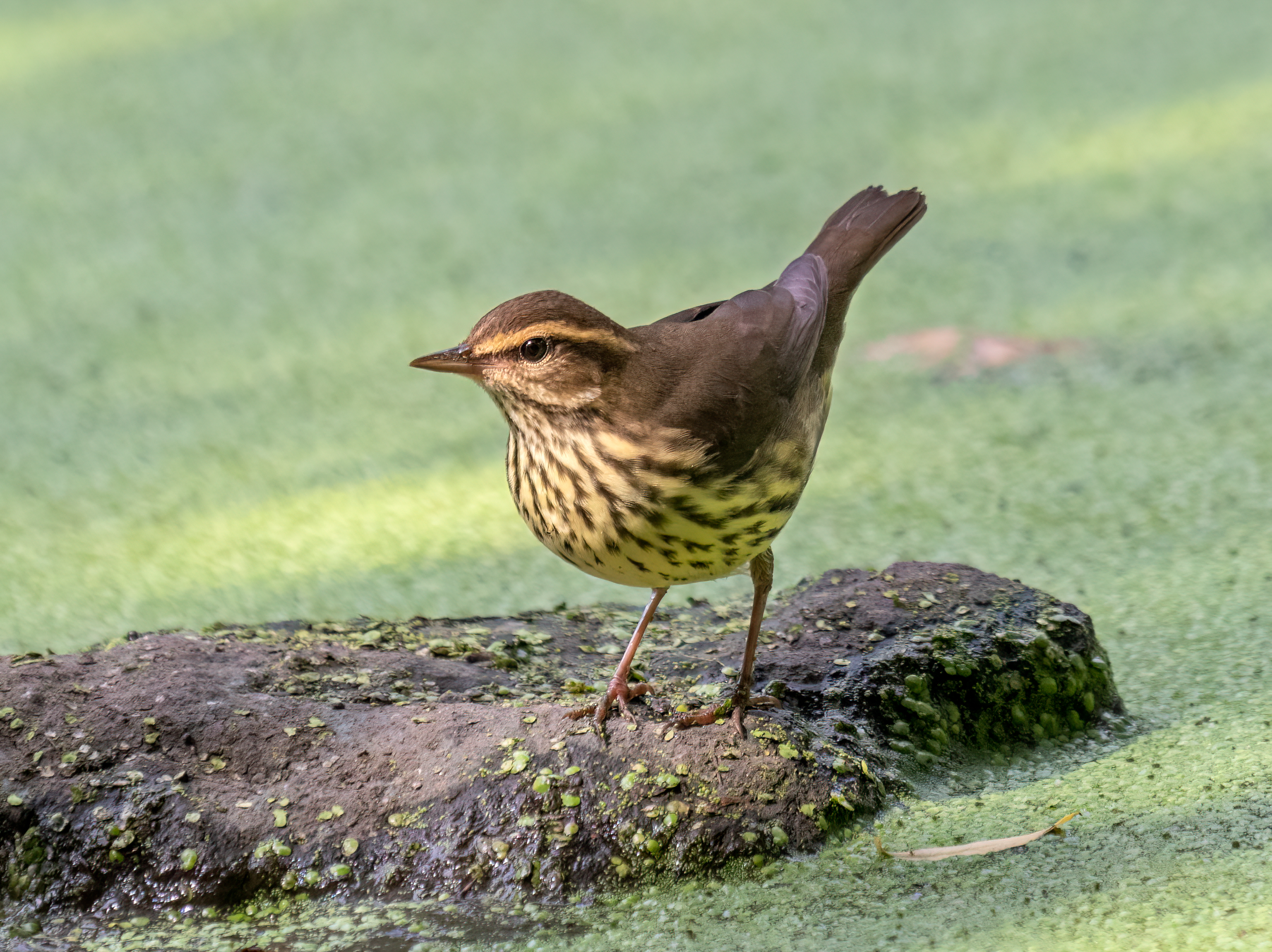
A small streaky warbler that walks along wetlands. Northern cousin to Louisiana Waterthrush — both walk rather than hop, unusual for warblers.
§ Quick facts
§ Encyclopedia
The northern waterthrush is a species of ground-feeding migratory New World warbler of the genus Parkesia. It breeds in the northern part of North America, in Alaska, Canada, and the northern United States; it winters in Florida, Central America, the West Indies, Venezuela, Colombia, and Ecuador. It is a rare vagrant to other South American countries and to western Europe. Its closest relative is the Louisiana waterthrush.
Source: Wikipedia — Northern waterthrush Licensed under CC BY-SA 4.0
§ Identification
Field marks. Brown above, whitish-to-buffy below with crisp dark streaking extending onto a finely spotted throat; a buffy eyebrow of even width that does not flare.
Similar species. Louisiana Waterthrush has a bright white throat, a broad eyebrow flaring behind the eye, pink legs, and prefers moving water.
Voice. A loud, emphatic, accelerating 'sweet-sweet-sweet swee-wee-wee chew-chew-chew' dropping at the end.
§ Diet & behavior
Diet. Insects (caterpillars primary), spiders, occasional berries on migration.
Behavior. Walks and bobs along the edges of still or slow water — bogs, swamps, wooded ponds — flipping leaves and probing mud.
§ Range
Boreal Canada in summer; winters Caribbean and Central America
§ Habitat
Bogs, swamps, wet woodlands
§ Threats
Boreal habitat loss, climate change.
§ Conservation status
According to the IUCN Red List, the northern waterthrush is currently classified as Least Concern.
§ What helps
Support boreal wetland conservation.
§ Further reading
- Wikipedia — Northern waterthrush
- www.allaboutbirds.org — authoritative profile of Parkesia noveboracensis
- IUCN Red List — search for Parkesia noveboracensis
- GBIF occurrence records
- Encyclopedia of Life — Parkesia noveboracensis
§ Sources cited
- Cornell Lab of Ornithology — All About Birds
- National Audubon Society
- iNaturalist
- IUCN Red List


