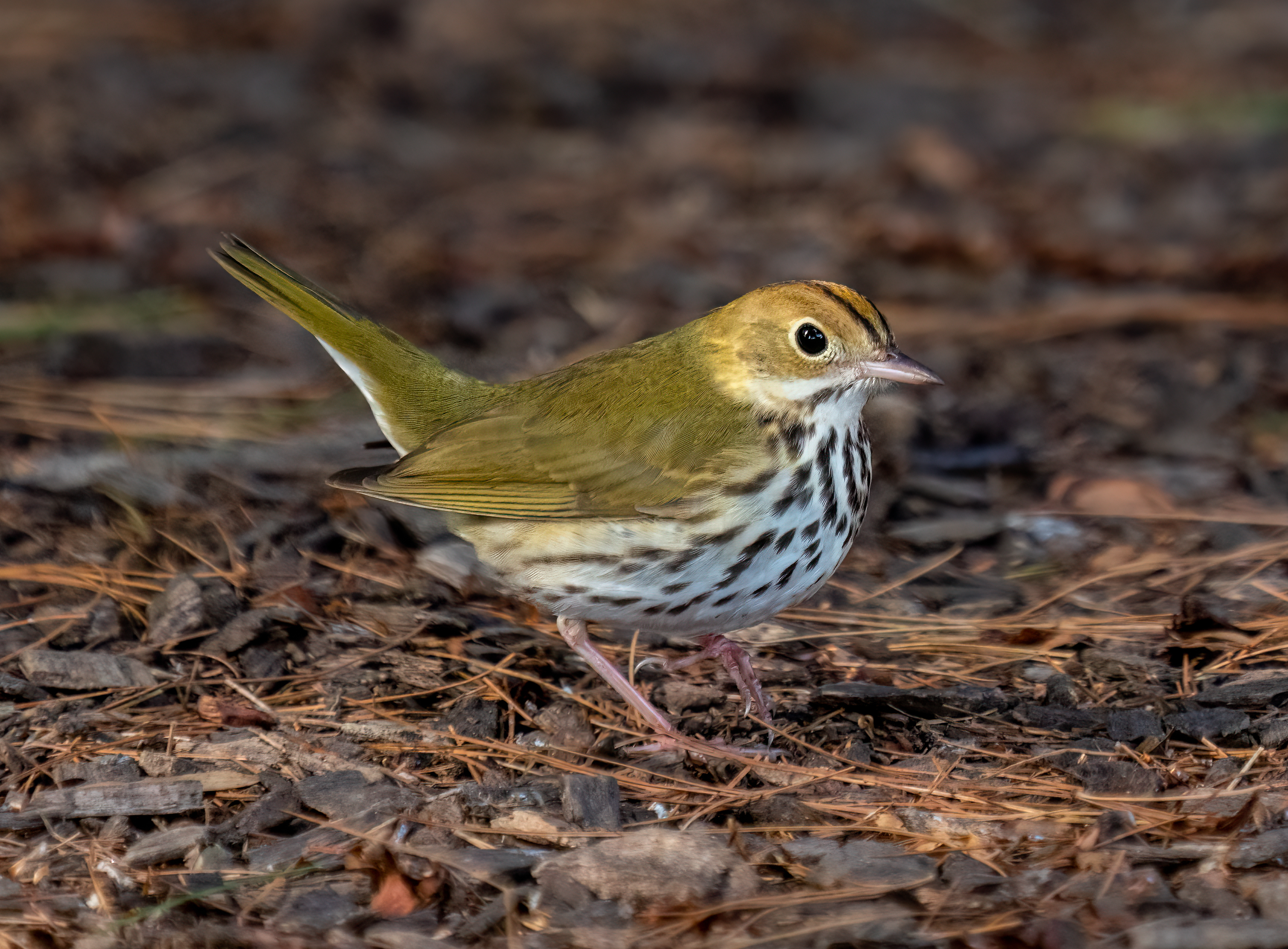
A medium-sized warbler that walks on the forest floor (vs. perching in foliage). Bold "teacher-teacher-teacher" song carries through eastern forests in spring.
§ Quick facts
§ Encyclopedia
The ovenbird is a small songbird of the New World warbler family Parulidae. It is the only species placed in the genus Seiurus. This migratory bird breeds in eastern North America and winters in Central America, many Caribbean islands, Florida and northern Venezuela.
Source: Wikipedia — Ovenbird Licensed under CC BY-SA 4.0
§ Identification
Field marks. Olive-brown above, white below with bold dark spotting/streaking, a black-bordered orange crown stripe, and a bold white eye ring. Pinkish legs.
Similar species. The waterthrushes are streaked but lack the orange crown and eye ring and habitually teeter near water.
Voice. An emphatic, ringing crescendo: 'tea-CHER tea-CHER TEA-CHER TEA-CHER' growing louder.
§ Diet & behavior
Diet. Insects (caterpillars primary), spiders, occasional berries on migration.
Behavior. Walks deliberately on the forest floor of mature deciduous woods, tail cocked; builds a domed, oven-shaped nest on the ground that gives the species its name.
§ Range
Eastern North American forests in summer
§ Habitat
Mature deciduous forests with leaf litter
§ Threats
Mature forest loss, fragmentation, forest leaf litter removal.
§ Conservation status
According to the IUCN Red List, the ovenbird is currently classified as Least Concern.
§ What helps
Support mature forest protection. Don't over-tidy forest floors.
§ Further reading
- Wikipedia — Ovenbird
- www.allaboutbirds.org — authoritative profile of Seiurus aurocapilla
- IUCN Red List — search for Seiurus aurocapilla
- GBIF occurrence records
- Encyclopedia of Life — Seiurus aurocapilla
§ Sources cited
- Cornell Lab of Ornithology — All About Birds
- National Audubon Society
- iNaturalist
- IUCN Red List


